

 Home
Cyber fraud is no longer limited to a single fraudulent transaction or a compromised bank account. In many cases, stolen money moves through multiple bank accounts, digital payment channels, and even cryptocurrency networks before investigators can identify where it ultimately goes.
A recent investigation by the Enforcement Directorate (ED) has highlighted the growing complexity of these financial crime networks. According to Hindustan Times, the ED arrested two individuals in connection with an alleged cyber fraud network involving more than ₹400 crore and over 600 cybercrime complaints.
The investigation reportedly uncovered connections involving mule bank accounts, suspicious financial transactions, and cryptocurrency transfers.
While the amount involved is significant, the incident raises a much bigger question: How effectively can financial institutions track fraudulent money once it enters a network of interconnected accounts?
Understanding how money moves after a cyber fraud incident is becoming just as important as identifying the initial fraudulent transaction.
Understanding the ₹400 Crore Cyber Fraud Case
The investigation reported by Hindustan Times highlights how cybercriminals may use multiple financial channels to move funds and make transactions harder to trace.
One of the major concerns in such cases is the use of mule bank accounts. These accounts can be used to receive money obtained through cybercrime and transfer it to other accounts, creating multiple layers between the original victim and the ultimate beneficiary.
Cryptocurrency transfers can further complicate investigations, particularly when funds move across different platforms and wallets.
The involvement of more than 600 cybercrime complaints also demonstrates how a single financial network can potentially be connected to multiple victims and fraudulent activities.
This highlights an important reality: financial crime is increasingly becoming a network-based problem rather than an isolated transaction-level issue.
1. Mule Accounts: A Critical Link in Cyber Fraud Networks
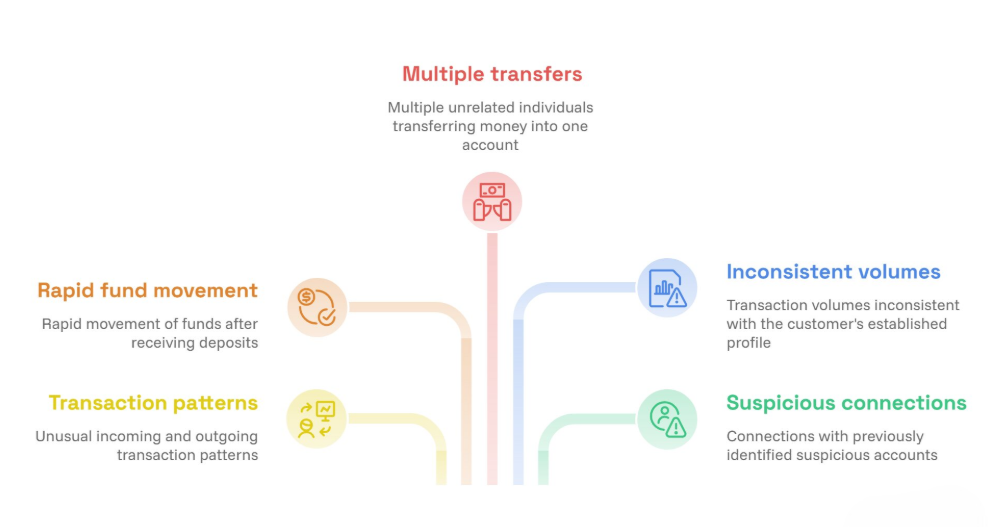
Mule accounts play an important role in many financial fraud operations.
A mule account is a bank account used to receive, transfer, or withdraw money obtained through illegal activities. In some cases, account holders knowingly participate in fraudulent operations. In others, they may be manipulated through fake job offers, commissions, or other deceptive arrangements.
Cybercriminals use these accounts to create multiple layers of financial transactions, making it harder to identify the original source of funds.
For example, money stolen from one victim may enter Account A, move to Accounts B and C, and eventually reach another bank account or digital asset platform.
Each additional transaction creates another layer that investigators must examine.
Why does mule account detection matter?
Financial institutions need to identify suspicious account activities by examining factors such as:
- Unusual incoming and outgoing transaction patterns.
- Rapid movement of funds after receiving deposits.
- Multiple unrelated individuals transferring money into one account.
- Transaction volumes inconsistent with the customer’s established profile.
- Connections with previously identified suspicious accounts.
Identifying these patterns early can help financial institutions detect potentially fraudulent accounts before they become part of larger financial crime networks.
2. Real-Time Transaction Monitoring: Detecting Fraud Before Funds Move
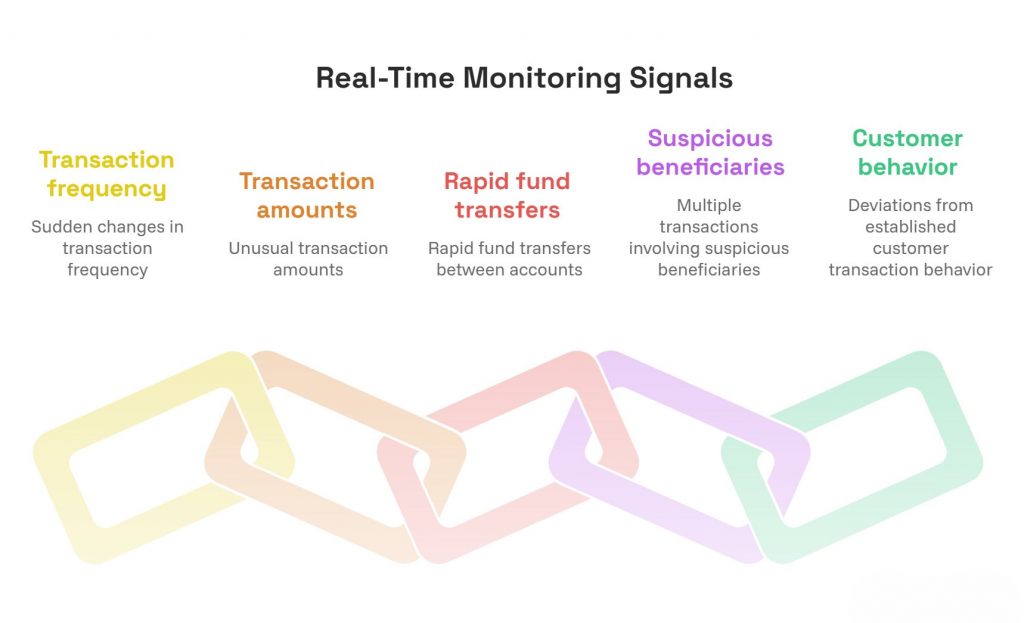
Timing is critical in cyber fraud investigations.
Once stolen money enters the banking system, it may be transferred through multiple accounts within a short period. Delayed detection can make it increasingly difficult to prevent further movement of funds.
Traditional monitoring approaches often rely on predefined rules, transaction thresholds, and periodic reviews. While these methods remain useful, they may struggle to identify sophisticated fraud patterns that evolve rapidly.
Real-time transaction monitoring helps financial institutions evaluate transactions as they occur.
For example, consider a bank account that normally receives a few small payments each day. Suddenly, it receives several large deposits from unrelated sources and transfers most of the money to different accounts within minutes.
A monitoring system can flag this unusual activity for further investigation.
Real-time monitoring can help identify:
- Sudden changes in transaction frequency.
- Unusual transaction amounts.
- Rapid fund transfers between accounts.
- Multiple transactions involving suspicious beneficiaries.
- Deviations from established customer transaction behavior.
The objective is not simply to identify suspicious transactions after they occur, but to detect potential risks early enough for appropriate intervention.
3. Network Intelligence: Connecting the Dots Between Accounts
One of the biggest challenges in investigating financial crime is understanding the relationships between different accounts.
Examining each transaction independently may not reveal the complete picture. An account that appears legitimate when viewed in isolation could be connected to several suspicious accounts through its transaction history.
This is where network intelligence becomes important.
Network intelligence examines relationships between accounts, individuals, transactions, devices, and other relevant entities to identify interconnected patterns.
For example:
- Account A receives funds from multiple unrelated accounts.
- Account B receives money from Account A and transfers it to Account C.
- Account C is also connected to several accounts previously flagged for suspicious activity.
- Multiple accounts repeatedly interact with the same beneficiaries.
Individually, these transactions may not immediately appear fraudulent. However, when examined collectively, they may reveal a connected financial network.
Network analysis can help financial institutions identify:
- Common beneficiaries across multiple accounts.
- Repeated fund transfers between interconnected accounts.
- Clusters of suspicious financial activity.
- Potential mule account networks.
- Hidden relationships between apparently unrelated entities.
This approach shifts the focus from individual transactions to the wider financial ecosystem surrounding suspicious activity.
4. Behavioral Analytics: Identifying Unusual Financial Activities
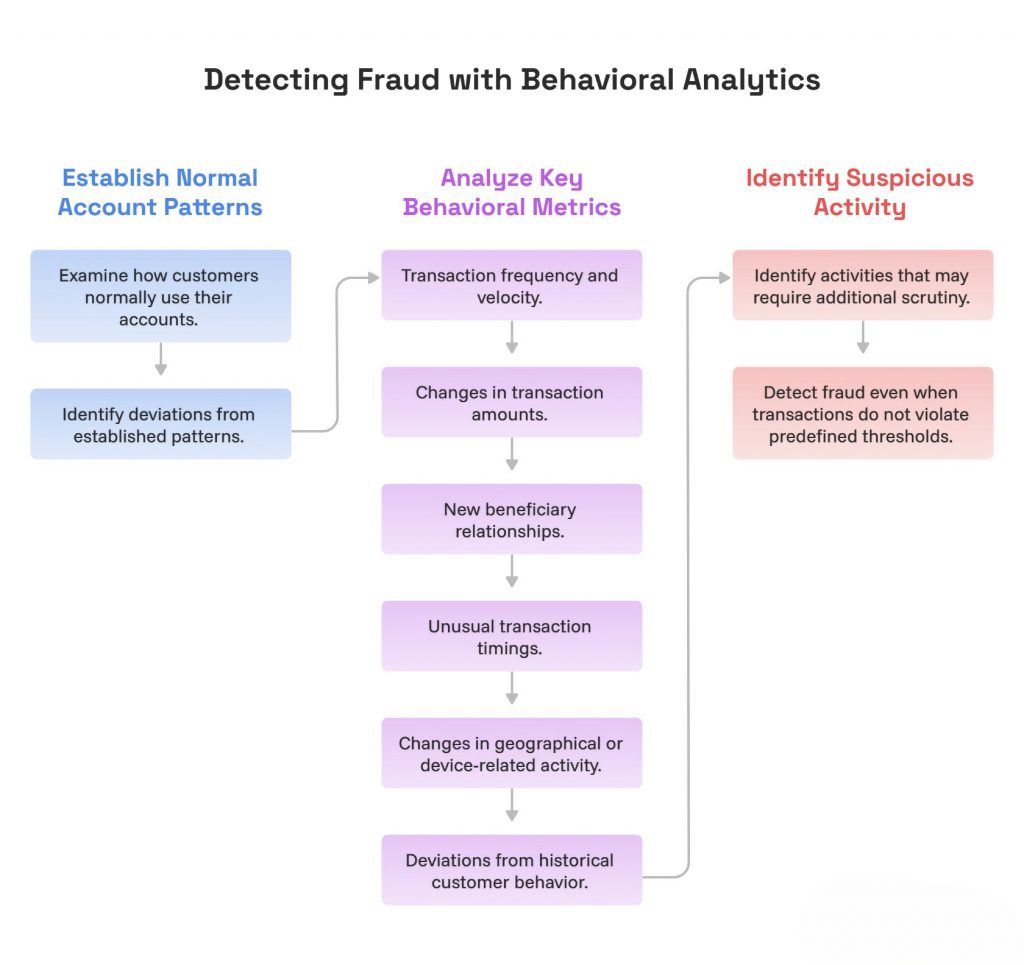
Not every fraudulent transaction violates a predefined rule.
Sophisticated financial crime operations may deliberately structure transactions to avoid triggering conventional monitoring systems.
Behavioral analytics helps address this challenge by examining how customers normally use their accounts and identifying deviations from established patterns.
For instance, if an account typically receives regular salary payments and makes routine household transactions, a sudden increase in high-value transfers to multiple unrelated beneficiaries may indicate unusual behavior.
Behavioral analytics can examine:
- Transaction frequency and velocity.
- Changes in transaction amounts.
- New beneficiary relationships.
- Unusual transaction timings.
- Changes in geographical or device-related activity, where available and permitted.
- Deviations from historical customer behavior.
By understanding normal financial behavior, monitoring systems can identify activities that may require additional scrutiny, even when individual transactions do not violate predefined thresholds.
5. AML Monitoring: Following the Movement of Suspicious Funds
Cyber fraud and money laundering can be closely connected.
After obtaining money through fraudulent activities, criminals may attempt to move, conceal, or disguise its origin through multiple financial transactions.
This makes Anti-Money Laundering (AML) monitoring an essential part of financial crime prevention.
AML monitoring helps financial institutions identify suspicious financial activities, examine transaction relationships, and support regulatory reporting obligations.
Important areas include:
- Identifying unusual patterns of fund movement.
- Monitoring transactions involving high-risk accounts.
- Detecting repeated transfers between interconnected entities.
- Examining suspicious beneficiary relationships.
- Identifying potential layering activities.
- Supporting suspicious transaction investigations and reporting.
When combined with transaction monitoring and network intelligence, AML systems can provide a more comprehensive understanding of suspicious financial activity.
Why Traditional Transaction-Level Monitoring Is Not Enough
Traditional rule-based monitoring remains an important component of financial crime prevention. However, relying exclusively on individual transaction alerts can create limitations.
Consider a situation in which ₹10 lakh is transferred through ten different accounts. Each transaction may fall below a predefined monitoring threshold.
When evaluated separately, these transactions might not immediately raise an alert. However, examining their relationships and movement patterns could reveal a coordinated fund transfer operation.
This illustrates why financial institutions need to move beyond isolated transaction monitoring.
A more comprehensive approach combines:
- Rule-Based Detection: Identifying transactions that violate predefined risk parameters.
- Behavioral Analytics: Recognizing unusual changes in customer activity.
- Network Intelligence: Identifying relationships between suspicious accounts and entities.
- Real-Time Monitoring: Detecting potentially fraudulent activity as it happens.
- AML Investigation: Examining suspicious fund movements and supporting compliance processes.
These capabilities complement one another and provide a stronger foundation for identifying complex financial crime patterns.
The Way Forward: Moving Towards Intelligence-Driven Financial Crime Prevention
The growing sophistication of cyber fraud requires financial institutions to rethink how they identify and investigate suspicious financial activity.
Detecting the first fraudulent transaction is important, but it does not necessarily reveal the complete financial crime operation.
The real challenge is understanding what happens next:
- Where does the money move?
- Which accounts receive the funds?
- Are multiple accounts connected through common beneficiaries?
- Do transaction patterns indicate coordinated activity?
- Can suspicious fund movements be identified before the money moves further?
Answering these questions requires a combination of real-time transaction monitoring, behavioral analytics, network intelligence, and effective AML processes.
Financial institutions must increasingly adopt connected and intelligence-driven monitoring approaches that help them identify suspicious relationships, recognize emerging patterns, and investigate financial risks more effectively.
Conclusion
The alleged ₹400 crore cyber fraud network reported by Hindustan Times highlights an important challenge facing the financial ecosystem: tracking money that moves through multiple accounts and financial channels.
With mule accounts, cryptocurrency transfers, and interconnected transaction networks becoming part of increasingly complex financial crime operations, identifying a suspicious transaction is only the first step.
Understanding the network behind that transaction is equally important.
The future of financial crime prevention will depend not only on how quickly institutions detect suspicious transactions, but also on how effectively they connect financial activities, identify hidden relationships, and track the movement of funds.
Because in modern financial crime, following the money can be just as important as finding the fraud.
Source: Hindustan Times – ED arrests two in ₹400 crore cyber fraud network, finds 600 cyber complaints
Frequently Asked Questions (FAQs)
1. What is the ₹400 crore cyber fraud case?
The ₹400 crore cyber fraud case involves an alleged financial crime network investigated by the Enforcement Directorate (ED). According to Hindustan Times, the investigation led to the arrest of two individuals and uncovered connections to more than 600 cybercrime complaints, mule bank accounts, suspicious transactions, and cryptocurrency transfers.
2. What is a mule bank account in cyber fraud?
A mule bank account is a bank account used to receive, transfer, or withdraw money obtained through fraudulent or illegal activities. Criminals use these accounts to move stolen funds through multiple transactions, making it difficult to trace the original source of money.
3. How do cybercriminals use mule accounts to transfer stolen money?
Cybercriminals transfer stolen money through multiple bank accounts to create layers of transactions. For example, funds received in one account may be transferred to several other accounts before reaching the final beneficiary or a digital asset platform. This makes financial investigations more complicated.
4. Why is real-time transaction monitoring important for detecting cyber fraud?
Real-time transaction monitoring helps financial institutions evaluate transactions as they occur. It can identify unusual transaction amounts, rapid fund transfers, suspicious beneficiaries, and unexpected changes in customer transaction behavior, allowing potential risks to be investigated earlier.
Ready to Stay
Compliant—Without Slowing Down?
Move at crypto speed without losing sight of your regulatory obligations.
With IDYC360, you can scale securely, onboard instantly, and monitor risk in real time—without the friction.


Related to this topic:

Smarter Fraud Detection for Banks with AI


