

Financial fraud is no longer limited to isolated suspicious transactions. Today’s fraud is faster, more coordinated, and more adaptive. Fraudsters use mule accounts, distributed transaction patterns, geographic dispersion, and rapid movement of funds to stay ahead of traditional monitoring systems.
That is why modern fraud prevention requires more than static rules or delayed review. It requires AI decisioning in real time.
AI decisioning allows financial institutions to evaluate transactions, behaviors, entity relationships, geographic patterns, and risk signals instantly. Instead of reacting after a fraud event is complete, institutions can identify suspicious activity as it develops and take action before losses escalate.
This is where IDYC360 delivers a stronger advantage. It is built not only to detect suspicious transactions, but to understand the wider fraud context around them.
What Is AI Decisioning in Fraud Prevention?
AI decisioning is the process of using machine learning, behavioral fraud detection, streaming data, and contextual intelligence to make risk decisions in milliseconds.
In a traditional setup, systems often review transactions after they are completed, or rely on rigid rules that create high false positives and still miss complex fraud patterns.
In an AI decisioning environment, every transaction can be evaluated using multiple signals at once, such as:
- past behavior of the entity
- transaction amount and frequency
- device, channel, and timing
- geographic movement
- network relationships between payer and beneficiary
- historical risk patterns
- anomaly and velocity indicators
The result is faster, smarter, and more defensible decision-making.
Why Traditional Fraud Monitoring Falls Short
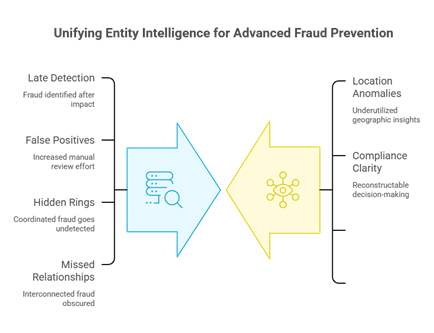
Traditional fraud systems usually focus on single transactions or fixed rules. That creates several problems:
- fraud is detected too late
- false positives increase investigation workload
- coordinated fraud rings remain hidden
- relationships across accounts or entities are missed
- location and movement-based anomalies are underused
- compliance teams struggle to reconstruct why a decision was taken
Modern fraud requires a system that can move from transaction monitoring to entity intelligence.
How AI Helps Prevent Fraud in Real Time
1. Behavioral intelligence
AI learns how customers, accounts, and entities normally behave. It observes spending patterns, transaction frequency, preferred locations, transaction timing, instruments used, and channel usage.
When behavior changes suddenly, such as an unusual value transfer, a new transaction corridor, a location jump, or abnormal velocity, the system identifies the deviation immediately.
This is critical because fraud often starts as a behavioral shift before it becomes a confirmed loss event.
2. Real-time risk scoring
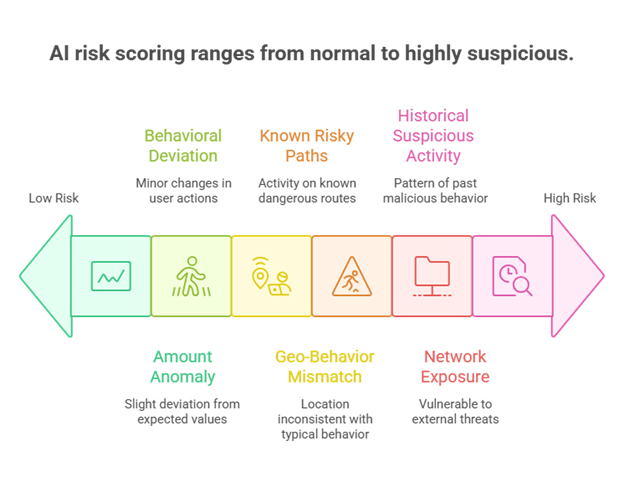
AI decisioning assigns dynamic risk scores to events as they happen.
Instead of evaluating only one factor, the system combines multiple signals including:
- amount anomaly
- behavioral deviation
- geo-behavior mismatch
- known risky paths or entities
- network exposure
This allows the platform to separate low-risk normal activity from events that need escalation, investigation, or blocking.
3. Anomaly detection beyond rules
Rules are useful, but rules alone are not enough.
AI-based anomaly detection helps identify activity that does not fit normal behavior, even if no predefined rule has been written for it. This is especially important for new fraud strategies, evolving mule behavior, and long-running low-and-slow abuse patterns.
Anomaly detection makes the system more adaptive and improves fraud discovery over time.
4. Event-driven decisioning pipeline
Fraud prevention is only effective when the system can process signals at operational speed.
IDYC360 uses an event-driven monitoring and decision pipeline that can ingest, analyze, enrich, and score transactions in near real time. This means that when a payment screening, the system does not wait for end-of-day review. It can evaluate the event instantly and trigger action in the same decision flow.
This reduces the gap between transaction initiation and fraud response.
5. Network and relationship intelligence
Fraud rarely happens in isolation. It often involves networks of linked accounts, beneficiaries, devices, locations, and transaction paths.
AI becomes significantly more powerful when it looks beyond the transaction and into the surrounding network.
By analyzing payer-beneficiary relationships, repeated patterns, multi-hop paths, suspicious funnels, mule structures, and coordinated movement of funds, institutions can identify organized fraud that would remain invisible in an account-centric system.
This is one of the strongest differentiators of IDYC360.

6. Geo-behavior intelligence
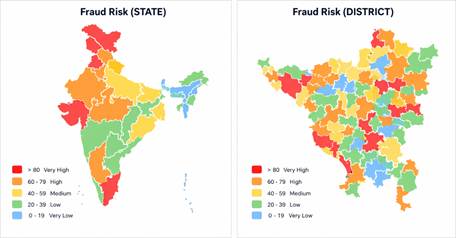
Fraud has a geographic story.
Sudden changes in region, abnormal state-to-state movement, inconsistent login and payment locations, unusual corridor activity, and hotspot concentration can all indicate elevated risk.
Geo-behavior analytics help detect:
- abnormal regional transaction bursts
- emerging fraud hotspots
- suspicious money movement patterns
- cross-state or cross-border corridors
- location behavior inconsistent with historical usage
This adds an important contextual layer to AI decisioning.
7. Explainable decisions
In regulated environments, a correct decision is not enough. Teams must also explain why the decision was made.
AI decisioning must support traceability, audit reconstruction, and investigation workflows. That means fraud teams, auditors, and compliance teams should be able to understand the underlying signals, decision path, and supporting evidence.
Explainability turns AI from a black box into a usable enterprise control system.
Benefits of AI Decisioning in Fraud Prevention
AI decisioning improves fraud prevention across multiple dimensions:
Speed
Transactions can be evaluated in milliseconds, enabling intervention before fraud fully executes.
Accuracy
Context-aware scoring reduces unnecessary alerts and improves prioritization.
Adaptability
Machine learning models evolve with new fraud patterns.
Scalability
Large transaction volumes can be monitored continuously.
Visibility
Behavior, geography, and network-level signals provide deeper fraud intelligence.
Operational efficiency
Investigators spend more time on meaningful alerts and less time on noise.
Regulatory readiness
Decisions are easier to justify, document, and defend.
How IDYC360 Helps Prevent Fraud More Effectively
IDYC360 is designed as a real-time financial crime intelligence platform, not just a transaction rule engine. It helps institutions move from fragmented detection to integrated, explainable, and entity-centric prevention.
1. Entity-centric intelligence
IDYC360 does not look at only one account or one event in isolation. It builds an entity view across behavior, counterparties, channels, geography, and risk signals.
This helps identify suspicious patterns that span multiple accounts, linked beneficiaries, or coordinated actors.
In short, it helps institutions detect fraud rings, not just suspicious transactions.
2. Real-time decisioning and alert orchestration
IDYC360 supports near real-time decisioning so institutions can:
- score risk instantly
- generate alerts immediately
- escalate cases faster
- trigger operational response before losses expand
This is essential in high-speed payment environments where delayed review is often too late.
3. Network and path analytics
One of the major strengths of IDYC360 is its ability to uncover hidden relationships.
Its network and path analytics help reveal:
- mule account structures
- layering patterns
- fund movement chains
- repeated payer-beneficiary corridors
- coordinated multi-entity fraud activity
- suspicious transaction funnels
This is especially valuable where fraudsters intentionally distribute activity across nodes to avoid threshold-based detection.
4. Geo-behavior analytics
IDYC360 adds geographic intelligence into fraud decisioning.
By analyzing country, state, district, city, and corridor movement patterns, it can detect unusual regional behaviors that rule-based systems often miss. This supports earlier identification of hotspot growth, abnormal movement, and location-based fraud escalation.
5. Event-driven monitoring and enrichment pipeline
IDYC360’s architecture supports continuous ingestion and evaluation of transaction events across channels. It can enrich events with historical, behavioral, geographic, and relational context before decisioning.
This event-driven monitoring approach helps remove blind spots between transaction occurrence and fraud action.
It also improves the platform’s ability to support both immediate response and downstream investigation.
6. Predictive rather than reactive monitoring
Many systems act only after a suspicious event has already caused damage.
IDYC360 is designed to support predictive risk identification by combining:
- historical behavior
- real-time activity
- anomaly signals
- network exposure
- geo-intelligence
- evolving model logic
This strengthens early warning capability and allows institutions to intervene before fraud becomes loss.
7. Explainable and audit-ready decisioning
Every material risk decision should be reconstructable.
IDYC360 is built to support transparent risk logic, investigation context, and defensible evidence trails. That makes it easier for banks and regulated institutions to support internal reviews, audit examination, escalation workflows, and reporting requirements.
8. Compliance-oriented architecture
Fraud prevention cannot be separated from governance and compliance.
IDYC360 is designed to support alignment with enterprise security, privacy, and regulatory expectations, including areas such as:
- PCI DSS-oriented security controls and payment data handling discipline
- privacy-by-design principles
- DPDPA and GDPR-oriented data governance considerations
- RBI and FIU monitoring expectations
- FATF-aligned risk-based monitoring principles
- evidentiary support for investigations and reporting
This means the platform is positioned not only to improve detection, but also to support safer operations, stronger governance, and more credible compliance programs.
9. Lower false positives with richer context
False positives remain one of the biggest challenges in fraud and AML operations.
Because IDYC360 uses behavior, geography, network context, and entity-level intelligence together, it helps institutions make more informed decisions instead of relying on narrow rule hits.
That can improve alert quality, reduce operational burden, and help teams focus on genuinely suspicious activity.
Why This Matters for Modern Financial Institutions
Banks, NBFCs, fintechs, and payment institutions are operating in an environment where fraud is:
- faster
- more distributed
- more coordinated
- more digital
- more difficult to explain using static systems
A modern defense strategy must combine:
- real-time monitoring
- AI decisioning
- entity intelligence
- network analysis
- geo-behavior signals
- explainable compliance workflows
This is exactly the direction in which IDYC360 is built.
Conclusion
AI decisioning is changing fraud prevention from delayed review to intelligent intervention.
The real value of AI is not only in detecting suspicious activity faster, but in understanding the wider context around that activity: who is involved, how the behavior is changing, how funds are moving, what network is emerging, and whether the event fits a broader fraud pattern.
IDYC360 brings these layers together in a single intelligence-led approach. By combining real-time decisioning, behavioral analytics, geo-behavior intelligence, network and path analytics, explainable scoring, and compliance-oriented architecture, it helps institutions prevent fraud with greater speed, precision, and confidence.
Fraud prevention is no longer only about catching bad transactions. It is about understanding risky entities, suspicious patterns, and coordinated behavior before losses become systemic.
That is where IDYC360 creates value.
FAQs
1. What is AI decisioning in fraud prevention?
AI decisioning refers to the use of artificial intelligence models to automatically analyze transactions, user behavior, and risk signals in real time, and then make instant decisions—such as approve, flag, or block a transaction.
2. How is AI decisioning different from traditional fraud detection?
Traditional systems rely on static rules (e.g., transaction limit breaches), whereas AI decisioning uses dynamic models that learn patterns over time. This allows detection of complex, evolving fraud tactics that rule-based systems often miss.
3. How does AI detect fraud in real time?
AI systems process multiple data points simultaneously, including:
- Transaction amount and frequency
- Device and location data
- Behavioral patterns
- Historical user activity
Based on this, the system assigns a risk score within milliseconds and takes action instantly.
4. What types of fraud can AI decisioning prevent?
AI decisioning is effective against:
- UPI and digital payment fraud
- Account takeover (ATO)
- Identity theft
- Social engineering scams
- Card-not-present (CNP) fraud
5. What is behavioral analytics in AI fraud detection?
Behavioral analytics tracks how users typically interact with systems—such as typing speed, login habits, and transaction behavior. Any deviation from normal patterns is flagged as a potential fraud signal.
Ready to Stay
Compliant—Without Slowing Down?
Move at crypto speed without losing sight of your regulatory obligations.
With IDYC360, you can scale securely, onboard instantly, and monitor risk in real time—without the friction.




Related to this topic:

Smarter Fraud Detection for Banks with AI