

Introduction
The Sandesara Group, led by Nitin and Chetan Sandesara, controlled the once-prominent Gujarat-based pharmaceutical and gelatin manufacturer.
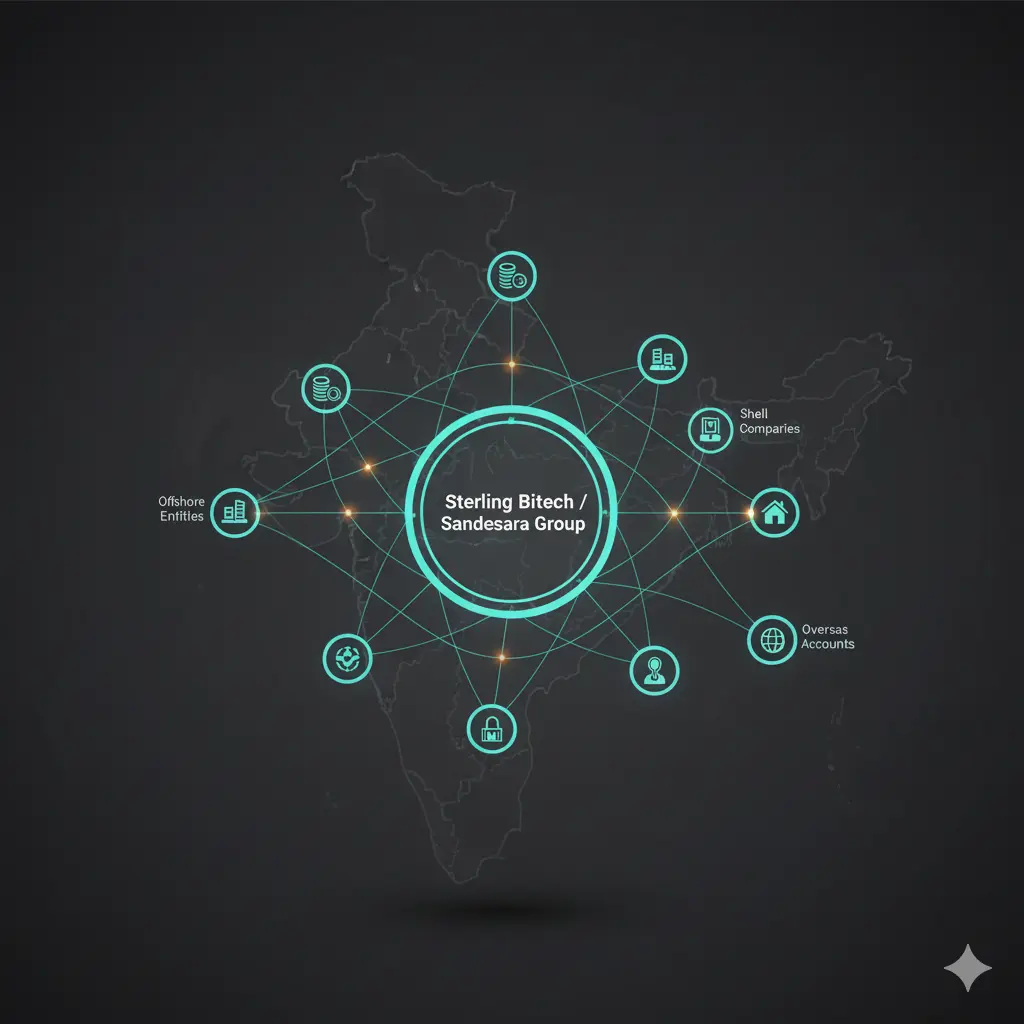
Behind its public reputation as an exporter of collagen-based products, investigators later uncovered one of India’s largest cross-border financial-laundering operations.
Between 2004 and 2012, the group allegedly defrauded Indian banks of more than ₹14,500 crore through circular lending, fictitious invoicing, and offshore layering.
What began as corporate over-leverage evolved into a sophisticated global laundering network spanning India, Nigeria, the UAE, and Caribbean havens.
The Sterling Biotech affair demonstrates how beneficial-ownership opacity, weak compliance coordination, and delayed risk detection can allow fraud to metastasize across jurisdictions.
It also shows why modern financial institutions need predictive compliance intelligence, the ability to correlate ownership, transactions, and geographic risk in real time.
Background: The Rise of Sterling Biotech
Founded in 1985, Sterling Biotech grew rapidly through government incentives and strong credit access.
The company soon diversified into oil, energy, and real estate under the wider Sandesara Group, creating more than 200 affiliates across Asia, Africa, and the Middle East.
By the late 2000s, Sterling was India’s largest gelatin producer and a major borrower from public-sector banks, including Andhra Bank, UCO Bank, and Bank of India.
To finance expansion, it repeatedly tapped term loans and working-capital limits while offering overstated asset valuations and inflated receivables.
This growth narrative concealed fragile cash flows and heavy dependence on intra-group borrowing, conditions that would later expose the company’s systemic governance gaps.
Anatomy of the Alleged Fraud
Investigations revealed that between 2004 and 2012, Sterling Biotech obtained large loans through misrepresentation and diverted the proceeds through a maze of related entities.
Funds raised in India were transferred to offshore subsidiaries and round-tripped back as foreign investments to create a façade of legitimacy.
Dozens of companies shared identical directors, email domains, and contact numbers, a classic sign of beneficial-ownership concealment.
Fictitious export invoices and fake supplier contracts were used to justify remittances abroad.
From there, funds were layered through accounts in Dubai, Nigeria, and the Caribbean before being reinvested into Indian projects or high-value assets.
Traditional due diligence systems failed because each transaction, viewed in isolation, appeared compliant.
What was missing was a unified view of entity control and transaction behavior, precisely the visibility that RegTech platforms are designed to deliver.
The Investigations Begin
The Central Bureau of Investigation (CBI) registered its first FIR in 2017 after banks flagged persistent defaults.
Soon after, the Enforcement Directorate (ED) initiated proceedings under the Prevention of Money Laundering Act (PMLA).
Key findings included:
- Diversion of bank loans to offshore entities and personal accounts.
- Circular financing within group companies to inflate turnover.
- Use of benami directors and shell firms to disguise control.
- Manipulation of accounting records to conceal non-performing loans.
The ED attached assets worth more than ₹9,000 crore, factories, land, aircraft, and overseas holdings, and sought to declare the promoters Fugitive Economic Offenders.
Interpol Red Corner Notices were issued as the Sandesaras relocated abroad, reportedly operating from Nigeria.
The case marked one of India’s earliest large-scale applications of cross-border AML cooperation under FATF Mutual Legal Assistance Treaties (MLATs), coordinating with regulators in the UAE and Europe.
The Modus Operandi: Layers of Laundering
- Inflated Exports and Shell Suppliers: Sterling Biotech generated fictitious export invoices to justify foreign remittances, while shell suppliers issued fake bills for raw materials.
- Circular Lending: Group entities borrowed from each other using bank-funded capital, masking the true end-use of funds.
- Round-Tripping via Offshore Entities: Money moved to offshore companies, then re-entered India as equity investments or loans.
- Use of Benami Accounts: Relatives, employees, and nominal shareholders fronted accounts to obscure control.
- Cross-Jurisdiction Layering: Funds passed through multiple legal systems to sever audit trails.
These activities align with FATF typologies of trade-based money laundering (TBML) and round-tripping, where legitimate trade channels mask the movement of illicit funds.
Legal Proceedings & Developments
Between 2017 and 2024, the ED and CBI filed multiple charge sheets detailing the laundering chain.
The ED invoked provisions under PMLA for attachment and confiscation, while tax authorities initiated actions under FEMA and the Income-Tax Act.
Key developments included:
- Judicial orders confirming provisional attachments of domestic and overseas properties.
- Proceedings under the Fugitive Economic Offenders Act (2018) to seize remaining assets.
- Parallel cases against bank officials accused of sanctioning loans without adequate due diligence.
- Cooperation with Nigerian and UAE authorities for asset identification.
Despite recovery efforts, much of the diverted capital remains overseas, underscoring the challenges of international asset repatriation and the need for digital traceability across borders.
Systemic Lessons in AML & Compliance
The Sterling Biotech affair revealed how weaknesses in financial crime governance can persist despite regulatory frameworks.
- First: Beneficial-ownership opacity remains a critical vulnerability. Without centralized UBO databases, multi-layered shareholding enables control concealment.
- Second: Enforcement coordination across agencies is fragmented. Separate investigations by ED, CBI, SEBI, and FIU-IND often proceed without shared data.
- Third: Compliance systems remain largely reactive. Institutions detect fraud only after defaults or enforcement triggers, not through predictive intelligence.
This case accelerated India’s adoption of beneficial-ownership disclosure norms, FATF-aligned cross-border cooperation, and greater emphasis on technology-enabled supervision.
How IDYC360 Could Have Detected Early Signals
The Sterling Biotech network displayed numerous early-warning indicators that modern compliance intelligence could have detected.
Entity and Ownership Mapping
IDYC360’s graph-based analytics automatically resolve connections among directors, shareholders, and related companies. Shared email domains, phone numbers, or director IDs across Sterling entities would have triggered alerts for common control.
Fund Flow Analytics
Machine-learning models track transaction paths to identify circular or layered transfers. Patterns of repetitive movement between Indian and UAE/Nigerian accounts would have stood out as anomalies.
Jurisdictional Risk Scoring
IDYC360 continuously scores counterparties by jurisdictional exposure. Transactions routed through high-risk or non-cooperative FATF jurisdictions escalate for enhanced due diligence.
Behavioral Analytics
AI-driven models evaluate transaction frequency, value, and direction to detect inconsistencies with declared business profiles.
Regulatory Integration
Automated connectors synchronize with FIU-IND and RBI databases, instantly flagging customers or entities already linked to enforcement cases.
Through these combined modules, IDYC360 would have uncovered ownership overlaps and fund-flow irregularities years before enforcement action.
Cross-Border Enforcement Challenges
The Sandesara case illustrates how laundering networks exploit jurisdictional fragmentation.
- Data Barriers: Different countries maintain separate KYC and UBO registries, hindering verification.
- Legal Inconsistency: Asset attachment and confiscation laws vary widely, complicating recovery.
- Delayed Information-Sharing: Requests through MLAT channels often take months.
- Complex Corporate Structuring: Layered offshore vehicles make ownership tracing resource-intensive.
IDYC360’s Cross-Jurisdictional Risk Intelligence Framework addresses these barriers by consolidating global enforcement and regulatory feeds.
Institutions can monitor exposure to entities operating in multiple jurisdictions while staying compliant with local laws.
Broader Impact on India’s Financial System
The Sterling Biotech scandal reshaped regulatory expectations across India’s banking and NBFC sectors.
- Public-sector banks instituted enhanced due diligence protocols for large corporate borrowers.
- The Ministry of Corporate Affairs introduced tighter beneficial-ownership disclosure rules.
- RBI issued guidelines for group-level exposure monitoring and early-warning systems.
- FIU-IND expanded its typology reports to include trade-based laundering and round-tripping schemes.
More broadly, the case highlighted how AML risk and credit risk are inseparable, compelling institutions to integrate compliance analytics into core banking systems.
The Role of IDYC360 in Strengthening Institutional Readiness
Unified Compliance Architecture
IDYC360 connects KYC, transaction monitoring, ownership intelligence, and case management within one platform, creating a continuous feedback loop between risk detection and regulatory reporting.
AI-Driven Alert Prioritization
Machine-learning filters reduce false positives by contextualizing risk, focusing analyst effort on material threats.
Cross-Border Data Feeds
Global enforcement watchlists, sanctions data, and PEP exposure integrate directly into the system, ensuring that high-risk counterparties are detected instantly.
Audit-Ready Evidence Trails
Every risk alert, decision, and review is automatically logged, satisfying PMLA, FEMA, and FATF recommendation requirements for traceability.
Regulatory Scalability
The platform’s modular architecture adapts to multiple regulators’ formats, RBI, FIU-IND, and SEBI, simplifying compliance across entities.
With these capabilities, IDYC360 converts compliance from a static obligation into an active shield against systemic risk.
Strategic Takeaways for Compliance Leaders
The Sandesara case offers enduring insights:
- Transparency is the first line of defence: Institutions must maintain continuous UBO visibility across subsidiaries and jurisdictions.
- Data integration prevents blind spots: Credit, audit, and compliance functions must share a common risk view.
- AI enhances human oversight: Predictive analytics can flag anomalies beyond manual capacity.
- Cross-border cooperation is crucial: Shared databases and standardized reporting accelerate asset recovery.
- Compliance culture starts at the board: Directors must view AML/CFT controls as strategic governance tools.
By embedding these lessons, financial institutions can prevent recurrence of similar failures and strengthen stakeholder trust.
Conclusion
The Sterling Biotech case is a defining example of how corporate fraud morphs into cross-border laundering when governance falters.
It exposed the vulnerabilities of traditional compliance frameworks and highlighted the urgency of real-time visibility into ownership and fund flows.
For regulators, it prompted a shift toward data-centric enforcement and international cooperation.
For financial institutions, it served as a reminder that preventive intelligence is the only true deterrent to financial crime.
Platforms like IDYC360 bridge this gap, integrating AI, risk analytics, and regulatory context into a single decision layer that detects, pre-empts, and documents risk before it turns into liability.
In an era where capital moves across borders in milliseconds, compliance must move faster and think smarter.
The Sandesara case proves that financial integrity cannot depend on post-event audits; it demands predictive compliance built on data, governance, and intelligence.
References
- Enforcement Directorate – Sterling Biotech Case Files (2017–2024).
- Central Bureau of Investigation – FIR and Charge Sheet on Sterling Biotech (2017).
- Ministry of Finance – Fugitive Economic Offenders Act (2018).
- FATF – Guidance on Beneficial Ownership Transparency (2022).
- Financial Intelligence Unit (India) – Cross-Border Laundering Typologies (2023).
- The Hindu Business Line – “Sterling Biotech Fraud: ED Traces Offshore Assets Worth ₹9,000 Crore,” 2024.
- Economic Times – “Inside the Sandesara Web: India’s Largest Offshore Laundering Network,” 2024.
Ready to Stay
Compliant—Without Slowing Down?
Move at crypto speed without losing sight of your regulatory obligations.
With IDYC360, you can scale securely, onboard instantly, and monitor risk in real time—without the friction.