

Introduction
The Financial Action Task Force (FATF) remains the world’s foremost body for setting and monitoring standards to combat money laundering, terrorist financing, and proliferation financing.
Its “grey list”, formally known as the list of ‘Jurisdictions Under Increased Monitoring, ‘ identifies countries with strategic AML/CFT deficiencies that are working with the FATF to improve them.
In recent years, South Asia has become a critical region in the FATF dialogue.
With complex remittance channels, porous borders, informal economies, and uneven regulatory maturity, several South Asian jurisdictions have faced heightened scrutiny.
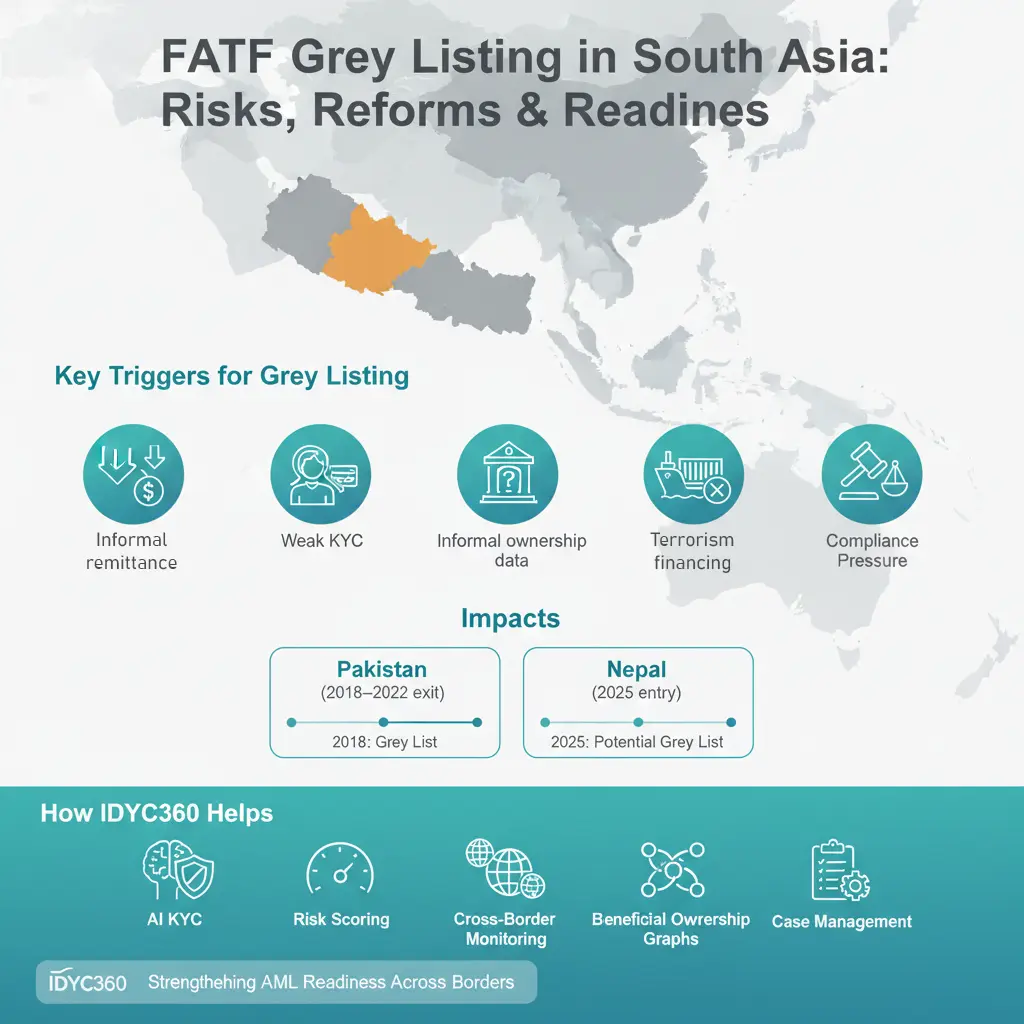
This case study explores the impact and mechanics of FATF grey listing in South Asia, focusing particularly on Pakistan’s and Nepal’s experiences, and explains how financial institutions can strengthen AML readiness using IDYC360’s AI-driven compliance ecosystem.
Understanding FATF Grey Listing
What Is the Grey List?
A country is placed on the FATF grey list when it has strategic AML/CFT deficiencies but has committed to an action plan to resolve them within agreed timelines.
These jurisdictions are monitored closely through FATF’s International Co-operation Review Group (ICRG) process.
Grey listing signals to the global financial community that enhanced due diligence (EDD) is required when dealing with entities from that jurisdiction.
It does not impose sanctions but creates reputational, investment, and transactional constraints that ripple across banking and trade.
Key Implications of Grey Listing
- Correspondent Banking Impact: International banks may restrict or terminate relationships with counterparties in grey-listed jurisdictions.
- Investment Slowdown: Capital inflows reduce due to risk perceptions, raising borrowing costs.
- Enhanced Scrutiny: Financial institutions must apply EDD on cross-border transactions involving such countries.
- Regulatory Pressure: Local regulators often intensify domestic AML/CFT obligations to restore credibility.
The South Asian Landscape
South Asia’s AML ecosystem reflects a delicate balance between rapid financial inclusion and persistent informal systems.
Remittance inflows, trade-based money laundering (TBML), and cross-border hawala networks increase the region’s exposure to FATF scrutiny.
Historically, Pakistan, Sri Lanka, and Nepal have faced or risked grey listing, while India remains a strong FATF member that influences regional standards.
The FATF’s focus has intensified on ensuring that these economies strengthen beneficial ownership transparency, financial intelligence sharing, and enforcement capacity.
Country Case Study: Pakistan’s Grey Listing Experience
Timeline Overview
- 2018: FATF placed Pakistan on the grey list for deficiencies in combating terrorism financing.
- 2019 to 2021: Action plan expanded to 34 items covering beneficial ownership, targeted sanctions, and financial intelligence improvements.
- October 2022: Pakistan exited the grey list after completing all action items, but FATF warned that continued vigilance was required.
Key Deficiencies Highlighted
- Weak enforcement against designated terrorist groups and charities.
- Limited beneficial ownership transparency.
- Inadequate risk-based supervision of financial and non-financial sectors.
- Inconsistent application of sanctions and cross-border reporting.
Economic Impact
According to the State Bank of Pakistan, grey listing cost the country an estimated US $38 billion in cumulative GDP losses (2018–2022).
The indirect cost came from reduced foreign investment, lower trade volume, and restricted correspondent banking channels.
Compliance Lessons
- Policy Reforms Alone Are Insufficient: Implementation and enforcement drive FATF progress.
- Inter-Agency Coordination: Fragmented oversight slowed Pakistan’s remediation timeline.
- Private-Sector Role: Banks became the first line of FATF compliance, reinforcing KYC, CDD, and transaction reporting frameworks.
IDYC360 Relevance
For institutions operating in similar environments, IDYC360’s continuous jurisdiction-risk scoring would have allowed real-time alignment of onboarding and monitoring workflows with FATF expectations, automatically updating country risk tiers as new FATF data is released.
Country Case Study: Nepal’s Grey Listing in 2025
Background
In February 2025, FATF added Nepal to its list of jurisdictions under increased monitoring.
The decision stemmed from deficiencies in beneficial ownership transparency, cross-border financial oversight, and non-compliance in remittance and real estate sectors.
Specific Deficiencies Identified
- Lack of an integrated beneficial ownership registry.
- Insufficient monitoring of cross-border remittance networks and informal value transfer systems.
- Limited enforcement of STR (Suspicious Transaction Report) obligations by non-bank financial institutions.
- Weak inter-agency coordination between Nepal Rastra Bank and the Financial Information Unit (FIU-Nepal).
Regional Context
Nepal’s grey listing reflects broader vulnerabilities in South Asia’s remittance ecosystem, particularly the heavy dependence on informal corridors from the Gulf, India, and Malaysia.
FATF flagged risks of terrorist financing and cross-border money laundering through unregistered money service operators.
Impact on Financial Institutions
- Banks must now apply enhanced due diligence when onboarding or transacting with Nepalese entities.
- Regional fintechs using Nepalese payment corridors are required to implement jurisdiction-linked transaction screening.
- Correspondent banks are reassessing risk appetite, particularly in trade and remittance channels.
IDYC360 Perspective
IDYC360’s Cross-Border Transaction Analytics module can automatically tag and risk-score transactions linked to FATF-monitored jurisdictions, ensuring compliance with evolving regional obligations.
Its Beneficial Ownership Intelligence Engine connects local registry data with global PEP/sanctions databases, bridging the transparency gap that FATF cited in Nepal’s case.
Regional Dynamics and Spillover Effects
While Pakistan’s delisting and Nepal’s inclusion are headline cases, the FATF’s focus extends to regional systemic risks:
- Informal Value Transfer Systems (IVTS): Hawala and hundi networks remain deeply entrenched across borders.
- Trade-Based Money Laundering (TBML): Mis-invoicing and over/under-valuation persist in India-Pakistan-Bangladesh corridors.
- Non-Profit Organizations: FATF’s Recommendation 8 continues to be a regional challenge due to weak oversight mechanisms.
- Virtual Assets: Rapid growth of crypto activity in India and Sri Lanka has raised FATF’s attention on Virtual Asset Service Providers (VASPs).
Regional cooperation through SAARC-level or FIU information sharing remains limited.
Without technological integration, compliance data silos prevent effective cross-jurisdictional monitoring.
Implications for Financial Institutions
Financial institutions, whether banks, NBFCs, or fintechs, are at the front line of FATF compliance execution.
Grey listing introduces multiple operational and reputational challenges:
Heightened Country-Risk Assessments
Institutions must calibrate onboarding and periodic reviews using jurisdiction-risk indicators, not merely customer-risk metrics.
Grey-listed countries require enhanced due diligence that validates the source of funds, beneficial ownership, and transaction purpose.
Correspondent Banking Pressures
Foreign banks often scale back correspondent relationships with institutions in grey-listed jurisdictions, affecting cross-border payments, trade finance, and liquidity access.
Regulatory Reporting and Escalation
Institutions must demonstrate active monitoring of FATF developments, update internal watchlists, and report exposure to grey-listed jurisdictions.
Technology Imperatives
Given the volume and complexity of cross-border data, manual compliance models are no longer viable.
Institutions need real-time intelligence engines that automatically integrate FATF status, country risk, and transaction monitoring.
How IDYC360 Strengthens AML Readiness
IDYC360 is engineered to help financial institutions transform FATF compliance from a reactive obligation into a proactive, intelligence-driven capability.
Jurisdiction-Linked Risk Scoring
- Dynamic scoring engine automatically updates risk ratings as FATF or regional advisories change.
- Configurable rules allow institutions to apply additional controls when engaging with grey-listed countries.
- Integrated into both KYC onboarding and transaction monitoring workflows.
Beneficial Ownership Graph Analytics
- AI-based graph models uncover hidden linkages across directors, entities, and jurisdictions.
- Identifies indirect exposure to grey-listed countries via related parties or counterparties.
- Cross-references FIU and sanctions databases to provide 360° beneficial ownership intelligence.
Cross-Border Transaction Surveillance
- Monitors payment flows by jurisdiction, corridor, and counterparty.
- Flags high-risk corridors (e.g., Nepal-India remittances or Pakistan-UAE trade flows) in real time.
- Machine-learning algorithms adapt thresholds based on evolving FATF typologies.
Case Management & Regulatory Audit Trail
- Unified dashboard for investigators and compliance officers.
- Automatic evidence capture for each alert and jurisdiction-risk escalation.
- Ensures audit readiness for FATF or regulator-driven inspections.
Predictive Compliance Intelligence
- Uses behavioural analytics and pattern recognition to forecast potential jurisdictional exposure before regulatory action occurs.
- Empowers boards and compliance heads to plan strategic de-risking measures.
Outcome for Clients
Institutions using IDYC360 gain an integrated, continuously learning system that transforms FATF monitoring from a manual reporting task into a real-time compliance advantage.
Common Challenges & Pitfalls
Despite progress, institutions in South Asia face recurring issues when responding to grey-listing scenarios:
- Over-reliance on Static Lists: FATF status alone doesn’t capture dynamic changes in risk behaviour. Risk frameworks must integrate real-time data.
- Data Fragmentation: Disconnected compliance systems make it difficult to correlate customer data with jurisdictional intelligence.
- High False Positives: Excessive manual alerts drain resources without improving detection quality. AI-based calibration is essential.
- Limited Skilled Analysts: Shortage of AML professionals in smaller jurisdictions exacerbates the challenge of sustained FATF compliance.
- Post-Delisting Complacency: Countries often relax controls after exiting the grey list, inviting renewed scrutiny. Continuous monitoring is crucial.
IDYC360’s platform directly mitigates these challenges by automating jurisdiction-risk intelligence, reducing false positives, and consolidating data across compliance functions.
Recommendations for Financial Institutions
Strengthen Jurisdictional Risk Frameworks
Integrate FATF status, Basel AML Index scores, and domestic advisories into the enterprise-wide risk model.
Implement Continuous Monitoring
Use platforms like IDYC360 to monitor FATF updates and recalibrate transaction thresholds automatically.
Enhance Beneficial Ownership Transparency
Leverage corporate registry integration and network analytics to detect indirect exposure to high-risk jurisdictions.
Prioritize Data Fusion
Consolidate KYC, trade, finance, remittance, and sanctions data into a single compliance data lake.
Collaborate Across Borders
Engage with regional FIUs, regulators, and correspondent banks for shared intelligence and typology updates.
Invest in RegTech Infrastructure
FATF compliance is now a data problem, not just a documentation problem. AI-driven tools like IDYC360 help institutions identify patterns beyond manual capacity.
Conclusion
The FATF grey list has become a litmus test for a nation’s AML/CFT credibility. For South Asia, a region where informal networks intersect with rapid digitalization, grey listing is both a challenge and a wake-up call.
For financial institutions, the lesson is clear:
AML readiness must evolve from policy compliance to predictive intelligence.
With IDYC360, organizations gain the power to:
- Detect exposure to high-risk jurisdictions in real time.
- Map complex ownership and transaction networks.
- Automate audit-ready reporting aligned with FATF’s evolving benchmarks.
As global compliance expectations rise, IDYC360 enables South Asian institutions to move from reactive defence to proactive financial integrity, ensuring sustainable access to the global financial system.
References
- Financial Action Task Force (FATF) – Jurisdictions under Increased Monitoring (Grey List).
- The Economic Times – “FATF grey listing: Nepal emerges as South Asian haven for money laundering,” Feb 2025.
- Indian Express – “Explained: What is FATF Grey List?”
- Times of India – “Not bulletproof: FATF warns Pakistan against terror funding lapses,” Oct 2025
- IFAC – “Pakistan’s Journey off the FATF Grey List and the Role of Accountants.”
- Basel Institute on Governance – “The FATF Grey List: Truth and Myths.”
Ready to Stay
Compliant—Without Slowing Down?
Move at crypto speed without losing sight of your regulatory obligations.
With IDYC360, you can scale securely, onboard instantly, and monitor risk in real time—without the friction.