Introduction
The Dewan Housing Finance Limited (DHFL) case remains one of India’s most striking examples of systemic financial misconduct, a ₹34,000-crore loan diversion and money-laundering scheme that shook the foundations of the country’s banking and regulatory ecosystem.
At its core, the scandal wasn’t just a failure of internal controls; it was a failure of visibility.
Hundreds of shell companies, opaque ownership structures, and fragmented compliance oversight allowed funds to flow unchecked for years.
The DHFL episode demonstrates a painful truth: when compliance systems operate in silos, financial crime finds space to thrive.
In this case study, we examine how the diversion unfolded, the red flags that went unnoticed, and how IDYC360’s AI-powered compliance platform could have helped financial institutions detect and prevent such large-scale fund misuse through real-time ownership analytics, transaction mapping, and end-use verification.
Case Summary
Founded in 1984, DHFL was one of India’s largest housing finance companies, offering loans for affordable housing. By 2018, it had built a massive loan book exceeding ₹1 lakh crore. Yet beneath that scale was an intricate web of fictitious lending, fund layering, and accounting manipulation.
In 2020, the Central Bureau of Investigation (CBI) and the Enforcement Directorate (ED) began probing DHFL’s promoters, Kapil Wadhawan and Dheeraj Wadhawan, for allegedly diverting bank loans to shell companies and for laundering proceeds of crime through benami entities.
The investigations revealed:
- More than ₹34,000 crore in loans from a consortium of 17 banks, led by Union Bank of India, were allegedly diverted.
- Over 66 shell companies were used to layer funds and reroute them into private investments and personal acquisitions.
- Dummy accounts and fake loan books were created to project solvency and attract further credit.
- Some diverted funds were allegedly reinvested in politically connected infrastructure projects and personal assets.
In January 2021, the CBI filed an FIR charging the Wadhawan brothers and DHFL executives under sections of the Indian Penal Code (IPC) and the Prevention of Corruption Act, followed by an ED prosecution under the Prevention of Money Laundering Act (PMLA).
Anatomy of the Diversion
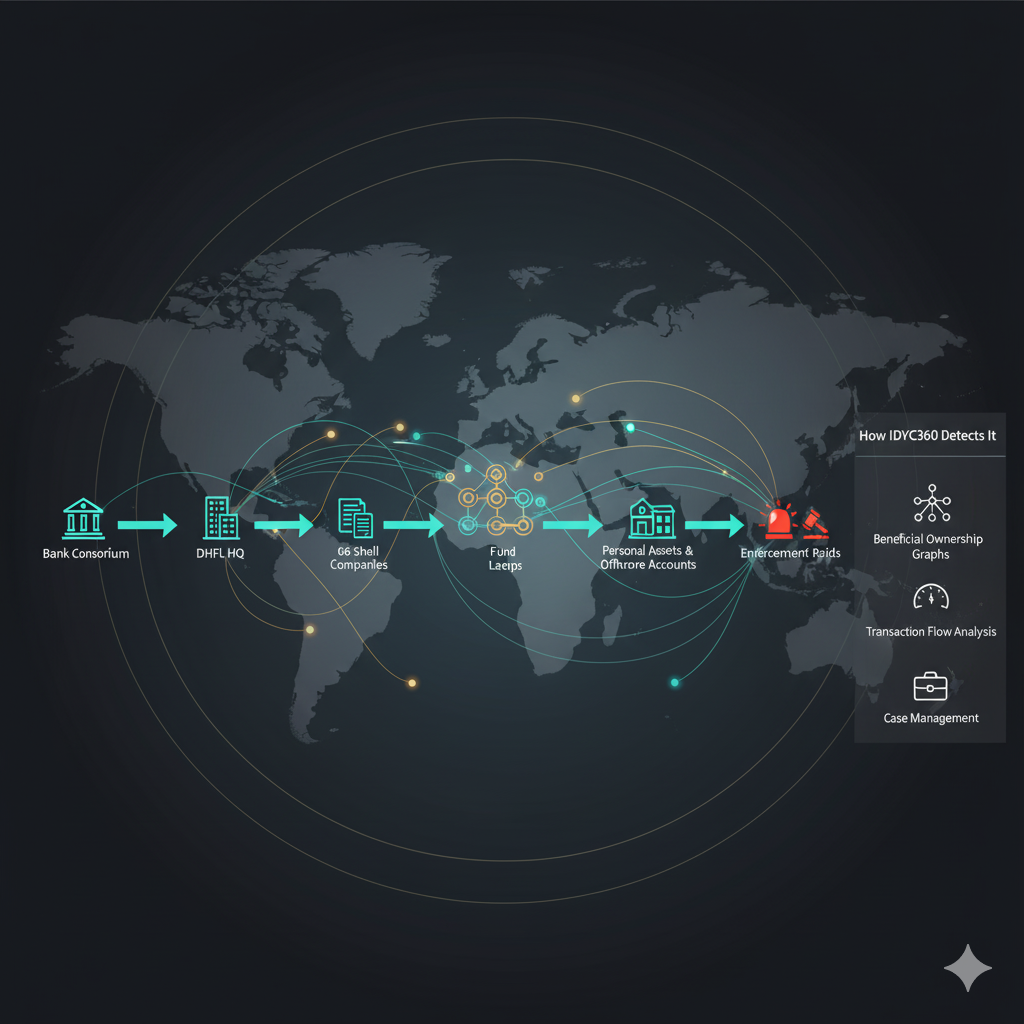
The fund diversion mechanism in DHFL’s case was elaborate but methodical. It reflected the classical playbook of financial engineering gone wrong.
Step 1: Sanction of Large Credit Lines
A consortium of banks sanctioned loans exceeding ₹40,000 crore to DHFL for on-lending in the housing and infrastructure sectors.
The funds were meant for project finance and low-cost housing loans.
Step 2: Routing through Shell Entities
Instead of reaching genuine borrowers, funds were transferred to “Project Companies”, front entities allegedly owned or controlled by the Wadhawans.
These companies had no operational history, assets, or employees.
Step 3: Circular Fund Movement
The project companies, after receiving funds, rerouted money to other Wadhawan-linked firms, often under the guise of short-term advances or inter-corporate deposits.
Step 4: Layering and Integration
Funds were layered through multiple bank accounts, some in India and others abroad.
Eventually, they were used for personal investments, land purchases, and corporate acquisitions, masking their illicit origin.
Step 5: Accounting Manipulation
DHFL allegedly recorded these disbursals as secured retail loans, creating a false impression of legitimate lending activity.
The loan book appeared strong, concealing actual stress.
Red Flags That Went Unnoticed
| Category | Red Flag |
| Ownership | Common directors and addresses across borrower companies |
| Transaction Pattern | Repetitive fund transfers within same corporate group |
| Documentation | Missing or identical KYC documents among borrowers |
| End-Use | No project activity corresponding to sanctioned amounts |
| Geography | Borrowers concentrated in non-core business regions |
| Risk Monitoring | Static credit scoring with no real-time behaviour tracking |
Banks largely relied on manual due diligence and borrower declarations, with little technological integration between loan sanctioning, disbursement, and compliance systems.
Regulatory & Enforcement Response
The regulatory chain of action unfolded in multiple stages:
- CBI FIR (2021): Filed against DHFL promoters, alleging criminal conspiracy, fraud, and breach of trust.
- ED Investigation (2021–2022): Uncovered over ₹1,200 crore in assets acquired using laundered funds.
- Forensic Audit (KPMG): Detected massive gaps between loan disbursal and borrower credentials.
- NCLT Proceedings: DHFL entered insolvency and was eventually acquired by Piramal Group under IBC resolution, with significant write-downs.
Regulators concluded that DHFL had systematically misused the loopholes in consortium lending and credit monitoring, exposing the lack of centralized visibility across banks.
Why Traditional Compliance Failed
Fragmented Data Infrastructure
Each bank relied on its own credit and compliance systems, with no unified view of DHFL’s total exposure or fund movement.
Absence of Beneficial Ownership Mapping
Borrower companies appeared unrelated in corporate filings but shared directors, phone numbers, and registered addresses, easily traceable through a centralized graph analytics tool.
Static Risk Models
Risk ratings were updated annually or quarterly, missing dynamic changes in borrower behaviour.
Manual End-Use Verification
Loan proceeds were verified through paper documentation and borrower reports, ineffective against digital fund diversion.
Lack of Pattern Recognition
No system existed to correlate transaction similarities or identify circular fund flows between related companies.
AML/CFT Lessons from the DHFL Case
The DHFL saga illustrates how credit risk and AML risk intersect.
The transaction trails and ownership patterns were red flags not only for credit default but also for money laundering.
Key Takeaways for Institutions:
- Every large exposure is a compliance risk: Credit due diligence must integrate AML indicators such as ownership overlap, related-party exposure, and fund flow anomalies.
- Consortium lending requires unified visibility: Without centralized compliance intelligence, large loans can be easily misused across multiple lenders.
- Beneficial ownership transparency is non-negotiable: Complex shareholding structures often conceal ultimate control — regulators now demand proactive identification.
- Real-time analytics beats post-facto audits: Detecting suspicious layering during the loan lifecycle prevents losses far more effectively than forensic recovery.
How IDYC360 Could Have Detected It Early
Beneficial Ownership Analytics
- IDYC360’s Entity Resolution Engine automatically uncovers hidden relationships between borrowers, directors, and linked entities.
- Visual ownership graphs reveal shared addresses, contact numbers, and registration overlaps.
- The system would have instantly highlighted the 66 “project companies” linked to the same promoter ecosystem.
Fund Flow & End-Use Monitoring
- AI-based transaction tracing correlates each loan disbursal with its declared purpose.
- Any deviation, such as circular routing or unrelated transfers, generates an immediate alert.
- In DHFL’s case, funds being sent to non-project entities would have triggered high-severity anomalies within days, not years.
Relationship Graphs & Circular Movement Detection
- The platform maps inter-company fund flows in near real-time.
- Pattern recognition algorithms detect repeated fund cycling or layering through related accounts.
- Visual dashboards simplify identification of money movement loops, a key red flag in the DHFL case.
Dynamic Risk Scoring
- Continuous risk scoring adjusts borrower ratings based on transaction behaviour, jurisdictional exposure, and counterparty connections.
- DHFL’s internal network would have rapidly escalated into a “critical-risk cluster,” prompting proactive reviews by the credit monitoring team.
Case Management and Regulatory Reporting
- Integrated case workflow consolidates all alerts, supporting documents, and internal notes.
- Generates audit-ready evidence for submission to RBI or FIU-IND, minimizing manual reconciliation effort.
In short, IDYC360 bridges the exact visibility gap that allowed DHFL’s fund diversion to flourish, connecting people, transactions, and entities under one compliance intelligence layer.
The Role of AI in Preventing Loan Diversion
Artificial Intelligence changes compliance from rule-based reaction to context-aware prediction.
In high-volume loan portfolios, AI can identify subtle behavioural deviations long before defaults or enforcement actions occur.
AI Use Cases in Credit Surveillance
| Function | AI Capability | Impact |
| Ownership Analysis | Graph Neural Networks | Identifies hidden control relationships |
| Fund Flow Monitoring | Machine Learning Anomaly Detection | Flags outlier transactions & layering |
| Risk Modelling | Predictive Analytics | Scores borrowers dynamically |
| Document Review | NLP-based OCR | Detects cloned or falsified documentation |
| Alert Prioritization | Risk Clustering | Reduces false positives; faster analyst action |
By combining these capabilities, institutions can monitor not only who receives funds but how those funds behave after disbursal, a core tenet of AML-aligned credit governance.
Broader Implications for India’s Banking Sector
The DHFL case was a turning point for India’s financial ecosystem. It led to structural and regulatory introspection across multiple fronts:
- RBI’s Enhanced Due Diligence Circulars: Banks are now required to strengthen borrower verification and monitor end-use of large exposures.
- FIU-IND Advisory (2022): Highlighted the integration of trade and credit transactions within AML reporting frameworks.
- Consortium Lending Governance Reforms: Mandated improved coordination and unified credit intelligence between member banks.
- Shift Toward RegTech Collaboration: Regulators increasingly encourage the adoption of AI and data-driven compliance solutions to minimize human dependency.
These shifts represent the gradual institutionalization of data-first AML culture, one where technology is an enabler, not a checkbox.
The IDYC360 Advantage in Large-Scale Lending
IDYC360 delivers the visibility, intelligence, and automation that large lenders need to stay ahead of sophisticated fraud and money laundering schemes.
| Capability | What It Solves |
| AI-Driven KYC/CDD | Ensures authenticity of borrower and linked entities |
| Beneficial Ownership Graphs | Reveals hidden control structures across group companies |
| End-Use Verification Module | Tracks fund flow consistency post-disbursement |
| Relationship Graphs | Maps circular fund transfers and indirect exposure |
| Jurisdiction Risk Scoring | Identifies offshore or high-risk linkages |
| Integrated Case Management | Centralizes alerts and documentation for regulator-ready audit trails |
Result:
Banks gain continuous risk intelligence, not static reports.
Early detection replaces reactive investigation, protecting both capital and credibility.
Strategic Takeaways
- Compliance is now a credit function: Financial institutions must embed AML principles into lending processes from day one.
- Transparency must be automated: Manual ownership tracing cannot match the scale of corporate layering used in modern financial crimes.
- Consortium exposure requires shared compliance infrastructure: IDYC360’s architecture allows multi-bank environments to maintain a unified compliance view without breaching data confidentiality.
- AI is not a luxury; it’s risk prevention: In a ₹34,000-crore fraud, early detection through AI analytics could have saved banks years of recovery effort and reputational loss.
Conclusion
The DHFL loan diversion case represents more than a financial scandal; it is a blueprint of how legacy compliance gaps can amplify systemic risk.
Multiple banks, regulators, and auditors failed not for lack of oversight, but for lack of connected intelligence.
As India’s financial institutions expand credit access and digitalize operations, the challenge of tracing fund authenticity will intensify.
Static compliance methods cannot detect dynamic fraud.
IDYC360 bridges that gap.
Through its AI-powered KYC, Beneficial Ownership Analytics, Transaction Monitoring, and End-Use Intelligence, it transforms compliance into a predictive shield — ensuring that every rupee lent remains traceable, legitimate, and defensible.
In the post-DHFL era, the institutions that survive are not those with the most paperwork, but those with the best data intelligence.
References
- Central Bureau of Investigation (CBI) – FIR on DHFL and Wadhawan Group Loan Diversion, January 2021.
- Enforcement Directorate (India) – Press Releases on DHFL PMLA Investigations (2021–2023).
- Financial Intelligence Unit – Trade and Credit-Based Money Laundering Typologies (2022).
- Economic Times – “DHFL promoters diverted ₹34,000 crore to shell firms, says CBI,” 2021.
- Business Standard – “ED attaches assets worth ₹1,200 crore in DHFL loan fraud case,” 2022.
- FATF – “Best Practices on the Use of Technology for AML/CFT.”
Ready to Stay
Compliant—Without Slowing Down?
Move at crypto speed without losing sight of your regulatory obligations.
With IDYC360, you can scale securely, onboard instantly, and monitor risk in real time—without the friction.