Introduction
Trade-Based Money Laundering (TBML) has emerged as one of the most complex and least detected forms of financial crime.
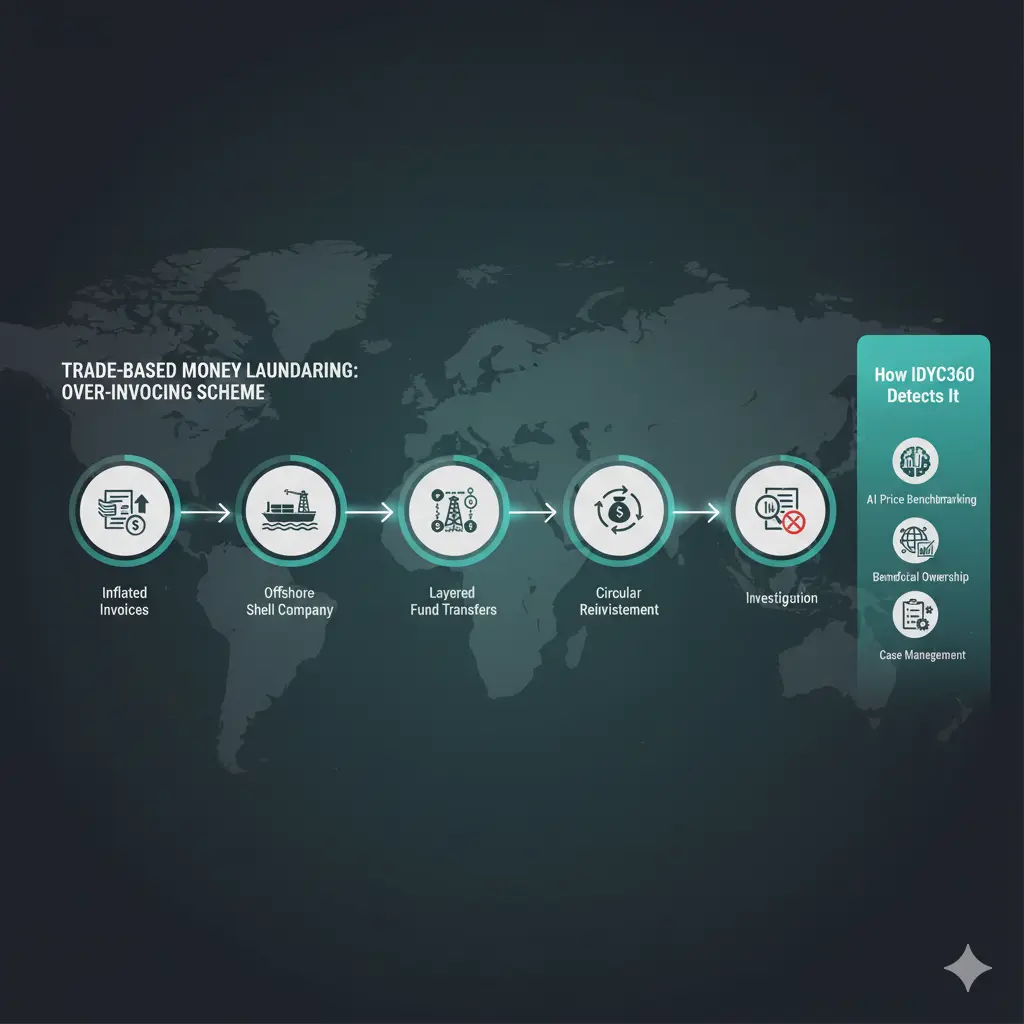
Unlike conventional money laundering, which moves funds through cash or banking channels, TBML hides illicit value transfers behind the façade of legitimate trade transactions, often using over- or under-invoicing, multiple invoicing, falsified documentation, or phantom shipments.
The Bhushan Steel over-invoicing case is a striking example of how trade transactions can be weaponized to move illicit funds across borders under the guise of exports and imports.
The case underscores systemic weaknesses in trade-finance monitoring, gaps in price benchmarking, and the need for integrated AML surveillance across banking and customs systems.
For financial institutions, the lesson is clear: traditional due diligence cannot detect over-invoicing.
What’s required is AI-driven trade intelligence, beneficial ownership mapping, and cross-border transaction analytics, precisely the foundation of IDYC360’s compliance ecosystem.
Understanding Over-Invoicing in Trade-Based Money Laundering
Over-invoicing occurs when the declared price of goods or services is artificially inflated on trade documents, often by a significant margin above the true market value.
Purpose:
- Transfer of value: The exporter receives inflated payments, effectively transferring funds abroad.
- Disguise of capital flight: Companies use over-invoicing to shift assets offshore while appearing compliant.
- Round-tripping: Funds sent abroad are sometimes reinvested into the same domestic company, disguised as foreign direct investment (FDI).
- Tax and subsidy manipulation: Export incentives or input credit claims can be fraudulently maximized.
Over-invoicing thrives in the gaps between trade and financial systems.
Banks check documentation for completeness, but seldom verify pricing authenticity. Customs officials validate goods descriptions but lack access to real-time financial flows.
Criminals exploit this disconnect.
Case Background: Bhushan Steel’s Alleged Scheme
Bhushan Steel Limited (BSL), one of India’s largest steel producers before its insolvency, was investigated by enforcement agencies for suspected over-invoicing of exports and imports.
According to reports and Enforcement Directorate (ED) filings:
- Bhushan Steel allegedly inflated invoice values to siphon funds abroad, using subsidiaries and front companies.
- The company imported equipment and raw materials at artificially elevated prices, transferring excess payments to overseas entities.
- These entities were allegedly related or controlled by the company’s promoters.
- Some funds were later routed back as foreign investments or trade settlements, effectively disguising proceeds of crime.
The Directorate of Revenue Intelligence (DRI) and ED initiated investigations under the Foreign Exchange Management Act (FEMA) and the Prevention of Money Laundering Act (PMLA), uncovering suspected multi-layered trade transactions with no corresponding physical movement of goods in certain instances.
The estimated over-invoicing value, as cited in multiple reports, ran into hundreds of crores, affecting both banking exposure and India’s export-import integrity.
How the Scheme Worked
The alleged mechanism followed a typical TBML structure:
- Inflated Import Pricing: BSL placed orders for steel manufacturing machinery through intermediaries. The intermediaries imported equipment at inflated prices, paying the foreign supplier the marked-up amount. The differential represented capital shifted out of India.
- Circular Trade Invoicing: Some exports were invoiced at inflated values to justify receipt of foreign funds. The counterparties were allegedly related entities abroad.
- Layering via Shell Entities: Multiple offshore companies were created in jurisdictions with limited information-sharing (e.g., Mauritius, Singapore, UAE). These entities were used to receive or remit inflated payments.
- Round-Tripping & Reinvestment: Funds transferred abroad were later reintroduced into India as legitimate foreign investment or repayment under trade contracts.
- Subsidy & Credit Abuse: Overstated export invoices also enabled fraudulent claims under export incentive schemes and higher input tax credits.
Systemic Weaknesses That Enabled the Fraud
Lack of Price Verification Mechanisms
Banks processed trade documents primarily for compliance completeness — not for market-value authenticity. No system existed to benchmark prices of steel machinery against global trade databases.
Siloed Data Between Customs, Banks, and FIUs
Financial institutions and customs authorities operated in isolation. Suspicious trade patterns visible to customs were not communicated to the banks financing those trades.
Absence of Beneficial Ownership Transparency
Entities involved in the foreign leg of transactions were structured through holding companies and nominees, obscuring true ownership.
Reactive Compliance
AML controls focused on post-event transaction monitoring rather than predictive intelligence. There was no mechanism to detect pricing anomalies or unusual trade volumes in real time.
Regulatory and Enforcement Response
The Bhushan Steel case triggered multi-agency investigations involving:
- Directorate of Revenue Intelligence (DRI): Scrutinized customs documentation and transaction values.
- Enforcement Directorate (ED): Investigated money laundering and proceeds of crime under PMLA.
- Serious Fraud Investigation Office (SFIO): Assessed corporate governance and accounting irregularities.
- Reserve Bank of India (RBI): Reviewed banking sector exposure and procedural lapses in trade-finance monitoring.
The enforcement findings emphasized that over-invoicing represents both a money-laundering technique and a trade compliance failure.
Such cases undermine export credibility, distort market pricing, and expose banks to cross-border AML risks.
Trade-Based Money Laundering Red Flags
The Bhushan Steel case exhibits several TBML indicators recognized by FATF and FIU-IND guidelines:
| Category | Red Flag Indicators |
| Pricing | Invoiced price deviates substantially from known market rates |
| Counterparty | Related or newly established foreign entities with minimal trade history |
| Transaction Patterns | Circular or mirror transactions between same groups of entities |
| Shipping Data | Inconsistency between shipping documentation and declared trade values |
| Jurisdictional Risk | Counterparties located in low-tax or secrecy jurisdictions |
| Financing Pattern | Multiple financing facilities used for similar shipments |
| Document Integrity | Repeated reuse of invoices or overlapping payment references |
How IDYC360 Detects Over-Invoicing & TBML
IDYC360’s platform was built to address the exact vulnerabilities exposed by cases like Bhushan Steel’s, where trade data, financial data, and ownership data must converge to uncover illicit activity.
Trade Intelligence Module
- AI-driven price benchmarking compares declared values against trusted global trade databases.
- Detects deviations beyond configurable thresholds, automatically flagging over-invoicing risk.
- Uses machine learning to refine price tolerance based on commodity type, trade corridor, and seasonality.
Document Screening Engine
- OCR and natural language processing (NLP) extract data from invoices, bills of lading, and customs forms.
- Validates consistency between quantities, HS codes, and declared prices.
- Flags cloned or modified invoices reused across multiple transactions.
Beneficial Ownership & Relationship Graphs
- AI builds relationship maps across directors, exporters, importers, and counterparties.
- Detects hidden common ownership between domestic exporters and foreign buyers.
- Cross-references with sanctions, PEP, and adverse media databases to identify linked risk entities.
Cross-Border Transaction Analytics
- Links trade documentation with actual payment flows through the banking network.
- Detects circular or layered payment chains typical of TBML.
- Visual dashboards highlight trade corridors with abnormal value-to-volume ratios.
Dynamic Risk Scoring
- Combines multiple parameters, pricing deviation, counterparty risk, and jurisdiction exposure into a unified Trade Risk Score.
- Updates in real time as new data arrives, ensuring continuous surveillance.
- Generates prioritized alerts for compliance analysts.
Case Management and Audit Trail
- Integrated workflow enables investigators to attach documents, flag alerts, and track resolution progress.
- Every risk decision is logged, creating a regulator-ready audit trail under PMLA and RBI’s KYC Master Direction.
Illustrative Scenario: IDYC360 in Action
To visualize how IDYC360 would have functioned in the Bhushan Steel case:
Transaction Entry
A trade-finance officer processes an import transaction for high-value machinery priced 45% above historical norms.
AI Benchmarking Trigger
IDYC360’s trade intelligence module automatically benchmarks the price against global data.
An anomaly alert is generated, tagged as “Over-Invoicing Risk: High.”
Cross-Border Relationship Analysis
The foreign supplier is identified as a newly incorporated entity in Singapore.
IDYC360’s relationship graph reveals a shared director with a Bhushan group subsidiary.
Pattern Correlation
Subsequent transactions show similar machinery imports from the same supplier at escalating prices.
The system correlates these patterns and escalates the case to Level 2 review.
Regulatory Case Escalation
Compliance officers review evidence via the case management module, attach supporting data, and file an STR (Suspicious Transaction Report) through IDYC360’s FIU integration.
Outcome
The transaction is blocked pending further verification, preventing illicit fund transfer.
This workflow demonstrates how automated intelligence, not manual checks, prevents TBML from maturing into systemic fraud.
Lessons for Financial Institutions
Integrate Trade and AML Data
Trade finance, remittance, and KYC systems must not operate in silos. Unified data enables pattern detection across transactions.
Strengthen Price Verification
Banks should adopt AI-based benchmarking to validate trade values against real-world market rates.
Enhance Ownership Transparency
Periodic updates to beneficial ownership records ensure counterparties are genuinely independent.
Implement Continuous Risk Scoring
Static customer profiles cannot capture evolving risk. Dynamic scoring updates risk levels automatically with each transaction.
Build Collaborative Ecosystems
Coordination among banks, customs, FIUs, and technology providers like IDYC360 enables shared vigilance.
The Regulatory Imperative
Regulators are now mandating enhanced trade-finance due diligence under both AML and prudential frameworks:
- RBI Master Direction on KYC (2023): Requires financial institutions to adopt risk-based monitoring for trade transactions and verify the end-use of funds.
- FATF Recommendation 13: Stresses the need for scrutiny of cross-border trade finance as a high-risk activity.
- FIU-IND Advisory Notes: Highlight TBML as a growing typology and encourage adoption of RegTech-driven detection systems.
- PMLA (India) & FEMA (Cross-border Controls): Enforcement authorities increasingly view trade-based over-invoicing as predicate offences for money laundering.
Compliance is therefore no longer limited to transaction reporting; it requires intelligence integration across trade, credit, and AML systems.
12. How IDYC360 Transforms Trade Compliance
IDYC360’s platform provides an end-to-end compliance architecture that merges trade analytics, ownership intelligence, and transaction monitoring.
| Feature | Value for Institutions |
| Global Trade Database Integration | Detects pricing anomalies automatically |
| Entity Resolution Engine | Uncovers hidden relationships across exporters/importers |
| Cross-Border Fund Flow Correlation | Links trade payments with underlying transactions |
| Customizable Risk Scoring | Adapts to sector, commodity, and jurisdictional risk |
| Audit-Ready Case Management | Simplifies STR filing and regulator interactions |
| AI-Powered Predictive Alerts | Identifies potential TBML before escalation |
The platform’s flexibility allows banks and corporates to deploy it either as an integrated compliance system or a specialized trade-risk analytics module connected to existing AML solutions.
Strategic Takeaways
Trade is the New Frontier of Money Laundering.
Traditional AML tools miss trade-based typologies because they rely on financial flows, not commercial value comparisons.
Over-Invoicing Is a Data Problem.
Detection requires global market price references, AI benchmarking, and pattern correlation.
Technology Enables Preventive Compliance.
With IDYC360, financial institutions can prevent fraudulent payments before they exit the system.
Collaboration Strengthens Defence.
Integrating regulators, customs data, and FIUs into the same surveillance ecosystem enhances systemic resilience.
Conclusion
The Bhushan Steel over-invoicing case is a powerful reminder that financial integrity extends beyond domestic banking.
In the era of globalized trade, illicit capital can travel seamlessly — camouflaged as legitimate invoices, freight charges, or export proceeds.
For compliance leaders, this case represents a call to action:
Detecting trade-based money laundering demands intelligence that spans entities, jurisdictions, and data sources.
IDYC360 provides exactly that, a unified, AI-powered platform that transforms compliance from reactive review into proactive prevention.
By embedding trade analytics, ownership transparency, and jurisdictional risk intelligence into every transaction, IDYC360 empowers institutions to safeguard trust, reputation, and compliance in a rapidly evolving trade-finance ecosystem.
References
- Directorate of Revenue Intelligence (DRI) – Investigation reports on over-invoicing in steel sector (2019–2022).
- Enforcement Directorate (ED) – Case filings under PMLA related to Bhushan Steel.
- Reserve Bank of India – Master Direction on KYC (updated 2023).
- FATF – Trade-Based Money Laundering Typologies Report.
- Financial Intelligence Unit – Typology Reports on Trade-Based Laundering in India.
Ready to Stay
Compliant—Without Slowing Down?
Move at crypto speed without losing sight of your regulatory obligations.
With IDYC360, you can scale securely, onboard instantly, and monitor risk in real time—without the friction.