

SSN: Social Security Number
Definition
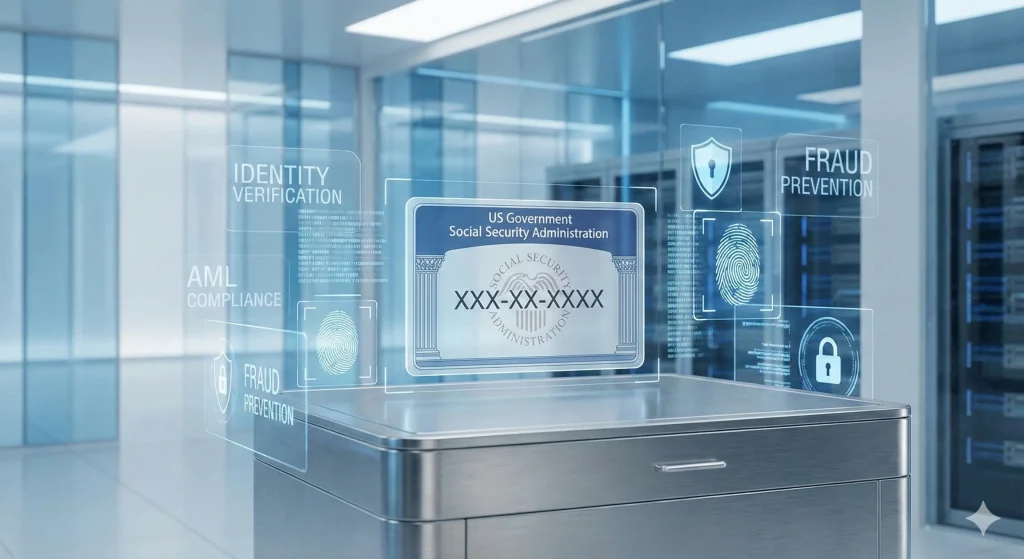
A Social Security Number (SSN) is a unique nine-digit identification number issued by the Social Security Administration to individuals in the United States.
It is primarily used for tracking earnings, administering social security benefits, and supporting tax reporting and identity verification processes.
Within AML/CFT frameworks, the SSN functions as a critical personal identifier used in customer due diligence (CDD), identity verification, sanctions screening, and fraud detection, particularly for U.S.-linked customers, transactions, and correspondent relationships.
Although not designed as a financial identifier, the SSN has evolved into a de facto identity anchor across banking, credit, employment, and government systems.
This dual role makes it both operationally valuable and highly sensitive from a financial crime and data-protection perspective.
Explanation
The SSN was introduced in 1936 to administer social security benefits in the United States.
Over time, its use expanded far beyond its original purpose.
Financial institutions, employers, credit bureaus, insurers, and government agencies adopted the SSN as a reliable means of uniquely identifying individuals across disparate systems.
From an AML/CFT standpoint, the SSN is commonly used to:
- Verify the identity of U.S. persons during onboarding
- Distinguish between individuals with similar names or dates of birth
- Support tax residency determinations
- Corroborate information obtained through KYC and EDD processes
However, widespread reliance on SSNs has also made them a prime target for misuse.
SSN compromise enables identity theft, account takeover, synthetic identity fraud, and laundering schemes that rely on false or manipulated identities.
As a result, regulators and institutions treat SSNs as high-risk data elements requiring strict access controls, encryption, and monitoring.
Social Security Numbers in AML/CFT Frameworks
SSNs intersect with AML/CFT regimes through identity verification, record-keeping, reporting, and investigative workflows.
While possession of an SSN does not itself indicate legitimacy, its correct validation is a core control in U.S.-centric compliance programmes.
Key AML/CFT linkages include:
- Customer Due Diligence (CDD): SSNs are used to verify identity for U.S. persons opening accounts or conducting regulated financial activity.
- Enhanced Due Diligence (EDD): High-risk customers may require deeper validation of SSN issuance, consistency across records, and linkage to tax filings or employment history.
- Transaction Monitoring: SSNs help correlate transactions across accounts, products, and institutions when investigating suspicious activity.
- Regulatory Reporting: SSNs may appear in suspicious activity reports, tax filings, and law-enforcement requests, subject to data minimisation rules.
Institutions must ensure that SSN usage aligns with privacy laws, AML regulations, and internal governance policies, particularly when data is shared across borders.
Key Components of the SSN Structure
Number Format
An SSN consists of nine digits, typically formatted as XXX-XX-XXXX.
While earlier issuance followed geographic and sequential logic, modern SSNs are issued randomly to reduce predictability and fraud.
Issuance and Eligibility
SSNs are issued to:
- U.S. citizens
- Lawful permanent residents
- Certain non-residents are authorised to work or receive specific benefits
Not all individuals interacting with U.S. financial institutions will have an SSN. In such cases, alternative identifiers may be used, subject to regulatory acceptance.
Role as an Identifier
Within financial systems, the SSN acts as:
- A primary identity key for individuals
- A linkage mechanism across datasets
- A validation attribute for credit and tax records
Its centrality increases both its compliance value and its abuse potential.
Risks & Red Flags Associated With SSNs
Misuse or manipulation of SSNs is a common enabler of financial crime.
Key risk indicators include:
- SSNs that do not match the name, date of birth, or citizenship records
- Reuse of the same SSN across multiple unrelated identities
- SSNs associated with deceased individuals
- Recently issued SSNs are used immediately for high-value transactions
- SSNs appearing in data breach or dark web intelligence feeds
From an AML perspective, these indicators often surface in fraud typologies that overlap with money laundering, particularly during placement and layering stages.
Common Methods & Techniques of SSN Abuse
Criminals exploit SSNs through a range of techniques, including:
- Identity Theft: Using stolen SSNs to open accounts, obtain credit, or move illicit funds.
- Synthetic Identity Fraud: Combining real SSNs (often of minors or dormant individuals) with fabricated names and addresses to create new identities.
- Account Takeover: Leveraging SSNs to bypass authentication controls and seize existing accounts.
- Mule Recruitment: Using compromised SSNs to create or control accounts used as money mules.
- Tax and Benefits Fraud: Laundering proceeds through fraudulent refunds or benefit claims linked to SSNs.
These methods frequently intersect with AML/CFT controls, as proceeds generated through SSN abuse must be integrated into the financial system.
Examples of SSN-Related AML Scenarios
Synthetic Identity Laundering
A criminal creates multiple synthetic identities using valid SSNs with fabricated personal details.
Accounts are opened at different banks, gradually built up with small legitimate-looking transactions, and later used to launder fraud proceeds through coordinated transfers.
SSN-Based Mule Network
Stolen SSNs are used to open accounts in the names of unwitting victims.
These accounts receive and forward illicit funds, fragmenting transaction trails and complicating attribution during investigations.
Cross-Border Exploitation
A non-U.S. criminal network uses compromised SSNs to access U.S. financial institutions remotely, routing funds through correspondent accounts and payment platforms to obscure origin and jurisdiction.
Impact on Financial Institutions
Failure to manage SSN-related risks can expose institutions to:
- Regulatory penalties for weak identity controls
- Reputational damage following data breaches or fraud exposure
- Financial losses from fraud, chargebacks, and remediation
- Increased operational costs due to investigations and customer remediation
- Heightened scrutiny from regulators and correspondent partners
Because SSNs are central to identity assurance, weaknesses in SSN controls often signal broader deficiencies in AML and fraud governance.
Challenges in Managing SSNs Effectively
Institutions face several structural challenges:
- Data Sensitivity: SSNs require stringent protection, limiting how widely they can be used internally.
- Privacy Regulations: Laws restrict storage, sharing, and retention, complicating investigative workflows.
- False Positives: Minor data-entry errors can trigger alerts, increasing operational burden.
- Legacy Dependence: Older systems may rely heavily on SSNs, limiting flexibility in adopting alternative identifiers.
- Cross-Border Constraints: Non-U.S. operations may lack the authority or capability to validate SSNs directly.
Balancing compliance, security, and usability remains a persistent challenge.
Regulatory Oversight & Governance
Regulatory expectations around SSNs span multiple domains:
- Identity Verification: Institutions must collect and verify SSNs where required, while avoiding unnecessary use.
- Data Protection: Encryption, access controls, masking, and audit trails are mandatory safeguards.
- Risk-Based Controls: SSN validation must be integrated into broader risk assessments, not treated as a standalone check.
- Incident Response: Breaches involving SSNs require prompt escalation, customer notification, and regulator engagement.
AML programmes are expected to integrate SSN governance with fraud prevention, cybersecurity, and privacy frameworks.
Importance of SSNs in AML/CFT Compliance
SSNs remain a foundational element of AML/CFT compliance for U.S.-linked financial activity.
When used correctly, they enhance identity assurance, support investigative accuracy, and strengthen transaction monitoring.
When misused or inadequately protected, they become powerful enablers of fraud and money laundering.
Effective SSN management enables institutions to:
- Strengthen customer identity confidence
- Detect complex fraud–laundering convergence typologies
- Reduce exposure to synthetic and identity-based crime
- Meet regulatory expectations for both AML and data protection
- Support intelligence-led, risk-based compliance frameworks
As financial crime grows more data-driven and identity-centric, the role of SSNs must be carefully governed within a holistic AML/CFT strategy.
Related Terms
- Customer Due Diligence (CDD)
- Enhanced Due Diligence (EDD)
- Identity Theft
- Synthetic Identity Fraud
- Know Your Customer (KYC)
- Data Privacy and Protection
References
- Social Security Administration – Social Security Number overview and issuance policy
- Social Security Administration – Protecting your Social Security number
- U.S. Federal Trade Commission – Identity theft and misuse of personal identifiers
- Financial Crimes Enforcement Network – Bank Secrecy Act and customer identification expectations
- National Institute of Standards and Technology (NIST) – Digital identity guidelines (identity proofing context)
Ready to Stay
Compliant—Without Slowing Down?
Move at crypto speed without losing sight of your regulatory obligations.
With IDYC360, you can scale securely, onboard instantly, and monitor risk in real time—without the friction.

