

Screening: Target Match
Definition
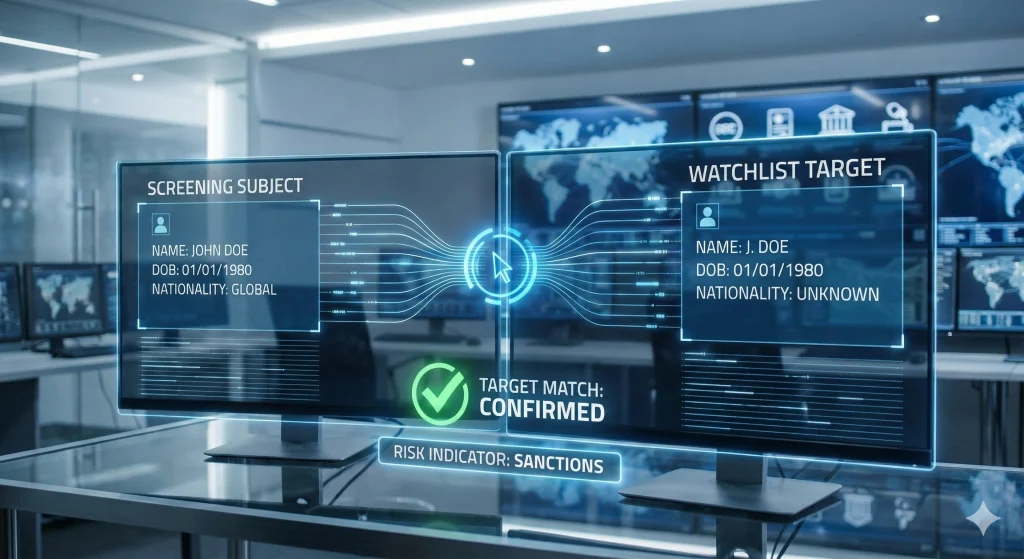
A target match in screening refers to a potential or confirmed alignment between a subject being screened (such as an individual, entity, vessel, or wallet address) and an entry on a reference list, including sanctions lists, watchlists, politically exposed persons (PEP) databases, adverse media repositories, or internal risk lists.
In AML/CFT frameworks, a target match represents a critical control event that requires evaluation, risk assessment, and, where applicable, escalation or regulatory action.
Target matches can range from low-confidence name similarities to high-confidence, exact matches confirmed through multiple identifiers.
The objective of screening systems is not merely to generate matches, but to accurately distinguish true positives from false positives while ensuring that genuine risks are not missed.
Explanation
Screening systems compare customer, counterparty, or transaction-related data against predefined target datasets.
A “target” refers to an individual or entity included on a list maintained by regulators, governments, law enforcement agencies, or commercial data providers.
A “match” occurs when screened attributes, such as name, date of birth, nationality, address, identification number, or other identifiers, align with attributes in the target record.
Target matches are inherently probabilistic rather than binary.
Variations in spelling, transliteration, aliases, incomplete data, or inconsistent formatting mean that screening engines often rely on fuzzy logic, scoring thresholds, and rule-based or machine-learning techniques.
As a result, screening generates alerts that must be reviewed and dispositioned by compliance teams.
Within AML/CFT programmes, target matching is a frontline preventive control. It is applied during customer onboarding (KYC/KYB), ongoing customer monitoring, payment and transaction screening, sanctions screening, and periodic reviews.
The effectiveness of this control depends on data quality, tuning of matching logic, governance processes, and analyst competence.
Target Matching in AML/CFT Frameworks
Target matching underpins several core AML/CFT obligations and regulatory expectations.
Its relevance spans multiple control domains:
- Sanctions compliance, where confirmed matches may require immediate blocking, rejection, or freezing of assets.
- PEP identification, where matches trigger enhanced due diligence rather than outright prohibition.
- Adverse media screening, where matches inform reputational and financial crime risk assessments.
- Counterparty and transaction screening, especially in cross-border payments and correspondent banking.
- Ongoing monitoring, where existing customers are re-screened as lists are updated.
Regulators expect institutions to apply a risk-based approach to target matching, ensuring that screening controls are proportionate to customer risk, product risk, geographic exposure, and transaction velocity.
Key Components of a Target Match Screening Process
Screening Data Inputs
Effective target matching depends on the breadth and quality of input data, including:
- Customer names, aliases, and former names.
- Dates of birth, incorporation dates, or registration numbers.
- Nationality, country of residence, or jurisdiction of incorporation.
- Addresses, identification documents, or tax identifiers.
- Transaction metadata such as payer, beneficiary, intermediary, or purpose codes.
Incomplete or poor-quality input data materially increases false positives and false negatives.
Target Lists and Data Sources
Target datasets typically include:
- National and supranational sanctions lists.
- Politically exposed persons databases.
- Law enforcement or regulatory watchlists.
- Adverse media and negative news sources.
- Internal blacklists or heightened-risk lists.
Institutions remain accountable for the appropriateness, coverage, and update frequency of the lists they use, even when relying on third-party vendors.
Matching Logic and Thresholds
Screening systems apply matching logic to compare inputs against targets. Common techniques include:
- Exact matching for identifiers such as passport numbers.
- Fuzzy name matching using phonetic, token-based, or distance algorithms.
- Weighted scoring models combining multiple attributes.
- Configurable thresholds to balance sensitivity and precision.
Threshold calibration is a governance decision and must reflect the institution’s risk appetite and regulatory expectations.
Types of Target Matches
Target matches are generally classified to guide response and escalation:
- False positives, where apparent similarity is coincidental, and risk is ruled out.
- Potential matches, where insufficient data exists to confirm or dismiss alignment.
- True matches, where identity or control is confirmed with high confidence.
- Exact or legal matches, typically involving unique identifiers or court-confirmed designations.
Clear classification standards are essential to ensure consistent decision-making and defensible audit trails.
Risks & Red Flags Associated With Target Matches
Target matching failures or weaknesses can expose institutions to significant AML/CFT risk.
Common risk indicators include:
- Repeated alerts involving the same customer due to poor data remediation.
- High volumes of false positives are overwhelming analyst capacity.
- Inability to obtain sufficient information to resolve potential matches.
- Matches involving high-risk jurisdictions, sectors, or typologies.
- Overrides or dismissals without a documented rationale.
Red flags are particularly acute in sanctions screening, where delays or errors can result in strict liability breaches.
Common Screening Challenges
Despite technological advances, target matching remains operationally complex.
Key challenges include:
- Name ambiguity and transliteration, especially across languages and scripts.
- Data fragmentation, when identifiers are spread across systems or jurisdictions.
- Alert fatigue, reducing analyst effectiveness, and increasing error risk.
- Latency issues, where real-time screening is required for payments or onboarding.
- Regulatory divergence, with differing expectations across jurisdictions.
Institutions must address these challenges through a combination of technology, process design, and skilled human review.
Examples of Target Match Scenarios
Sanctions Screening at Onboarding
An individual applicant’s name partially matches an entry on a sanctions list.
The system generates a medium-confidence alert due to name similarity and shared nationality.
Analysts review additional identifiers, confirm a different date of birth, and document the alert as a false positive.
Transaction Screening in Cross-Border Payments
A beneficiary bank name triggers a high-confidence match against a restricted entity.
The transaction is placed on hold, escalated to compliance, and ultimately rejected following confirmation of a true match.
PEP Identification During Periodic Review
An existing customer is re-screened following an updated PEP list.
A new match is identified linking the customer to a senior political role.
Enhanced due diligence is applied, and the customer’s risk rating is revised.
Adverse Media Match
A corporate customer name aligns with recent negative media coverage related to fraud investigations.
While not prohibited, the match prompts enhanced monitoring and management review.
Impact on Financial Institutions
Target matching directly affects institutional risk posture and compliance outcomes:
- Regulatory enforcement and penalties for missed or mishandled matches.
- Reputational damage from facilitating sanctioned or criminal activity.
- Operational inefficiencies driven by excessive alert volumes.
- Increased compliance costs related to investigations and remediation.
- Potential civil or criminal liability in severe cases.
Effective target matching is therefore both a compliance necessity and an operational priority.
Governance & Control Expectations
Regulators expect institutions to demonstrate strong governance over screening programmes, including:
- Documented screening policies and procedures.
- Clearly defined escalation and decision-making authority.
- Regular tuning, testing, and validation of matching algorithms.
- Independent model and rule reviews.
- Comprehensive audit trails for alert handling and outcomes.
- Ongoing training for analysts and reviewers.
Oversight should extend to third-party vendors and outsourced screening services.
Importance of Target Matching in AML/CFT Compliance
Target matching is a foundational control that enables institutions to prevent exposure to sanctioned parties, politically exposed persons, and known or suspected criminals.
When implemented effectively, it allows institutions to:
- Detect prohibited or high-risk relationships early.
- Apply proportionate controls such as enhanced due diligence or transaction blocking.
- Demonstrate regulatory compliance and defensible decision-making.
- Support intelligence-led AML/CFT programmes through accurate risk identification.
As financial crime typologies evolve and data volumes increase, institutions must continuously refine their target matching frameworks to maintain effectiveness, accuracy, and regulatory alignment.
Related Terms
- Sanctions Screening
- Politically Exposed Person (PEP)
- False Positive
- True Positive
- Customer Due Diligence (CDD)
- Transaction Screening
References
- Financial Action Task Force (FATF) – International Standards on Combating Money Laundering and the Financing of Terrorism & Proliferation
- Financial Action Task Force (FATF) – Guidance on Sanctions, Proliferation Financing and Screening
- Bank for International Settlements / Basel Committee – Sound management of risks related to money laundering and financing of terrorism
- Wolfsberg Group – Sanctions Screening Guidance
- UK Financial Conduct Authority – Financial Crime Guide: Screening and Matching Controls
- Office of Foreign Assets Control (OFAC) – Sanctions List Search and Compliance Guidance
Ready to Stay
Compliant—Without Slowing Down?
Move at crypto speed without losing sight of your regulatory obligations.
With IDYC360, you can scale securely, onboard instantly, and monitor risk in real time—without the friction.