

Proof of Address
Definition
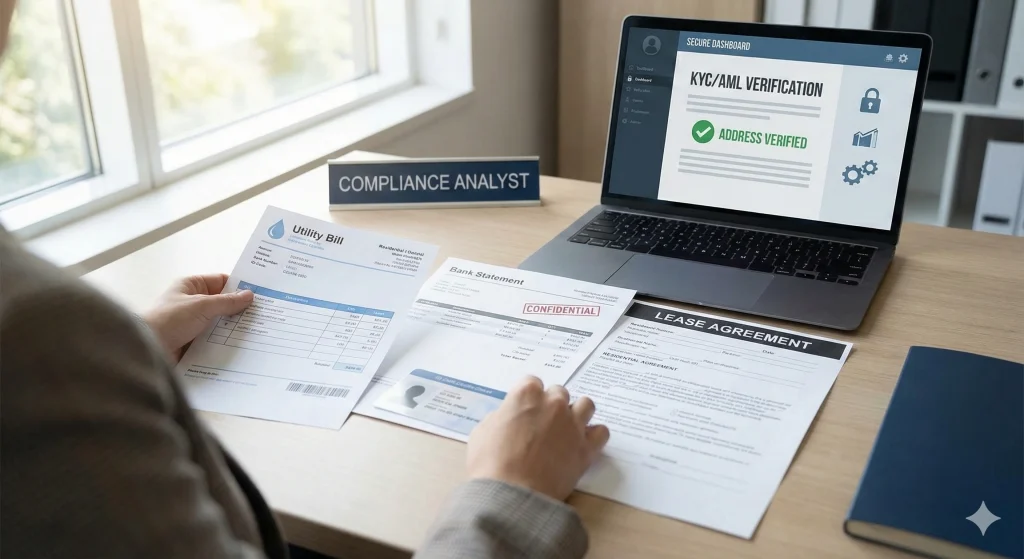
Proof of address refers to documentary or digital evidence that verifies a customer’s residential or business address as part of customer due diligence obligations.
It is a core AML/CFT requirement used to authenticate identity, assess geographic risk, and ensure that financial institutions maintain accurate and up-to-date customer information.
Accepted documents typically include government-issued records, utility bills, bank statements, tax documents, or verified digital address attestations.
Within AML/CFT frameworks, proof of address helps mitigate impersonation, fraud, account misuse, and cross-border laundering schemes.
It also enables institutions to segment customers by jurisdictional exposure and apply appropriate risk-based controls, including enhanced due diligence for high-risk locations.
Explanation
Proof of address serves as a secondary identity attribute that complements identity verification.
While identity documents confirm who a customer is, proof of address confirms where the customer is located and where regulatory responsibility may lie.
Geographic indicators are central to AML/CFT risk assessment, as certain jurisdictions have higher exposure to corruption, sanctions, tax evasion, terrorist financing, or weak regulatory oversight.
Institutions typically require recent documents (often not older than 90 days), original or digitally authenticated copies, and consistency with other identity information.
In digital onboarding environments, address verification may rely on trusted third-party databases, financial records, biometric-linked digital IDs, or utility-provider APIs.
The reliability of the address evidence directly influences the strength of the CDD profile and the institution’s confidence in the legitimacy of the customer.
Proof of Address in AML/CFT Frameworks
Proof of address requirements are embedded into global CDD obligations, particularly for onboarding individuals, beneficial owners, and legal entities.
In AML/CFT programs, documentation of address supports:
- Customer identification and verification under FATF Recommendation 10.
- Geographic risk classification relating to jurisdictional exposure.
- Screening alignment for sanctions, watchlists, and adverse media.
- Detection of identity discrepancies that may signal impersonation or fraud.
- Regulatory expectations for “sufficient understanding of customer profile.”
Institutions must have policies outlining what constitutes acceptable proof of address, how frequently it must be refreshed, and what alternative measures apply when a customer cannot provide standard documents.
Risk-based flexibility is permitted but must be justified and documented.
Key Components of Proof of Address
Commonly Accepted Documents
Institutions typically accept a variety of documents, such as:
- Government-issued documents like national ID records, driving licenses, residence certificates, or tax assessments.
- Utility bills for electricity, gas, water, or landline services.
- Bank statements, credit card statements, or mortgage statements.
- Property tax receipts or registered rental agreements.
- Employer-issued letters confirming residential address (in specific risk-based contexts).
- Digital address verification issued by trusted government or regulated platforms.
Digital Proof of Address Innovations
With digital onboarding and remote KYC accelerating, institutions employ:
- Electronic KYC (e-KYC) systems linked to government registries.
- Geolocation-based verification combined with digital identity credentials.
- Utility-provider integrations that verify address data in real time.
- Verified digital documents with QR-coded authenticity markers.
- Blockchain-backed attestations provided by regulated identity platforms.
Digital methods must remain compliant with local KYC regulations and ensure that data integrity, provenance, and authenticity are preserved.
Risks & Red Flags Related to Proof of Address
Proof of address misuse is a common precursor to identity fraud, mule account creation, and laundering schemes.
Key risks include:
- Use of forged or altered address documents.
- Multiple unrelated individuals using the same address, indicating synthetic or networked identities.
- Discrepancies between the stated address and other KYC information.
- Addresses located in high-risk jurisdictions associated with sanctions or weak AML controls.
- Use of temporary, non-verifiable, or unverifiable accommodation addresses.
- Customers who repeatedly change their address without clear rationale.
Potential red flags include:
- Inability or unwillingness to provide acceptable documents.
- Documents issued by unregulated or unknown entities.
- Documents showing signs of photo manipulation, mismatched fonts, or metadata inconsistencies (for digital files).
- Addresses traced to commercial mail-forwarding services or virtual offices without substantive presence.
Common Methods & Techniques for Misuse
Criminals may exploit address verification gaps through:
- Fraudulent documents, including forged utility bills or counterfeit tax notices.
- Third-party rented addresses, where criminals pay individuals to lend their postal address.
- Use of shell companies with virtual office addresses to obscure beneficial owners.
- Synthetic identities, combining genuine and fabricated address components.
- Layering via address mobility, using frequent address changes to destabilise monitoring and weaken the audit trail.
Such methods undermine the ability of institutions to maintain accurate customer profiles and assess jurisdiction-specific risk.
Examples of Proof of Address Scenarios
Retail Customer with Valid Residence Documentation
A new customer provides a recent electricity bill and a national ID, both showing the same address.
The bank validates the bill’s authenticity and completes onboarding with standard due diligence.
High-Risk Jurisdiction Address Disclosure
A corporate beneficial owner lists an address in a jurisdiction subject to FATF increased monitoring.
The institution applies enhanced due diligence, requiring additional verification, independent documentation, and ongoing monitoring.
Fintech Digital Verification Flow
A fintech platform integrates an e-KYC API that verifies customer addresses using government digital registries, utility-provider databases, and device geolocation signals.
The platform achieves rapid onboarding while maintaining AML/CFT compliance.
Suspicious Use of a Mail-Forwarding Address
Several unrelated customers submit the same commercial mailbox address.
The compliance team investigates further, identifies a fraud network, and files a suspicious transaction report.
Altered Utility Bill
A customer submits a utility bill PDF with metadata showing modification timestamps inconsistent with issuance.
The institution rejects the document and seeks additional evidence.
Impact on Financial Institutions
Insufficient address verification exposes institutions to:
- Increased fraud and impersonation risk.
- Regulatory penalties for inadequate CDD documentation.
- Compromised sanctions and adverse media screening accuracy.
- Reputational consequences following onboarding of bad actors.
- Operational inefficiencies through repeated remediation cycles.
- Potential misuse of bank accounts for laundering, terrorist financing, or mule activity.
Failure to maintain updated address records may weaken ongoing monitoring, obstruct effective investigations, or delay regulatory reporting.
Challenges in Verifying Proof of Address
Institutions face several systemic hurdles:
- Global inconsistencies in acceptable documents and verification standards.
- Lack of reliable documentation in regions with informal addressing systems.
- Difficulty authenticating digital or scanned documents without tamper-evident features.
- High false-positive rates when addresses match high-risk areas or multiple individuals.
- Limited interoperability across databases, registries, and identity platforms.
- Privacy and data protection restrictions that limit access to government records.
These challenges often necessitate supplementary verification measures, alternative documents, or a multi-layered verification approach.
Regulatory Oversight & Governance Expectations
Regulators mandate that financial institutions:
- Establish clear, risk-based policies defining acceptable address documents.
- Periodically review and refresh address documentation, especially for higher-risk customers.
- Verify authenticity, consistency, and recency of submitted documents.
- Use alternative verification measures where traditional documents are unavailable, while ensuring a sufficient assurance level.
- Maintain strong governance, including documentation, audit trails, and accountability for onboarding decisions.
- Ensure any reliance on third-party verification providers meets regulatory expectations for accuracy, security, and oversight.
Supervisory assessments often include testing of customer files for address verification completeness and authenticity.
Importance of Proof of Address in AML/CFT Compliance
Effective address verification strengthens the integrity of customer profiles and AML/CFT risk assessments.
It allows institutions to:
- Validate customer identity and jurisdictional exposure.
- Prevent anonymity-driven laundering, impersonation, and fraud schemes.
- Improve accuracy of sanctions screening and risk scoring.
- Support intelligence-led transaction monitoring by reinforcing customer baselines.
- Enhance cross-border compliance through clear geographic traceability.
- Meet regulatory expectations for strong CDD and ongoing monitoring.
Robust governance around proof of address contributes to a resilient AML/CFT programme capable of responding to evolving typologies, digital threats, and regulatory changes.
Related Terms
- Customer Due Diligence (CDD)
- Know Your Customer (KYC)
- Beneficial Ownership
- Identity Verification
- High-Risk Jurisdiction
- Address Verification Service (AVS)
References
- FATF Recommendation 10: Customer Due Diligence
- BIS: Sound Practices on Customer Due Diligence and Address Verification
- UK JMLSG Guidance, Customer Identification and Address Verification (Part I, Section 5)
- FinCEN: Identity and Address Verification Guidance for Financial Institutions
Ready to Stay
Compliant—Without Slowing Down?
Move at crypto speed without losing sight of your regulatory obligations.
With IDYC360, you can scale securely, onboard instantly, and monitor risk in real time—without the friction.