

Phishing
Definition
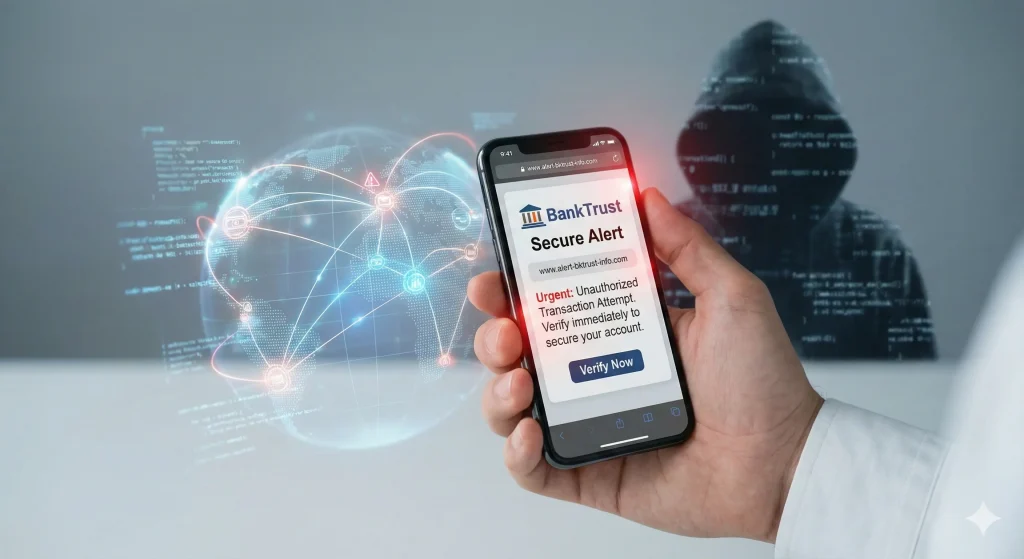
Phishing is a fraudulent technique in which attackers impersonate trusted entities to deceive individuals or organisations into revealing sensitive information, installing malware, or authorising illegitimate financial transactions.
In AML/CFT environments, phishing represents a critical predicate enabler for account takeover, identity theft, mule recruitment, payment fraud, and the laundering of illicit proceeds through compromised accounts.
Phishing exploits social engineering, psychological manipulation, and digital impersonation.
Threat actors use emails, SMS (smishing), voice calls (vishing), instant messaging platforms, counterfeit websites, and spoofed digital identities to elicit confidential data or induce harmful actions.
Because phishing frequently leads to unauthorised financial activity, regulatory frameworks treat it as a serious financial crime risk and a major operational threat to financial institutions.
Explanation
At its core, phishing relies on misrepresentation: criminals craft messages or interfaces that appear legitimate, often mimicking banks, payment providers, government agencies, fintech platforms, or trusted partners.
These attacks persuade victims to disclose login credentials, OTPs, card numbers, personal identifiers, or authorise fraudulent transactions.
Modern phishing has evolved beyond basic email scams. Attackers now deploy:
- Highly personalised spear-phishing campaigns targeting specific employees or high-value individuals.
- Business email compromise (BEC) to redirect payments or modify vendor banking information.
- Malware-laced attachments or links that install remote-access tools.
- Synthetic or deepfake voice messages that impersonate executives.
- Phishing kits, available on the dark web, enabling scalable campaigns.
The ultimate objective varies, credential theft, data extraction, fund diversion, mule recruitment, identity takeover, or ransomware deployment.
In AML/CFT ecosystems, phishing is especially dangerous because compromised accounts can be used as conduits for laundering proceeds, layering transactions, or facilitating fraud at scale.
Phishing in AML/CFT Frameworks
Phishing intersects with AML/CFT compliance obligations across several axes:
- Account takeover from phishing can lead directly to unauthorised transfers, cross-border payments, and mule activity that mimic legitimate customer behaviour.
- Fraud proceeds generated through phishing are often rapidly laundered through digital channels using micro-transactions, prepaid instruments, or virtual assets.
- Institutions must identify anomalous behaviour post-compromise, such as deviations from customer profiles, sudden login pattern changes, or unusual transfer requests.
- Suspicious transaction reporting (STR/SAR) obligations arise when institutions detect that phishing-related compromise is being used to facilitate illicit flows.
- FATF guidance on fraud, cyber-enabled financial crime, and emerging risks emphasises transparency, beneficial ownership clarity, and strong controls on digital onboarding and remote access.
From a correspondent banking perspective, phishing-driven mule networks may exploit weak AML programmes in smaller institutions, creating cross-jurisdictional exposure.
Key Components of Phishing Attacks
Common Phishing Vectors
- Email phishing using spoofed sender addresses, fake domains, or malicious links.
- Smishing (SMS phishing) delivering harmful links or fraudulent OTP requests.
- Vishing (voice phishing) via social engineering calls impersonating institutions.
- Clone phishing where legitimate communications are duplicated with malicious edits.
- Spear phishing targeting specific individuals such as CFOs or compliance officers.
- Business Email Compromise (BEC) modifying payment instructions or vendor details.
- Social media phishing using fake profiles or impersonated corporate accounts.
Attack Mechanics
Phishing attacks often follow a structured sequence:
- Creation of a deceptive message or interface.
- Emotional triggers such as urgency, fear, reward, or authority.
- Victim engagement via link, form, call, or download.
- Credential harvesting or malware installation.
- Exploitation: unauthorised transactions, data theft, further compromise.
Risks & Red Flags
Phishing creates both direct operational risk and downstream AML/CFT risk. Key indicators include:
- Sudden changes in customer login behaviour or device fingerprints.
- Login attempts from unusual geolocations following a phishing event.
- Multiple failed authentication attempts preceding success.
- Rapid transfers to new beneficiaries immediately after credential compromise.
- Customers reporting receiving suspicious emails, calls, or OTP requests.
- Internal staff receiving targeted emails requesting payment instruction changes.
- Unusual vendor modification requests, especially under urgency or secrecy.
Institutions must monitor for patterns that signal mule activity stemming from phishing, including high-velocity small-value transfers, sudden balance depletion, or transactional flows inconsistent with customer history.
Common Methods & Techniques for Misuse
Cybercriminals exploit phishing for financial crime in several ways:
- Credential theft for account takeover, enabling unauthorised transfers or card fraud.
- Mule recruitment by sending job-offer phishing messages that lure individuals into permitting use of their accounts.
- Identity theft that supports fraudulent onboarding, synthetic identities, or shell entities.
- Access to corporate systems leading to manipulated invoices, diverted payments, or insider impersonation.
- Compromise of AML-relevant data, such as KYC records, which enables further fraud.
- Phishing-as-a-service models that industrialise and anonymise attack execution.
Examples of Phishing Scenarios
Credential Harvesting Leading to Mule Flows
A victim enters online banking credentials into a spoofed login page.
Criminals immediately access the account, initiate multiple small-value cross-border transfers, and use a network of mule accounts to layer proceeds through several institutions.
BEC-Driven Vendor Payment Fraud
Attackers compromise a supplier’s email account and send new banking instructions to a corporate customer.
Payments are routed to a mule-controlled account, rapidly withdrawn, and layered through cash deposits and virtual asset conversions.
Fintech App OTP Phishing
Threat actors impersonate a payment platform and request OTP verification.
Once obtained, they link the victim’s account to a fraudulent device and process high-velocity peer-to-peer transfers.
Phishing-Led Remote Access Fraud
Victims are deceived into installing remote-access tools.
Criminals subsequently navigate online banking sessions, initiate transfers, and obscure activity through screen blanking or process injection.
Regulator Impersonation Scam
Attackers pose as law enforcement or AML regulators, claiming that the victim must verify identity or provide documents.
Stolen data is later used to open accounts for laundering illicit proceeds.
Impact on Financial Institutions
Phishing incidents produce multilayered consequences for institutions:
- Direct financial loss due to unauthorised transactions, reimbursement obligations, and fraud write-offs.
- Elevated STR/SAR filings linked to phishing-driven mule activity.
- Reputational damage stemming from perceived weak cybersecurity or inadequate customer protection.
- Increased operational workload for investigations, customer outreach, forensics, and recovery.
- Heightened regulatory scrutiny for failing to detect or mitigate phishing-enabled account takeover.
- Broader ecosystem exposure if compromised accounts are used to launder proceeds across institutions.
Challenges in Detecting & Preventing Phishing-Related Abuse
AML/CFT teams face significant barriers, including:
- High sophistication of phishing attacks, including domain spoofing and AI-enhanced impersonation.
- Difficulty distinguishing legitimate customer behaviour from attacker-controlled sessions.
- Cross-border mule networks that quickly dissipate stolen funds.
- Data-sharing limitations that slow identification of multi-institution attack campaigns.
- Fragmented visibility where fraud teams detect phishing indicators but AML teams see only transactional anomalies.
- High transaction velocity in digital payments, reducing intervention windows.
Integrated fraud–AML intelligence, device telemetry, behavioural analytics, and early-warning systems are increasingly essential.
Regulatory Oversight & Governance Expectations
Supervisors expect financial institutions to implement robust anti-phishing controls, including:
- Strong authentication measures (MFA, behavioural biometrics, device binding).
- Real-time fraud detection frameworks integrated with AML monitoring.
- Customer education programmes addressing phishing risks.
- Incident response protocols and reporting mechanisms for cyber-enabled fraud.
- Supply-chain safeguards to mitigate BEC risk.
- Adherence to FATF guidance on digital identity, cybersecurity controls, and fraud-related predicate offences.
- Governance structures ensuring fraud, cybersecurity, and AML teams collaborate effectively.
Regulators increasingly treat phishing not merely as a cybersecurity concern but as a direct enabler of financial crime.
Importance of Addressing Phishing in AML/CFT Compliance
Addressing phishing risk strengthens institutional resilience by enabling:
- Early detection of compromised accounts before illicit flows occur.
- Prevention of mule activity and fraud-driven layering schemes.
- Compliance with regulatory expectations on cyber-enabled crime.
- Protection of customer trust and reduction of operational losses.
- Enhanced intelligence-led AML programmes that integrate fraud indicators, behavioural analytics, and cross-channel surveillance.
As phishing continues to evolve through AI-enhanced impersonation, deepfake content, and large-scale automation, institutions must adopt adaptive, cross-functional models that unify fraud, cybersecurity, and AML/CFT capabilities.
Related Terms
- Account Takeover
- Business Email Compromise (BEC)
- Mule Account
- Social Engineering
- Identity Theft
- Predicate Offence
References
All links validated and direct to the source.
- Anti-Phishing Working Group (APWG): Phishing Activity Trends Report
- FATF: Cyber-enabled Fraud and AML/CFT Risks
- Europol: Internet Organised Crime Threat Assessment (IOCTA)
- US Cybersecurity and Infrastructure Security Agency (CISA): Phishing Guidance
- UK National Cyber Security Centre (NCSC): Phishing Attacks Guidance
Ready to Stay
Compliant—Without Slowing Down?
Move at crypto speed without losing sight of your regulatory obligations.
With IDYC360, you can scale securely, onboard instantly, and monitor risk in real time—without the friction.

