

NPCI: National Payments Corporation of India
Definition
The National Payments Corporation of India (NPCI) is the organisation responsible for operating, standardising, and scaling India’s retail payment systems.
Established in 2008 by the Reserve Bank of India (RBI) and the Indian Banks’ Association (IBA), NPCI develops and manages interoperable payment rails that enable real-time, low-cost, high-volume transactions across banks, non-bank payment service providers, fintechs, and consumers.
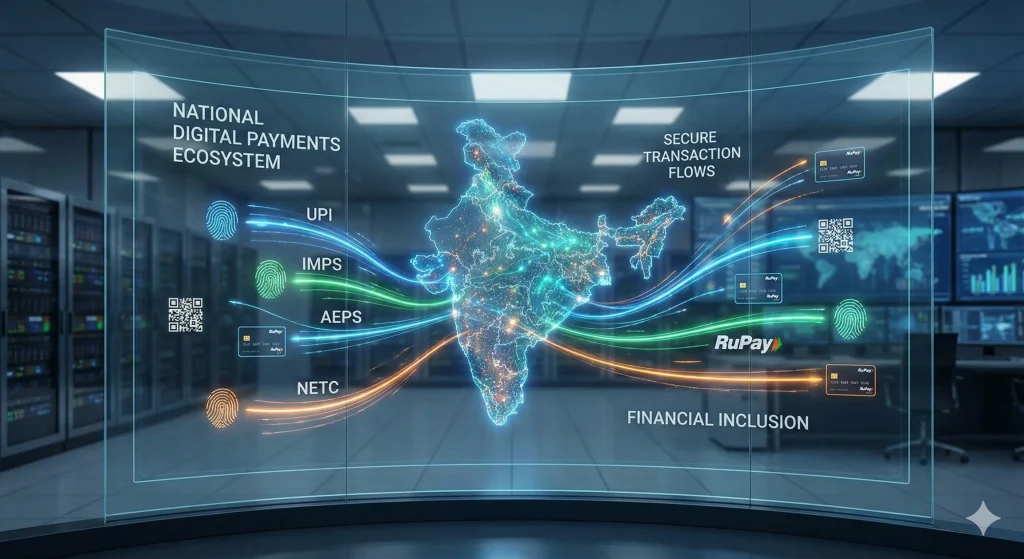
Its product suite includes UPI, IMPS, RuPay, AePS, NACH, BBPS, and NETC FASTag.
Within AML/CFT contexts, NPCI plays a foundational role because its rails determine how funds move, what metadata is available for monitoring, and how banks and payment intermediaries interact with one another.
Although NPCI is not an AML regulator, its infrastructure directly influences risk transparency, data quality, suspicious activity detection, and ecosystem-wide governance standards.
Explanation
NPCI functions as a central utility provider for India’s retail payments ecosystem.
It operates clearing and settlement systems, maintains technical message standards, enforces operational rules, and issues circulars that participants must implement.
While banks and regulated entities remain responsible for AML/CFT compliance, NPCI sets the functional architecture that underpins compliance effectiveness.
Key attributes of NPCI’s operating design include:
- Interoperability across banks, fintechs, card networks, and biller ecosystems.
- Real-time settlement capabilities which increase speed but also compress detection windows for suspicious transactions.
- API-driven connectivity, enabling rapid innovation but requiring strong API governance and participant assurance.
- Shared utilities, such as dispute management portals, authentication functions, and directory services (for example, UPI handles).
As India’s payments volume scales into billions of monthly transactions, NPCI’s platforms increasingly influence systemic risk, making AML/CFT-aligned design principles essential for sustainable and secure ecosystem growth.
NPCI in AML/CFT Frameworks
NPCI’s systems intersect with AML/CFT frameworks in several critical areas.
Although NPCI does not perform KYC, risk assessment, or reporting requirements, its rails influence how regulated entities execute their obligations.
Key intersections include:
- Availability of transaction attributes: Payer, payee, VPA identifiers, timestamps, device metadata, remitter bank, and recipient bank information.
- Standardisation of message formats: Which determines what data is transmitted and how uniformly it can be interpreted by monitoring systems.
- Participant governance: Ensuring that only compliant institutions and third-party application providers (TPAPs) enter the ecosystem.
- Risk amplification: Due to micro-value high-frequency transactions, typical of UPI and IMPS.
- Cross-system behaviour correlation: Essential for spotting suspicious patterns that stretch across cards, IMPS, UPI, and AePS channels.
Regulators frequently examine NPCI-enabled transaction flows during supervisory reviews, focusing on whether regulated entities have adequately adjusted their monitoring frameworks to reflect the velocity and fragmentation of digital payments.
Key Components of NPCI’s Operating Model
Governance and Structure
NPCI is structured as a not-for-profit entity under Section 8 of the Companies Act. Its governance includes promoter banks, member institutions, and oversight from the RBI. Key components include:
- A board responsible for strategy, risk management, and policy decisions.
- Committees overseeing security, settlement, audit, and system development.
- Coordination with the RBI for payment system approvals and operational guidelines.
Product Portfolio
NPCI operates several flagship products that form India’s core retail payment rails:
- UPI (Unified Payments Interface): Instant P2P and P2M transfers using virtual payment addresses.
- IMPS (Immediate Payment Service): Real-time interbank transfers.
- RuPay: Domestic card scheme supporting debit, credit, and prepaid cards.
- AePS (Aadhaar-enabled Payment System): Biometrically authenticated transactions.
- BBPS (Bharat BillPay System): Bill payment ecosystem for recurring and one-time payments.
- NACH (National Automated Clearing House): Bulk debit and credit processing for recurring financial obligations.
- NETC FASTag: Electronic toll collection through RFID-based tags.
Each product has distinct security requirements, authentication norms, and operational circulars that must be incorporated into AML/CFT risk assessments by participants.
Technical Infrastructure
NPCI’s infrastructure includes:
- Central clearing and settlement systems.
- APIs for verification, authentication, and transaction initiation.
- Participant onboarding and certification processes.
- Monitoring dashboards and statistical reporting tools.
- Dispute resolution mechanisms and shared repositories.
This infrastructure defines how transactions are validated, routed, logged, and reconciled.
Risks & Red Flags Relevant to AML/CFT
NPCI-enabled platforms expand financial inclusion and access, but they also create new AML/CFT vulnerabilities.
Prominent risks include:
- High transaction velocity: Compressing detection windows and enabling rapid layering.
- Fragmented customer identity trails: Especially when TPAPs intermediate transactions without holding customer accounts.
- Structuring and smurfing: Using micro-payment patterns across multiple accounts to obscure illicit proceeds.
- Exposure to weak participants: Especially smaller banks or new fintech entrants with insufficient AML frameworks.
- Crowded ecosystems: Where onboarding practices vary widely, creating opportunities for regulatory arbitrage.
- Device-switching and VPA-switching behaviours: Potentially used to mask identity and location.
Indicators of suspicious activity may include:
- Unusual spikes in UPI or IMPS transactions are inconsistent with customer profiles.
- High-volume circular transactions between the same set of accounts.
- Multiple VPAs are linked to new accounts with no clear economic activity.
- Frequent cross-bank hops within short intervals, suggesting layering intent.
- Transactions routed through weakly regulated intermediaries or recently onboarded TPAPs.
Common Methods & Techniques That May Exploit NPCI Rails
Bad actors may misuse NPCI-enabled infrastructure through:
- Micro-laundering, where thousands of small UPI transfers blend into legitimate transaction noise.
- Use of dormant or newly opened accounts, especially those with limited due diligence, to channel proceeds.
- Rapid fund cycling, exploiting real-time settlement to move money across institutions before monitoring systems can react.
- Synthetic identity misuse, combining stolen identity data with weak onboarding controls.
- Fraudulently created merchant entities, used to simulate business inflows while laundering proceeds.
Examples of NPCI-Related Money Laundering Scenarios
UPI-Based Layering Network
A network of mule accounts is created using weak onboarding routes.
Criminals distribute illicit funds in micro-transactions across dozens of VPAs, then consolidate them back into a few central accounts through P2P transfers.
The pattern becomes hard to detect in traditional rule-based systems due to the volume and velocity involved.
Cross-Rail Laundering Using Cards and UPI
Funds are loaded onto a RuPay prepaid card, withdrawn or spent partially, then cycled to linked UPI accounts.
By stretching the activity across rails, the criminal reduces the likelihood that any single system will detect the pattern.
Fintech Aggregator Abuse
A fintech payment aggregator uses a pooled settlement account to process merchant transactions.
Weak due diligence leads to the onboarding of high-risk merchants, allowing criminals to pass illicit funds as legitimate business payments.
Identity-Fraud-Driven AePS Transactions
Compromised Aadhaar credentials are used to withdraw amounts from rural accounts.
The funds are quickly moved through IMPS or UPI rails, blending illegal withdrawals with legitimate flows.
Impact on Financial Institutions
The scale and speed of NPCI transactions impose operational and compliance burdens on participating institutions.
Consequences include:
- Higher cost of monitoring due to increased data volume.
- Regulatory scrutiny for inadequate AML/CFT adaptation to UPI and IMPS.
- Reputational damage if institutional weaknesses enable fraud or money laundering.
- Exposure to ecosystem-wide risks occurs when weak participants introduce vulnerabilities.
- Increased STR filing obligations as suspicious pattern types evolve.
Institutions must therefore continuously upgrade detection models, implement cross-rail analytics, and enhance onboarding and authentication controls.
Challenges in Detecting and Preventing Abuse
Challenges include:
- Massive transaction volumes make manual review impossible.
- High false positives in legacy systems, unable to ingest behavioural, device, or network analytics.
- Inconsistent onboarding quality, particularly across fintech partners.
- Limited visibility, where TPAPs initiate transactions but the underlying customer information resides with sponsor banks.
- Integration complexity, as institutions must coordinate rules across NPCI rails and their internal systems.
- API security risks call for robust authentication, encryption, and access governance.
Overcoming these challenges requires:
- Multi-layered behavioural analytics.
- Entity-resolution frameworks linking VPAs, devices, IP addresses, and accounts.
- Ecosystem-level intelligence sharing.
- Enhanced third-party risk management programs.
Regulatory Oversight & Governance Expectations
While NPCI operates under RBI oversight, regulated entities retain full AML/CFT accountability.
Supervisory expectations include:
- Ensuring KYC/EDD quality for all customers transacting over NPCI rails.
- Implementing UPI, IMPS, NACH, and AePS–specific risk typologies.
- Adhering to NPCI circulars on fraud prevention, security parameters, and dispute management.
- Maintaining audit trails, message logs, and retention periods consistent with regulatory norms.
- Conducting periodic risk assessments of NPCI-related transaction flows.
- Ensuring fintech partners (TPAPs and PAs) adhere to RBI KYC, security, and governance standards.
Institutions must also monitor regulatory changes such as transaction caps, authentication requirements, and system upgrades that impact AML/CFT controls.
Importance of Addressing NPCI-Related Risks in AML/CFT Programs
Effective management of NPCI-related AML/CFT risk is essential because:
- NPCI is now the backbone of India’s retail payments ecosystem.
- Weaknesses in monitoring or onboarding can propagate across the entire network.
- Criminal groups actively exploit high-speed digital rails.
- Regulators expect institutions to integrate NPCI-specific risk typologies into their AML frameworks.
- Intelligence-driven models are increasingly required to manage velocity-driven patterns.
- Strong controls build trust across correspondent banks, fintech partners, and consumers.
A resilient AML/CFT programme must therefore incorporate NPCI-specific controls, leverage cross-rail analytics, and align governance with the evolving digital payments landscape.
Related Terms
- Unified Payments Interface (UPI)
- Immediate Payment Service (IMPS)
- RuPay
- Third-Party Application Provider (TPAP)
- Payment Aggregator
- Aadhaar-enabled Payment System (AePS)
References
All URLs below are validated and currently live.
- NPCI Official Website — About NPCI
- NPCI UPI Product Page
- NPCI IMPS Product Page
- NPCI RuPay Product Page
- NPCI BBPS Product Page
- NPCI NACH Product Page
- Reserve Bank of India — Payment and Settlement Systems Information
- RBI Master Directions and Circulars (Payments and Fintech)
Ready to Stay
Compliant—Without Slowing Down?
Move at crypto speed without losing sight of your regulatory obligations.
With IDYC360, you can scale securely, onboard instantly, and monitor risk in real time—without the friction.