

MVTS: Money Value Transfer Services
Definition
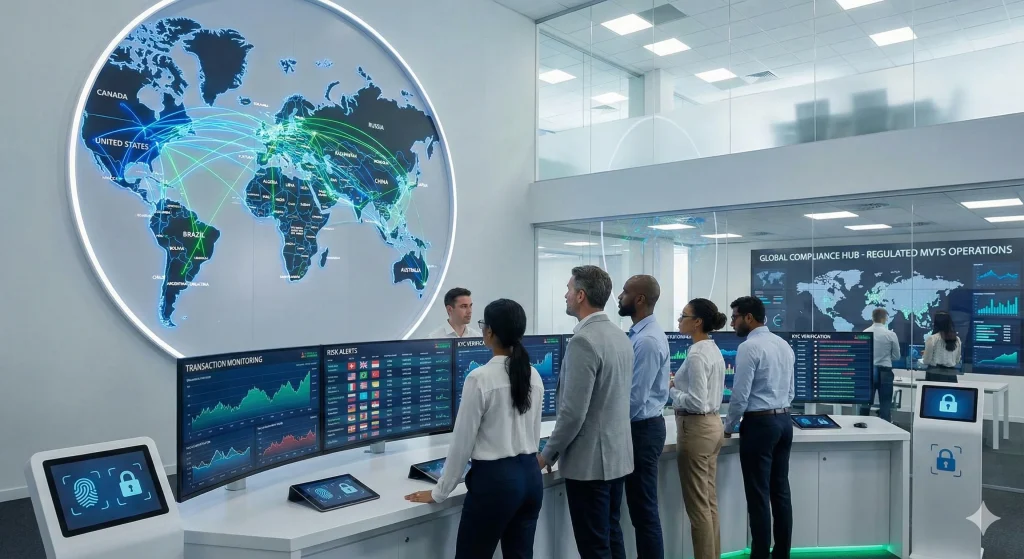
Money Value Transfer Services (MVTS) refer to businesses or mechanisms that transfer monetary value domestically or across borders without necessarily moving physical currency or relying on traditional bank-based infrastructure.
These services include formal providers such as licensed remittance companies, payment institutions, and fintech money transfer operators, as well as informal networks such as hawala, hundi, fei-chien, and other value-transfer arrangements.
MVTS play a significant role in enabling financial inclusion and supporting migrant remittances.
However, in AML/CFT frameworks, they present elevated risks due to speed, cross-border reach, customer anonymity vulnerabilities, and regulatory unevenness across jurisdictions.
In AML/CFT regulation, MVTS providers are designated as reporting entities required to comply with customer due diligence, record-keeping, transaction monitoring, suspicious transaction reporting, sanctions compliance, and local licensing obligations.
Their risk exposure is magnified when servicing high-risk corridors, operating through agents, or facilitating large volumes of small-ticket transfers that can conceal illicit flows.
Explanation
MVTS operates by accepting monetary value from a sender and ensuring equivalent value is delivered to a beneficiary, either in cash, bank credit, mobile wallet credit, or other convertible instruments.
The underlying settlement between sending and receiving agents may involve netting, cash balancing, trade transactions, or the movement of digital value, depending on whether the network is formal or informal.
Key operational elements include:
- Collection of funds: From customers through cash, bank transfers, payment cards, or digital channels.
- Messaging networks: Used to communicate and transfer details between sending and receiving parties.
- Settlement mechanisms: Which may be regulated (central bank-supervised) or unregulated (informal balancing).
- Agent and sub-agent networks: That extend geographic reach and enable last-mile delivery.
The regulatory concern arises when MVTS providers fail to properly identify customers, rely on loosely controlled agent networks, or operate across jurisdictions with weak AML/CFT enforcement.
Informal systems like hawala may be used for legitimate cultural and commercial purposes, but they are also exploited to move illicit proceeds, disguise beneficial ownership, or bypass sanctions restrictions.
MVTS in AML/CFT Frameworks
MVTS intersect with AML/CFT controls at multiple points, making them a focal category for regulators and financial intelligence units.
Key intersections include:
- Customer due diligence and KYC: Requirements for both walk-in and digital onboarding.
- Transaction monitoring: To detect unusual patterns such as smurfing, rapid pass-through flows, or transactions involving conflict zones.
- Agent network oversight: Where compliance expectations extend to third-party partners representing the MVTS provider.
- Sanctions screening: Given that MVTS channels are frequently targeted by sanctioned entities seeking alternative value-transfer routes.
- Reporting obligations: Including suspicious transaction reports (STRs) and cross-border wire reporting where applicable.
- Licensing and supervision: As regulators mandate transparency, governance, and record-keeping across MVTS ecosystems.
Regulators assess MVTS entities for system adequacy, risk classification, operational resilience, and adherence to national AML guidelines.
Weaknesses in these domains often lead to penalties, de-risking, or termination of correspondent accounts used for settlement.
Key Components of MVTS
Victimisation and Predicate Crimes
MVTS channels can be abused to obscure proceeds from:
- Fraud, cybercrime, or online scams.
- Drug trafficking or organised crime networks.
- Human trafficking, migrant smuggling, and illicit trade.
- Tax evasion and underground economy activities.
- Corruption, bribery, or embezzlement schemes.
These predicate crimes exploit the rapid, border-agnostic nature of MVTS networks to move funds discreetly and rapidly.
MVTS Operational Model
Typical MVTS operations include:
- A sender submitting funds at an MVTS outlet or digital platform.
- An agent or operator transmitting transaction details via proprietary or informal messaging systems.
- A receiver collects equivalent funds at the destination, often based on a code, identity verification, or local customs.
- Settlement occurs later between the sending and receiving entities, either via bank transfers, trade balancing, or physical cash movements.
Formal vs. Informal MVTS
- Formal MVTS: Are licensed, technologically enabled, regulated remittance and payment service providers.
- Informal MVTS: Operate outside supervisory frameworks, often relying on cultural networks and trust-based arrangements, which makes them vulnerable to misuse.
Common Methods & Techniques
Criminals exploit MVTS for illicit transfers using several techniques:
- Smurfing or structuring small repeat transfers to avoid reporting thresholds.
- Use of third-party senders or receivers, including proxy identities.
- Layering via multiple MVTS providers, moving value across regions in quick succession.
- Use of informal networks such as hawala to obscure origin and beneficial ownership.
- Crypto-to-fiat or fiat-to-crypto conversions are integrated into MVTS-like flows.
- Use of high-risk agents or sub-agents, including remote, lightly supervised outlets.
These methods help criminals disguise transaction purposes, break audit trails, and exploit regulatory asymmetries between jurisdictions.
Risk Indicators and Red Flags
Red flags commonly associated with MVTS include:
- Frequent remittances just below reporting thresholds.
- Multiple customers using the same sender or beneficiary details.
- Rapid movement of value through different agents or MVTS providers.
- Transfers involving high-risk or sanctioned jurisdictions.
- Beneficiaries collecting funds in multiple locations within short timeframes.
- MVTS agents exhibiting unusually high transaction volumes are inconsistent with their profile.
- Customers are reluctant to provide identification or use inconsistent documents.
- Use of cash-intensive agents in regions where legitimate remittance demand is low.
Examples of MVTS Misuse Scenarios
Hawala-Based Laundering
A criminal organisation uses hawala brokers to move illicit proceeds from Country A to Country B.
The transfer is completed within hours with no physical funds crossing borders, and no regulatory record is generated. Settlement may occur via trade mis-invoicing or value exchange between brokers.
Cybercrime Proceeds via Digital MVTS
Fraudsters transferring stolen e-commerce proceeds route them through multiple digital MVTS wallets before cashing out in a low-regulation market, layering and integrating the funds.
Agent Network Abuse
A sub-agent operating in a remote region processes unusually high incoming remittances.
Investigations reveal that the agent is part of a mule network receiving structured deposits from criminal groups.
Cross-Border Structuring
Criminals break large illicit sums into hundreds of small MVTS transactions originating in different cities, all converging to a single offshore beneficiary disguised as a small business.
Impact on Financial Institutions and MVTS Providers
The misuse of MVTS exposes institutions and operators to significant consequences:
- Regulatory sanctions, including penalties, licence suspension, or restrictions on corridor operations.
- Reputational damage, affecting customer confidence and correspondent relationships.
- Operational burden, stemming from compliance monitoring, audits, and enhanced due diligence.
- De-risking by banks, where settlement accounts are terminated due to perceived MVTS vulnerabilities.
- Forensic and legal exposure, including asset freezing or seizure where illicit flows are detected.
MVTS providers often face heightened scrutiny due to their financial inclusion role and geographical spread, making robust governance essential.
Challenges in Detecting & Preventing MVTS-Related Laundering
Institutions struggle to mitigate MVTS risks due to:
- High transaction volumes and velocity obscure illicit patterns.
- Cross-border fragmentation in licensing and AML requirements.
- Informal agents operating beyond supervisory visibility.
- Technological innovations enabling anonymous or pseudonymous transfers.
- Data quality gaps or limited access to beneficiary-side information.
- Criminal exploitation of high-risk humanitarian corridors under the guise of remittances.
Balancing financial inclusion with robust AML/CFT controls remains an ongoing challenge.
Regulatory Oversight and Governance
MVTS oversight includes:
- FATF Recommendations: Particularly those on money or value transfer services and wire transfer transparency.
- National licensing frameworks: Requiring registration, fit-and-proper checks, agent due diligence, and audit mandates.
- Financial intelligence units (FIUs): Monitoring STRs and typology trends.
- Central bank supervision: Enforcing capital adequacy, safeguarding of customer funds, and AML programme standards.
- Internal governance: Including board accountability, compliance functions, agent training, AML system testing, and continuous improvement.
Strong governance mitigates reputational and regulatory exposure while enabling safe financial inclusion.
Importance of Addressing MVTS Risks in AML/CFT Compliance
Effective management of MVTS risks enables institutions and regulators to:
- Protect financial systems from criminal misuse and cross-border illicit flows.
- Maintain integrity and trust in remittance markets.
- Comply with FATF standards and jurisdictional AML/CFT laws.
- Safeguard correspondent banking access and settlement channels.
- Promote intelligence-led AML strategies that incorporate MVTS typologies, pattern analytics, and behavioural indicators.
MVTS will continue evolving alongside digital payments, fintech innovation, and global migration trends.
Institutions must adapt through risk-based, data-driven AML programmes capable of addressing both formal and informal MVTS ecosystems.
Related Terms
- MVTS Agent
- Hawala
- Remittance Service Provider (RSP)
- Structuring
- Cross-Border Payment
- Trade-Based Money Laundering (TBML)
- Sanctions Screening
- Correspondent Banking
References
- Three Stages of Money Laundering – Complete eBook
- AML & CFT in Banking – Executive Summary (BIS / FSI)
- United States Money Laundering Prevention Guide (FinCEN)
- FATF Recommendation 14: Money or Value Transfer Services
Ready to Stay
Compliant—Without Slowing Down?
Move at crypto speed without losing sight of your regulatory obligations.
With IDYC360, you can scale securely, onboard instantly, and monitor risk in real time—without the friction.

