

Mutual Legal Assistance Treaty
Definition
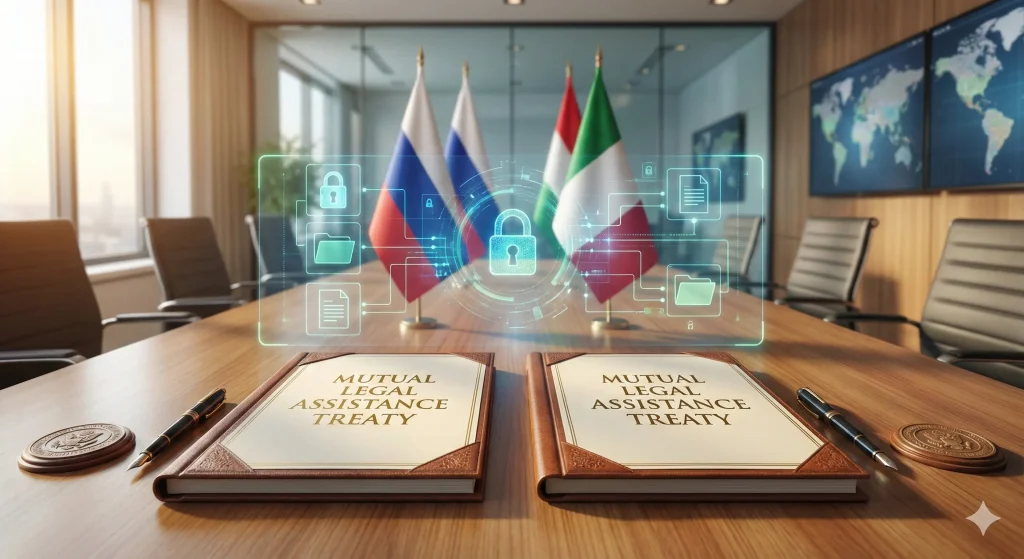
A Mutual Legal Assistance Treaty (MLAT) is a formal bilateral or multilateral agreement between sovereign states to facilitate cooperation in criminal investigations and prosecutions by enabling the exchange of information, evidence, and enforcement assistance.
These treaties establish legal frameworks through which a requesting state can ask a requested state to provide assistance, such as obtaining documents, executing searches, serving judicial notices, or transferring witnesses or suspects, in support of a criminal matter.
In the context of AML/CFT, MLATs play a crucial role in enabling cross-border cooperation to trace proceeds of crime, execute confiscation orders, freeze illicit funds, and coordinate investigations of financial crime across jurisdictions.
Explanation
MLATs have been developed to overcome the limitations of letters rogatory and informal cooperation channels by creating binding obligations for states to respond to assistance requests in a standardised manner.
They often designate a “Central Authority” in each signatory state responsible for receiving and transmitting requests.
For example, in one jurisdiction, the Ministry of Home Affairs serves as the nodal authority for MLAT requests.
These treaties specify key components such as the scope of assistance, applicable criminal offences, dual-criminality requirements (if any), confidentiality provisions, grounds for refusal (such as national security or human rights), and procedural rules for execution of requests.
They may cover activities such as obtaining testimony, serving judicial documents, tracing and confiscating assets, and executing searches abroad.
In practice, MLATs enhance AML/CFT efforts by enabling law enforcement and financial intelligence units to access overseas evidence, partner with foreign agencies, freeze assets located abroad, and follow funds across borders.
Without such cooperative frameworks, investigations may stall when evidence or funds are located outside the domestic jurisdiction.
How MLATs Operate in AML/CFT Frameworks
MLATs intersect with AML/CFT frameworks in multiple ways:
- Facilitate asset-tracing and freezing in foreign jurisdictions after detecting suspicious activity or STRs.
- Allow coordination between FIUs and law enforcement across borders when illicit funds or proceeds are moved internationally.
- Support the implementation of confiscation and recovery regimes globally by providing access to overseas evidence or property.
- Provide legal channels for cooperation where informal cooperation or ad-hoc requests may be insufficient or too slow.
Financial institutions indirectly benefit from MLAT regimes because when authorities have reliable cooperative frameworks, enforcement becomes more effective and deterrence stronger.
AML/CFT teams should therefore factor the existence and maturity of MLAT frameworks into country risk assessments and cooperation risk considerations.
Key Components of MLAT Frameworks
Central Authority and Transmission
- Each State Parties appoint a Central Authority tasked with receiving incoming requests and transmitting outgoing ones.
- The Central Authority handles formal documentation, verifies compliance with treaty requirements, and ensures liaison with judicial or law enforcement bodies.
Scope and Covered Assistance
- Treaties define the types of assistance covered: Obtaining testimony, documents, service of judicial process, transfer of detained persons or evidence, asset freezing or confiscation assistance.
- Some MLATs extend to civil, administrative, or regulatory matters; others are limited to criminal matters only.
Grounds for Refusal
- Assistance may be refused under certain conditions, such as if the request relates to political offences, discrimination, risk of torture or death penalty, or if domestic law prohibits the measure.
- Treaties often allow for “public order” or “national security” refusals, meaning institutions must assess practical execution risk.
Dual-Criminality and Legal Compatibility
- Some treaties require the underlying offence to be criminal in both requesting and requested states (dual-criminality).
- Others may list specific offences or adopt a broader “catch-all” clause to facilitate assistance for financial crimes, transnational organised crime, corruption, or terrorism financing.
Procedures and Documentation
- Requests must include required particulars: Identity of individuals, factual description of offence, relevant legal provisions, purpose of request, data or testimony sought, and translation where necessary.
- Execution timelines, confidentiality obligations, translation requirements, costs, and mode of service are specified.
Asset Recovery and Financial Crime Focus
- MLATs are particularly relevant in AML/CFT when authorities seek assistance to trace, freeze, or confiscate proceeds of crime held abroad.
- Effective MLAT frameworks, therefore, embed access to banking records, nominee-ownership information, cross-border asset transfers, and cooperation with FIUs.
Examples & Scenarios
- A national FIU files a suspicious transaction report indicating funds transferred abroad. Through an MLAT, the relevant request is sent to the foreign state’s Central Authority to obtain account records and freeze the funds.
- Law enforcement uncovers a cross-border fraud ring; to investigate, they request another country’s assistance for witness testimony and a search of servers located overseas.
- In a corruption case, official seized assets are held in a foreign jurisdiction; an MLAT is invoked to obtain records, effect domestic confiscation orders, and repatriate assets.
- A country with weak investigative capacity receives assistance from a better-equipped partner under a multilateral MLAT convention to pursue organised crime networks spanning multiple states.
Impact on Financial Institutions & AML/CFT Programmes
For Financial Institutions
- The existence of MLAT treaties in major correspondent or cross-border partner jurisdictions may reduce country cooperation risk.
- Weak MLAT frameworks (or absence thereof) in certain jurisdictions raise red flags for AML teams; these may be reflected in higher country risk scores, enhanced due diligence requirements, or increased monitoring of transactions linked to such jurisdictions.
For AML/CFT Programmes
- Compliance teams must incorporate MLAT-related considerations into their country risk assessment, correspondent banking relationships, transaction monitoring rules for cross-border activity, and suspicious activity/transaction reporting frameworks.
- Regulators may require institutions to assess how MLAT frameworks in relevant jurisdictions impact the institution’s ability to trace illicit flows and support investigations.
For Law Enforcement and Regulators
- MLATs facilitate more timely and effective global cooperation, increasing the capacity to sanction, freeze, and recover illicit proceeds.
- They enhance deterrence: criminals know that cooperation is legally structured and may face asset recovery or cross-border prosecution.
Challenges & Limitations
- Some countries may have MLATs but limited practical enforcement capacity, resulting in significant delays.
- High refusal rates due to domestic legal barriers, national security grounds, or human rights concerns may undermine the utility of an MLAT in practice.
- Differences in legal systems, languages, translation requirements, and administrative burdens can slow processing of requests.
- The requiring party may still find it difficult to obtain digital evidence located abroad, where local laws limit access or data is held in non-cooperative jurisdictions.
- Some jurisdictions still rely primarily on letters rogatory or informal cooperation rather than formal MLAT mechanisms.
- Financial crime investigations may span multiple jurisdictions with differing MLAT availability, requiring layered or alternative cooperation mechanisms, which complicates coordination.
Regulatory Oversight & Governance
- Organisations like the Financial Action Task Force (FATF) emphasise cross-border cooperation as a key component of effective AML/CFT regimes; MLATs form part of this cooperation architecture.
- Regional bodies (for example, the European Commission) support mutual legal assistance and extradition frameworks across member states.
- National legislation typically designates the Central Authority and outlines procedures for submission, execution, refusal, and follow-up of requests (for example, in one jurisdiction, the Ministry of Home Affairs acts as nodal authority for MLATs).
Importance of MLATs in AML/CFT Compliance
Mutual legal assistance treaties are foundational to effective AML/CFT architectures because they provide the legal mechanism by which cross-border investigations, asset tracing, and evidence gathering can occur.
Without robust MLAT frameworks, investigations of complex financial crime can be severely hampered. Furthermore, from an institutional perspective:
- Organisations are expected to assess country cooperation risk and reflect MLAT availability in risk scoring, correspondent banking assessments, and transfer pricing policies.
- Compliance programmes that consider MLAT frameworks are better positioned to support investigation readiness, incident response planning, and regulatory expectations for cross-border cooperation.
- Regulators increasingly expect institutions to demonstrate awareness of jurisdictional cooperation limitations, including treaty availability, practical performance of MLATs, and alternative cooperation channels.
Related Terms
- Extradition Treaty
- Letters Rogatory
- Asset Recovery
- Cross-Border Investigation
- Central Authority
- Country Cooperation Risk
References
- Guidelines on Mutual Legal Assistance in Criminal Matters – Ministry of Home Affairs (India)
- Treaties on Mutual Legal Assistance in Criminal Matters – U.S. Department of Justice
- Mutual Legal Assistance and Extradition – European Commission
- List of MLAT Treaties – Department of Legal Affairs, Government of India
Ready to Stay
Compliant—Without Slowing Down?
Move at crypto speed without losing sight of your regulatory obligations.
With IDYC360, you can scale securely, onboard instantly, and monitor risk in real time—without the friction.