

MFA: Multi-Factor Authentication
Definition
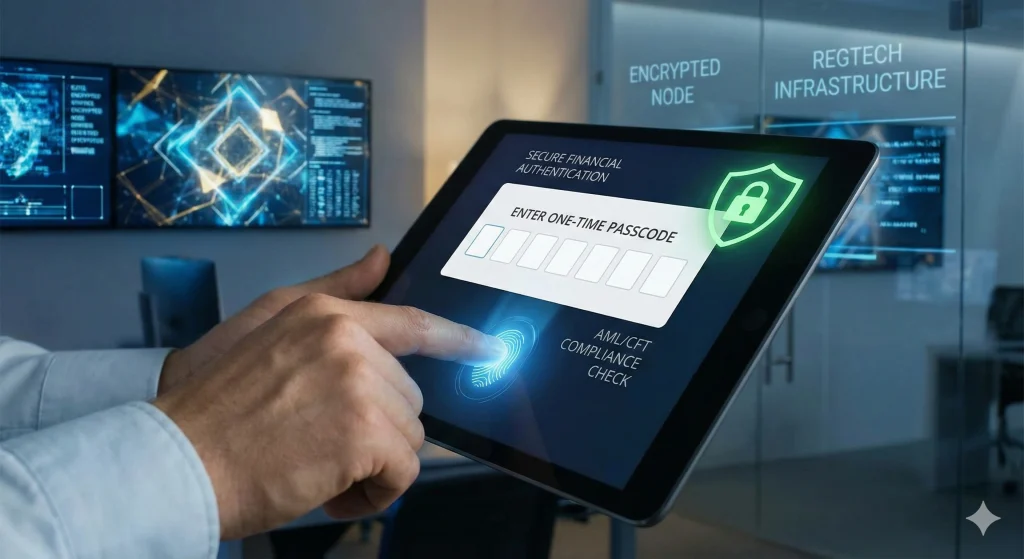
Multi-Factor Authentication (MFA) is a security process that requires a user to provide two or more independent credentials (factors) to verify their identity before gaining access to a system, application, or data.
The factors are typically drawn from different categories: What the user knows (knowledge), what the user has (possession), and what the user is (inherence/biometric).
In the context of AML/CFT and financial services, MFA strengthens access controls and helps defend against identity theft, account takeover, unauthorised withdrawals, and other misuse of privileged access.
Explanation
MFA operates on the principle that even if one authentication factor (for example, a password) is compromised, additional factors provide layered defence, making it much harder for an attacker to gain access.
For example, after entering a password (something you know), a user might also be required to input a one-time code generated by a hardware token or smartphone app (something you have), and/or present a fingerprint or facial recognition scan (something you are).
In financial institutions, MFA is widely used for user logins, account changes, high-value or high-risk transactions, remote access, administrative access, and when external parties interface with internal systems.
The aim is to align access risk with the sensitivity of the activity and to close gaps that could otherwise be exploited for money laundering, sanctions circumvention, or fraud.
MFA in AML/CFT Frameworks
MFA interfaces with AML/CFT programmes by enhancing the identity verification, access control, monitoring, and governance layers of a financial institution’s risk framework.
Key intersections include:
Access and Identity Control
- Requiring MFA for system logins, especially to client-facing portals, internal dashboards, and correspondent banking links.
- Applying MFA for remote access by staff, vendors, and agents to minimise the risk of credential compromise.
- Ensuring that onboarding of high-risk clients or sensitive accounts triggers stronger or additional authentication requirements.
Transaction and Account Security
- Use MFA when customers initiate large transfers, open new payees, or engage in high-risk channels (for example, cross-border flows).
- Applying step-up or challenge authentication when behaviour deviates from established patterns.
- Controlling access to high-risk products (such as trade finance, private banking, or crypto-asset gateways) via MFA gating.
Governance and Monitoring
- Logging MFA usage and failure rates, anomalies in factor usage, and authentication patterns for audit and compliance review.
- Using MFA failure or abnormal factor usage as an indicator for potential insider abuse, account takeover, or external fraud tied to money laundering risk.
- Including MFA effectiveness as part of control self-assessments, internal audit, and board oversight of financial crime controls.
Key Components of MFA
To design and implement MFA effectively, institutions should consider several components:
Authentication Factors
- Knowledge factors: Passwords, PINs, secret questions.
- Possession factors: Hardware tokens, smartphone apps, security keys, smart cards.
- Inherent factors: Biometrics such as fingerprint, face, and voice recognition.
- Additional optional factors: Location (“somewhere you are”), behaviour (“something you do”), such as geolocation, device fingerprinting, and behaviour analytics.
Independence and Assurance
- The factors used must be independent so that compromising one does not reduce the assurance of the others.
- Assurance levels and system maturity models guide how strong MFA must be, especially for high-risk systems or regulatory requirements.
Integration and User Experience
- The MFA solution must integrate with the institution’s identity and access management (IAM) infrastructure, risk monitoring platforms, and transaction systems.
- Usability is crucial: Overly burdensome MFA may lead to workarounds, user fatigue, or increased helpdesk costs.
- Recovery and fallback procedures must be robust, secure, and well-governed to avoid creating new vulnerabilities.
Examples of MFA Scenarios
- A customer logs into a banking app using a password and then receives a push notification on their smartphone to approve the login.
- A remote vendor gains access to a financial institution’s network using their credentials and then must insert a hardware security key in their computer (possession) before connection is granted.
- A high-value wire transfer triggers a second factor: The user is prompted for a fingerprint scan and then a time-based one-time passcode generated by an authenticator app.
- An account change request for a high-risk customer profile triggers adaptive MFA: The system detects an unusual login location and requires an extra identity verification step.
- An internal admin panel access for AML alerts requires MFA: Password, device certificate, and biometric verification are required.
Impact on Financial Institutions
Implementing MFA offers multiple benefits:
- Increased security posture: Reduces risk of credential theft, account takeover, unauthorised access, and therefore reduces potential money-laundering infiltration.
- Enhanced regulatory compliance: Many regulators require strong customer authentication and secure access controls; MFA is often a key component of compliance programmes.
- Strengthened customer and partner trust: Demonstrating robust access controls enhances confidence in digital services and correspondence relationships.
- Reduced fraud and insider risk: MFA helps mitigate insider threats, vendor account misuse, and external intrusion that drive illicit activity.
However, institutions must also manage challenges: implementation cost, user adoption, managing exceptions, and ensuring fallback processes are secure.
Challenges in Managing MFA
Despite its benefits, MFA comes with hurdles:
- Some MFA methods (for example, SMS codes) remain vulnerable to SIM-swapping, phishing, interception, and other attacks.
- User fatigue: Repeated notifications or inconvenient authentication steps may lead users to disable or circumvent MFA or search for weaker methods.
- Recovery procedures: If users lose access to a second factor (for example smartphone or a token), the fallback process must be secure; otherwise, it may become an exploitable weakness.
- Integration complexity: legacy systems, third-party services, and diverse customer profiles complicate consistent MFA deployment.
- Balancing security and usability: Too aggressive MFA may hinder business operations or frustrate customers, particularly for lower-risk activities.
Best Practices & Governance
- Conduct a risk-based assessment of where MFA is required, tie MFA deployment to customer risk profiles, product risk, channel risk, and access sensitivity.
- Use the strongest practicable factors for high-risk systems and external access (for example, hardware keys, biometrics) rather than relying solely on weaker methods like SMS.
- Ensure factors are independent and cannot be easily intercepted or bypassed by a single attack vector.
- Monitor usage of MFA: log successes, failures, attempts, anomalies, user behaviour changes, and integrate with transaction monitoring.
- Define clear recovery and fallback procedures that maintain security integrity and governance oversight.
- Train staff, vendors, and customers on MFA usage, security awareness, and help desk support, to reduce misuse or bypassing.
- Review and update MFA controls periodically, adapt to new threats (for example, push-bombing or notification fatigue attacks), and evolve business channels.
- Report governance metrics to senior management and board: adoption rates, factor usage, failure/lock-out rates, incident correlation, and control exceptions.
Regulatory and Standards Context
- The National Institute of Standards and Technology (NIST) defines MFA in its glossary and digital identity guidelines as requiring two or more distinct factors: something you know, something you have, something you are.
- The Cybersecurity & Infrastructure Security Agency (CISA) emphasises MFA as a layered approach to credential security and recommends its use for high-risk access and remote systems.
- The PCI Security Standards Council (PCI SSC) requires MFA for remote access into cardholder data environments and provides supplemental guidance for MFA implementation.
- The Open Web Application Security Project (OWASP) provides a cheat sheet on MFA factors, methods, and weaknesses, highlighting that true MFA requires independent factors from different categories.
Importance of MFA in AML/CFT Compliance
For financial institutions seeking to satisfy AML/CFT obligations, MFA is vital because it strengthens the identity and access layer, which is foundational for many downstream controls, customer risk management, transaction monitoring, sanctions screening, and suspicious activity reporting.
Without robust access controls, fraud and illicit flows may exploit account or system vulnerabilities.
By integrating MFA, institutions enhance their preventive controls, reduce opportunities for credential compromise and insider misuse, and support a digital-first, risk-based compliance framework aligned with modern threats and regulator expectations.
Related Terms
- Adaptive Authentication
- Single‐Factor Authentication (SFA)
- Strong Customer Authentication (SCA)
- Identity and Access Management (IAM)
- Step-Up Authentication
- Credential Stuffing
References
- Cybersecurity & Infrastructure Security Agency (CISA) – Multi-Factor Authentication (MFA)
- NIST Glossary – Multi-Factor Authentication
- PCI Security Standards Council – Multi-Factor Authentication Guidance v1.0 (February 2017)
- OWASP Cheat Sheet – Multifactor Authentication
- AWS – What is MFA (Multi-Factor Authentication)?
Ready to Stay
Compliant—Without Slowing Down?
Move at crypto speed without losing sight of your regulatory obligations.
With IDYC360, you can scale securely, onboard instantly, and monitor risk in real time—without the friction.