

Money Order
Definition
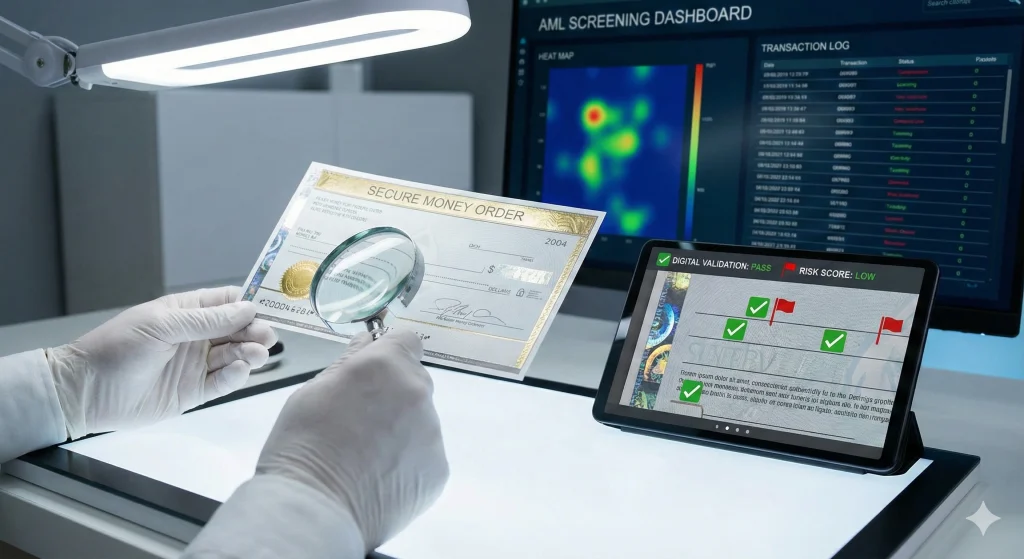
A money order is a prepaid negotiable instrument issued by a financial institution, post office, or retail outlet on behalf of a purchaser to pay a specific amount to a named payee.
Because it is prepaid and guaranteed by the issuer, a money order functions as a more secure alternative to cash or a standard personal cheque, especially when the payer or payee lacks a conventional bank account.
In the context of AML/CFT, money orders are classed as “monetary instruments” and therefore fall within the regulatory frameworks that govern the movement and reporting of funds susceptible to misuse for money laundering, terrorist financing, fraud, or other financial crime.
Explanation
A money order is typically obtained by the purchaser paying cash or a debit card to the issuer, who then creates a document with the amount, the named payee, a serial number, and possibly other security features.
The purchaser retains a receipt or stub, and the payee redeems or deposits the money order.
Because the funds are prepaid, the risk of bounce is eliminated compared to a personal cheque.
However, the very features that make money orders attractive to legitimate users, anonymity or lack of bank account requirement, ease of transport, and prepaid value, also make them potentially attractive to misuse by financial criminals.
For example, layering or pass-through transactions may be hidden within money-order flows, and multiple low-value money orders may aggregate to significant sums.
Money Orders in AML/CFT Frameworks
Money orders present specific risk intersections within AML/CFT frameworks.
Financial institutions and regulated entities must consider:
Customer and Transactional Risk
- Customers purchasing large volumes of money orders in a short period may be exhibiting structuring behaviour.
- Recipients of money orders who do not match the expected business or personal profile may signal unexpected risk.
- Use of cash or prepaid debit for money order purchases may increase placement risk.
- Geographic corridors with weak regulation receiving money-order funds raise layering or integration concerns.
Screening and Monitoring Implications
- Money orders must be considered in the monitoring of monetary instruments, including the identification of bearer or end-payable at delivery instruments.
- Rules and alerts should be calibrated to detect rapid issuance, redemption, or deposit of money orders inconsistent with the profile.
- Charge-back, refund, or redemption patterns via money orders should be reviewed for suspicious behaviour.
Regulatory Reporting and Control Requirements
- In many jurisdictions, thresholds exist for reporting when multiple money orders are purchased or redeemed.
- Money orders may trigger suspicious transaction reports if they are inconsistent with the customer’s known profile, or if they facilitate movement of funds across borders.
- The administrative process for money orders (receipts, serial tracking) must be robust to support investigations.
Key Characteristics of Money Orders
Issuance and Redemption Features
- Money orders are purchased upfront, and cash or debit payment is required.
- They typically bear a fixed maximum value per order (for example, historically in the U.S., many issuers capped domestic money orders at US$1,000).
- The issuer provides a receipt or stub to the purchaser to retain for tracking.
- Redemption normally requires the payee to present the order for deposit or cash-out; depending on issuer policy, identity may be required.
Advantages and Limitations
Advantages include:
- Provides a payment alternative when either the payer or the payee lacks a bank account.
- Prepaid value removes the risk of bounce compared to a personal cheque.
- Minimal payer bank details are shown, reducing exposure of payer account information
Limitations include:
- Limited maximum value per order means large payments require multiple orders.
- Tracking and tracing can be more difficult compared to electronic payments or bank drafts.
- Because of anonymity in some cases, money orders may be attractive to misuse, requiring enhanced controls.
Examples of Money Order Use Cases
Domestic Utility Payment
A consumer without a bank account uses a money order purchased at a post office to pay a utility bill.
The amount is printed, the payee is the utility company, and the consumer retains the receipt.
The utility company redeems or deposits the money order into its account.
International Remittance Substitute
In countries or regions where bank access is limited, a migrant worker purchases a money order and sends it to a relative who lacks a bank account.
The relative cashes or deposits it locally. Because the funds are prepaid, the issuer is guaranteed.
Alternative To Cash Payment
A small business prefers to accept money orders from certain customers who pay by cash or prepaid cards but wish to provide a traceable payment method rather than cash.
The business deposits the money orders into its bank account.
Fraudulent or Money-Laundering Scenario
A criminal purchases multiple money orders using cash from different locations, then either consolidates them via deposit into an account or smashes them through multiple payees, effectively layering funds.
Because each money order is within institutional limits, the aggregate movement disguises the true magnitude of transfers.
Impact on Financial Institutions
- Institutions must include money orders in their transaction-monitoring framework alongside other monetary instruments.
- Policies must define thresholds, velocity rules, and alert scenarios for money-order issuance and redemption.
- Enhanced due diligence may be required when customers purchase significant volumes, or when redemption occurs instantaneously in high-risk jurisdictions.
- Institutions should train front-line staff to identify money-order misuse (structuring, suspicious payees, abnormal geographic patterns).
- Failure to manage money-order risks may lead to regulatory penalties, reputational damage, and increased scrutiny from AML supervisors.
Challenges in Managing Money Order Risk
- Money orders are less granular than bank transfers; tracking payee details, origin, and destination may be difficult.
- Issuance and redemption may cut across retail outlets, post offices, banks, and non-bank agents, complicating data aggregation.
- Multiple small-value orders (below thresholds) may aggregate to substantial risk unnoticed.
- Cross-border money orders, though smaller in value, may travel through jurisdictions with weak AML regulation, increasing layering risk.
- New technologies (digital equivalents, e-money, mobile purchase of money orders) introduce evolving risk vectors that require adaptation of legacy monitoring models.
Regulatory Oversight & Governance
- Regulators expect institutions to treat money orders as monetary instruments subject to AML/CFT oversight.
- Financial institutions should document money-order products within their risk assessments, specifying risk factors, controls, and monitoring scenarios.
- Internal audit should test money-order issuance and redemption controls, including tracking of receipts, serial numbers, and redemption data.
- Boards and senior management should receive periodic reports on money-order volumes, risk metrics, and trends, and policy adjustments made to mitigate emerging risk.
Importance of Money Orders in AML/CFT Compliance
While many institutions focus on digital transfers, high-value wires, or cross-border flows, money orders remain relevant, often for lower-value transactions but high in volume, and their misuse can undercut financial crime systems.
Properly managed, money orders offer secure and traceable payment alternatives.
Mismanaged, they offer layering and anonymisation opportunities.
Institutions that incorporate money orders into their AML/CFT frameworks ensure they treat the full spectrum of monetary instruments, allocate resources appropriately, detect anomalous behaviour, enable effective case generation, and remain aligned with global supervisory expectations.
Effective oversight and proactive controls enable financial institutions to:
- Lower the risk of being unwitting conduits for illicit funds.
- Improve traceability of payment flows, even in underserved segments.
- Align with regulatory expectations for the monitoring of monetary instruments.
- Adapt to emerging threats where money-order products or equivalents are used in layering schemes.
Related Terms
- Monetary Instrument
- Prepaid Instrument
- Cheque
- Cashier’s Check
- Money Transfer Service
- Payment Instrument
- Structuring
References
- “Money Order – Definition, How It Works, Types,” Corporate Finance Institute
- “What Is a Money Order and How It Works?” Empower
- “Money Order – Definition,” Investopedia
- “Monetary Instruments – §1010.100(dd)(1), BSA/AML General Definitions (FFIEC).
Ready to Stay
Compliant—Without Slowing Down?
Move at crypto speed without losing sight of your regulatory obligations.
With IDYC360, you can scale securely, onboard instantly, and monitor risk in real time—without the friction.

