

Media Screening
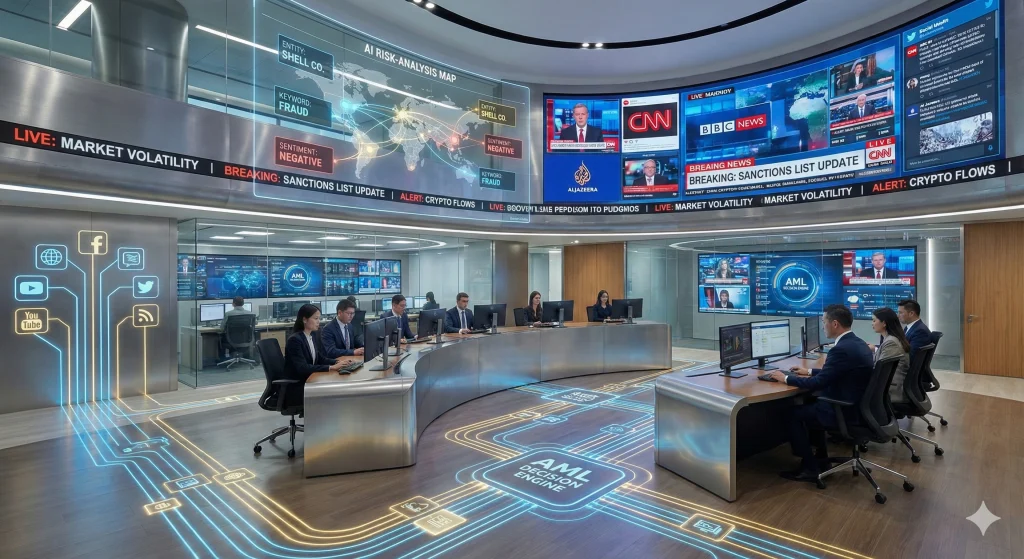
Definition
Media screening refers to the process by which organisations evaluate and monitor publicly available media sources (such as news articles, blogs, social media posts, podcasts, forums, and other digital content) to identify negative, adverse, or risk-related information about persons, entities, or counterparties.
In the context of AML/CFT frameworks, media screening is a crucial complement to other forms of monitoring (such as sanctions screening or transaction monitoring) as it can reveal emerging risks, reputational hazards, and links to illicit activity before they appear in formal watchlists or regulatory sanctions.
Explanation
Media screening goes beyond simply checking whether a name appears in a sanctions list.
It involves proactive scanning of open-source intelligence (OSINT) and media coverage to identify potential risk flags.
For example, a beneficial owner of a corporate customer may not yet be subject to regulatory action, but a news article may report an investigation into corruption, money-laundering, or other predicate offences.
By capturing those signals early, an institution can adjust the risk rating of the customer or engage enhanced monitoring.
Media screening works in three main phases: Identifying the individual or entity, searching and retrieving relevant media, and assessing whether the information is material and poses a risk to the institution.
The process is typically risk-based: higher-risk customers or jurisdictions warrant deeper and more frequent checks.
It supports both onboarding and ongoing monitoring activities, and helps organisations demonstrate to regulators that they are applying a holistic due diligence approach.
Media Screening in AML/CFT Frameworks
In the anti-money laundering and countering financing of terrorism (AML/CFT) landscape, media screening occupies an important role because:
- It provides early warning of emerging risk factors before they become regulatory or criminal findings.
- It captures reputational risk tied to persons or entities that may not yet appear on official lists.
- It enhances other screening mechanisms (such as sanctions, PEP, or transaction-based monitoring) by adding public-domain context.
- It supports narrative intelligence and helps build a richer risk profile beyond quantitative thresholds.
When integrated effectively, media screening aids in customer risk rating, enhanced due diligence (EDD), ongoing monitoring, and model calibration.
In practice, institutions commonly embed media screening in their customer lifecycle workflows; at onboarding, periodically during the relationship, and when trigger events occur (such as a major news report or negative media mention).
Regulators increasingly expect such practices, especially in higher-risk sectors such as correspondent banking, fintech, trade finance, or complex corporate services.
Key Components of Media Screening
Scope of Sources
Media screening should cover a variety of media types, including:
- International and regional news portals and archives
- Financial crime typology reports and investigative journalism
- Social media platforms and blogs (publicly accessible)
- Official announcements, government disclosures, and litigation databases
- Forums and dark web references (in higher-risk cases)
Search Methodology and Trigger Keywords
Effective screening typically involves:
- Defining relevant keywords tied to financial crime, fraud, bribery, corruption, sanctions, trafficking, proliferation, etc.
- Using entity identifiers beyond name (e.g., date of birth, registration number, aliases) to refine results
- Applying Boolean logic, natural language processing, and thematic filters to isolate meaningful content
- Prioritising results by jurisdictional risk, time sensitivity, and relevance to the entity’s business model
Assessment and Decision Making
Once media content is retrieved, institutions must:
- Determine whether the information relates to the specific entity or a homonym (false positives)
- Assess the reliability of the source, context of the mention, and outcome of reported activity (e.g., investigation, regulatory action, unverified allegation)
- Decide on the risk impact (Does this require EDD? Should the account be closed? Is a Suspicious Activity Report required?)
- Document the findings, decisions taken, and actions implemented
Integration with Systems and Controls
Media screening is most effective when integrated with broader compliance tooling and processes:
- Link screening outcomes to customer risk ratings and lifecycle workflows
- Trigger alerts or workflows (such as EDD trigger, enhanced monitoring, and account restrictions) when adverse findings occur
- Use dashboards, scorecards, and metrics to measure screening coverage, false positives, and outcome performance
- Review and calibrate the screening programme periodically (reviewing sources, keywords, frequency, and risk thresholds)
Examples of Media Screening Scenarios
- A corporate customer seeks to open an account in a high-risk jurisdiction. Media screening reveals a recent news article alleging its beneficial owner was involved in an offshore tax evasion scheme. The institution escalates the review and applies enhanced monitoring.
- A fintech digital wallet onboarding process flags a new user as high-risk. Media screening detects a social-media post claiming the user’s previous payment account was flagged for suspicious transactions. The institution temporarily suspends the account pending investigation.
- A correspondent banking institution receives a request from a lower-tier bank in a developing country. Media screening across the lower-tier bank’s board members reveals links to politically connected individuals under investigation for money laundering. The institution requires additional assurances and documentation.
- An existing customer is subject to a major shareholder change. Trigger event policies prompt a new media scan, which uncovers an investigative report referencing the new shareholder’s involvement in fraud. The bank re-rates the customer as higher risk and increases monitoring thresholds.
Impact on Financial Institutions
Effective media screening yields multiple benefits:
- Improved risk detection by capturing early signals of misconduct or financial crime associations
- Enhanced regulatory compliance by demonstrating a holistic due diligence programme that includes OSINT monitoring
- Reduced reputational risk through avoidance of relationships with high-risk or unknown parties
- More informed resource allocation by identifying which relationships require EDD or heightened oversight
However, media screening also carries operational challenges: ensuring adequate source coverage, balancing false positive/negative rates, managing huge volumes of data, and integrating results into governance workflows.
Poor execution may lead to missed adverse signals or excessive alerts that divert resources.
Challenges in Managing Media Screening
- Homonym risk and false positive matches require robust disambiguation and verification processes.
- Source reliability and authenticity can vary widely across jurisdictions; scouring lesser-known sources may introduce noise rather than insight.
- Volume of media content is vast and rising; organisations must balance automation with human review.
- Risk of outdated results: negative media may emerge after onboarding or may be removed/archived. Ongoing monitoring is essential.
- Integration complexity: Linking screening results into customer lifecycle systems, alert systems, case management, and supervisory reporting.
Regulatory Oversight and Governance
Regulators and standard-setting bodies increasingly emphasise media screening as part of effective AML/CFT frameworks.
For instance:
- Financial Action Task Force (FATF) Recommendations call for risk-based due diligence, which includes open source checks and adverse media monitoring.
- Jurisdictions implementing the 6th Anti‑Money Laundering Directive (6AMLD) in the EU require firms to perform “open source or adverse media searches” for high-risk customers.
- Compliance guidelines and industry articles reinforce the need for media screening to support sanctions compliance, reputational risk management, and fraud prevention.
It is incumbent on senior management, compliance officers, and risk teams to establish media screening policies, manage oversight, define metrics (e.g., time to escalation, false positive rates), and ensure ongoing review of sources and methodologies.
Importance of Media Screening in AML/CFT Compliance
Media screening is not a standalone tool; rather, it integrates with the broader risk-based AML/CFT framework.
By providing early signals, contextual intelligence, and continuous monitoring, it supports more effective customer risk assessment, portfolio oversight, and decision-making.
Whether at onboarding or during ongoing monitoring, it enhances institutions’ ability to detect suspicious behaviour, allocate resources proportionately, and maintain regulatory expectations around due diligence.
Ultimately, media screening contributes to building resilient compliance programmes that can adapt to evolving threats, biometric or digital identity disruptions, and emerging typologies such as fintech scams, social-media-enabled fraud, and global sanctions evasion.
For institutions adopting an intelligence-first programme, media screening forms a key pillar, allowing them to move from reactive detection to proactive prevention.
Related Terms
- Adverse Media Screening
- Open Source Intelligence (OSINT)
- Enhanced Due Diligence (EDD)
- Customer Risk Rating
- Ongoing Due Diligence (ODD)
- Reputation Risk
- Risk-Based Approach
References
- A Step-by-Step Guide to Adverse Media Screening
- Regulatory Compliance on Adverse Media Screening
- Integrating Adverse Media Screening into AML Framework: A Guide for DNFBPs and VASPs
- Negative Media Screening: A Key Component in Your AML/CTF Defence Strategy
- The FATF Recommendations
Ready to Stay
Compliant—Without Slowing Down?
Move at crypto speed without losing sight of your regulatory obligations.
With IDYC360, you can scale securely, onboard instantly, and monitor risk in real time—without the friction.

