

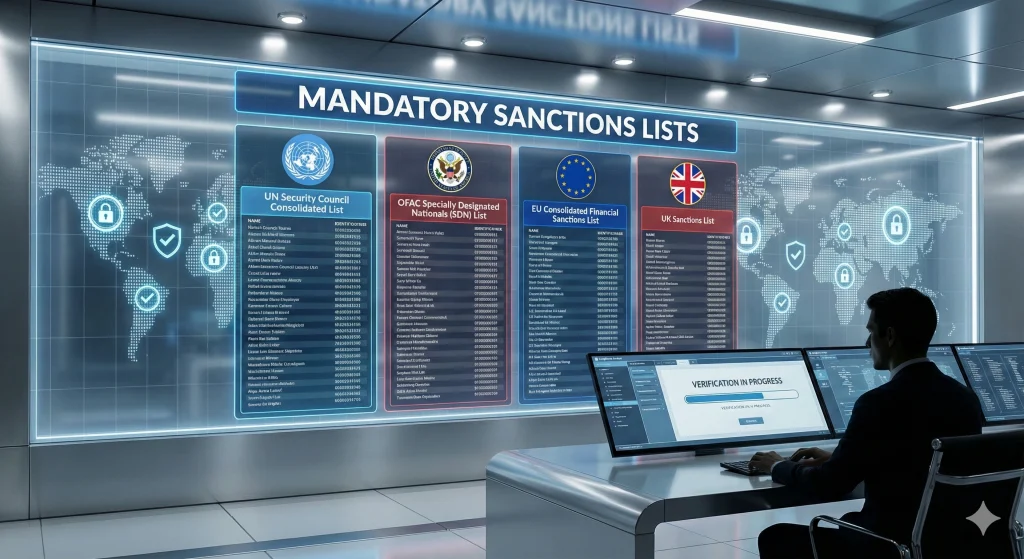
Mandatory Sanctions Lists
Definition
Mandatory sanctions lists are official registers maintained by governments, multilateral bodies, and regulatory authorities, which identify individuals, entities, vessels, regimes, or sectors subject to legally binding financial, trade, or economic restrictions.
These lists impose obligations on regulated entities, such as banks, payment providers, fintechs, and correspondent banks, to screen, block, freeze, or report dealings with the listed parties.
Explanation
Such sanctions lists are foundational in AML/CFT frameworks because they help prevent illicit actors from accessing the financial system or engaging in transactions that may facilitate money laundering, terrorist financing, weapons proliferation, or state-sponsored wrongdoing.
Mandatory lists differ from voluntary or advisory lists in that they carry legal enforceability; it is not optional for regulated entities to ignore them.
Organizations must integrate these lists into their screening workflows (customer onboarding, transaction monitoring, counterparty screening) and ensure real-time checks against the latest updates of the lists.
Failure to do so can lead to significant regulatory, financial, and reputational consequences.
Role in AML/CFT Frameworks
Mandatory sanctions lists intersect with AML/CFT programmes in multiple ways:
- They form part of the customer due diligence (CDD) and onboarding process; entities and individuals must be checked against these lists before establishing a business relationship.
- They influence transaction monitoring, where any payment or transfer involving a listed party must trigger a block, hold, or escalation.
- They inform risk assessments, since exposure to jurisdictions or counterparties on sanctions lists increases inherent and residual risk.
- They require policies and procedures to manage screening, list updates, false positive resolution, de-listing acknowledgements, and audit trails.
- They support regulatory reporting, especially when institutions suspect sanction evasion, clearance issues, or involvement of designated parties.
Key Components of Mandatory Sanctions Lists
- Issuing authority: Governments (e.g., the Office of Foreign Assets Control (OFAC) in the US), multilateral bodies (e.g., the United Nations Security Council), and regional bodies (e.g., the European Union) publish lists.
- List content: Typically includes name, aliases, identifiers (e.g., registration numbers, dates of birth), reason for listing, effective date, sanctions type (asset freeze, trade ban, travel prohibition).
- Legal effect: Transactions or dealings with listed parties are prohibited, unless a licence or exception applies. Entities must block assets, refuse services, or report accordingly.
- Update mechanism: Lists are dynamic, entries are added, amended, or removed frequently. Regulated firms must maintain automated or manual update processes.
- De-listing and exceptions: Some regimes provide processes for removal or exceptions; institutions must monitor for such changes.
Examples of Mandatory Sanctions Lists
- The US SDN list maintained by OFAC targets individuals and entities engaged in terrorism, narcotics trafficking, weapons proliferation, and other malign activities.
- The EU’s consolidated list of persons, groups, and entities subject to EU restrictive measures, which must be enforced by Member States.
- The UN Security Council sanctions list covers regimes, individuals, and entities associated with threats to international peace and security.
Risks & Challenges
- Keeping pace with frequent updates, failure to screen against the latest list may mean non-compliance.
- Managing false positives, common names, or aliases can trigger alerts that require resource-intensive resolution.
- Integrating sanctions lists across multiple jurisdictions, a party may appear on one list but not another, requiring global coordination.
- Monitoring for sanctions evasions, complex ownership structures, sanctioned party proxies, and shell entities can mask listing status.
- Ensuring governance and auditability, institutions must document their screening procedures, exceptions, licences, and remediation actions.
Impact on Financial Institutions
- Strong sanctions-list compliance is a key indicator of AML/CFT programme maturity.
- Non-compliance can lead to enforcement actions, large fines, loss of correspondent banking access, and reputational damage.
- Institutions must invest in technology, up-to-date data, screening tools, and workflow integration to properly operationalise the lists.
- Sanctions screening supports other modules such as transaction monitoring, customer risk-scoring, and validation of beneficial ownership.
- The existence of multiple overlapping lists increases complexity; firms must prioritise and harmonise screening across lists to ensure coverage without over-burdening operations.
Best Practice Recommendations
- Maintain automated list update mechanisms to ensure the most current version is always used.
- Use multiple screening attributes (e.g., name, alias, ID number, country) to reduce false negative risks.
- Employ initial screen at onboarding, continuous monitoring during the relationship, and periodic re-screening.
- Document governance procedures; who oversees list updates, how licences are tracked, and how escalations and blocks are handled.
- Provide training and awareness to front-office, risk, and compliance teams about sanctions obligations and emerging list entries.
- Review vendor and third-party coverage, ensuring counterparties are also screened against relevant lists.
- Conduct periodic audit and testing of sanctions screening functionality and rule logic to validate effectiveness and coverage.
Regulatory Oversight & Governance
- The FATF expects institutions to adopt risk-based approaches, which include screening against sanctions lists as part of preventive controls.
- Supervisors in each jurisdiction assess whether entities have adequate sanctions screening frameworks, policy coverage, technology, and governance.
- Institutions must ensure their sanctions-list screening integrates with broader AML/CFT risk assessments, monitoring, investigation, and reporting frameworks.
- Boards and senior management should set risk appetite for sanctions exposure and confirm that controls meet that appetite.
Importance of AML/CFT Compliance
Mandatory sanctions lists are vital to preventing misuse of the financial system by sanctioned parties, and form a core strand of AML/CFT compliance programmes.
Effective implementation ensures that institutions:
- Avoid facilitating prohibited transactions
- Demonstrate proactive compliance with global regulatory obligations.
- Integrate sanctions screening within broader customer and transaction risk frameworks.
- Support intelligence-led detection by linking sanctions hits with broader financial crime indicators.
Given the evolving geopolitical landscape, the proliferation of sanctions regimes, and increasing regulatory scrutiny, institutions that treat sanctions screening as a one-time exercise will be exposed. Instead, sanctions list compliance must be continuous, integrated, and adaptive.
Related Terms
- Sanctions Screening
- Watchlist Filtering
- De-listing Process
- Trade Embargo
- Asset Freeze
- Counterparty Risk
- Transaction Monitoring
References
- “Sanctions List: Definition & Use – Glossary.” LSEG Risk Intelligence.
- “Sanctions Lists In AML Compliance: Definition, Types, And …” Facctum.
- “Basic Information on OFAC and Sanctions.” Office of Foreign Assets Control (US Treasury).
- “Sanctions | Security Council.” United Nations Security Council.
Ready to Stay
Compliant—Without Slowing Down?
Move at crypto speed without losing sight of your regulatory obligations.
With IDYC360, you can scale securely, onboard instantly, and monitor risk in real time—without the friction.