

LLP: Limited Liability Partnership
Definition
A Limited Liability Partnership (LLP) is a business structure that combines the flexibility and operational features of a partnership with the liability protection typical of a corporation.
It allows partners to manage the business directly while limiting their personal liability for the partnership’s debts and the misconduct of other partners.
The LLP is a separate legal entity in many jurisdictions, distinct from its partners, and may also be treated as a pass-through entity for tax purposes.
Explanation
In an LLP, partners retain the right to actively manage the business, unlike in certain other limited structures where some members may be non-managing.
The key advantage lies in the limited liability protection; partners are generally not personally liable for the negligence or misconduct of other partners.
However, the extent of liability protection and regulatory requirements can vary significantly across jurisdictions.
Some jurisdictions restrict LLP formation to professional services (law firms, accounting firms, etc.), while others allow a broader range of businesses to adopt the LLP form.
Because it blends partnership flexibility with liability protection, the LLP structure is often chosen when participants want both active involvement and a shield from certain liabilities.
It supports collaborative business models, especially where the partners’ exposure to risk (professional or otherwise) is high.
Key Features & Characteristics
- Separate Legal Entity: An LLP is often recognised as a legal entity distinct from its partners.
- Limited Liability: Partners typically are not personally liable for the wrongful actions or debts of other partners beyond their capital contribution.
- Active Management by Partners: All partners may participate in business management without losing liability protection (depending on jurisdiction).
- Pass-Through Tax Treatment: Frequently, profits (and losses) pass directly to partners, avoiding corporate-level tax in certain jurisdictions.
- Flexible Partner Structure: Many jurisdictions permit any number of partners and allow natural persons or corporate entities as partners.
- Regulatory Variation: Formation, filing, compliance obligations, and permitted activities vary significantly by legal jurisdiction.
Formation & Governance
Forming an LLP generally involves:
- Filing a registration or incorporation document with the relevant authorities.
- Preparing an LLP agreement or partnership deed that sets out governance, profit distribution, rights, and responsibilities of partners.
- Appointing designated partners in jurisdictions where such roles are mandated (for example, in India under the Limited Liability Partnership Act).
- Complying with ongoing filing and disclosure requirements such as annual returns, statements of accounts, or audits, depending on size and jurisdiction.
Partners should ensure that the governance framework addresses exit strategies, capital contributions, partner retirement or withdrawal, decision-making processes, and dispute resolution mechanisms.
Advantages of an LLP
- Provides partners with protection for personal assets against certain partnership liabilities.
- Allows partners to manage the business directly rather than being passive investors.
- Retains partnership-style flexibility in profit sharing and internal arrangements.
- May offer tax efficiencies via pass-through treatment in many jurisdictions.
- Facilitates collaborative business models, especially among professionals or risk-exposed ventures.
Limitations & Considerations
- Liability protection may not extend to all types of obligations, depending on jurisdiction (for example, contractual obligations or fraud).
- Not always suitable for raising large external investors or public fundraising (since many jurisdictions limit LLPs in this regard).
- Governance and partner agreements must be robust to avoid disputes, deadlocks, or misalignment among partners.
- Regulatory and filing compliance may be significant depending on size, jurisdiction, and business activities.
- Conversion out of LLP to another structure (or vice versa) may involve complex procedures and tax consequences.
Use Cases & Examples
- Professional Service Firms: Law firms, accounting practices, or consulting firms where partners want to actively manage and need liability protection.
- Joint Ventures: Two or more entities wish to collaborate on a venture with shared management and liability shielding.
- Small and Medium Enterprises: Businesses that want partnership flexibility but raise risk exposure through growth or cross-border activity.
- Cross-Border and Multi-Jurisdictional Structures: Enterprises where the location of partners, operations, or risk exposures spans jurisdictions, and a flexible yet protected model is needed.
Implications for AML/CFT and Financial Crime Risk
The structure and legal status of an LLP can have specific implications for anti-money laundering (AML) and combating the financing of terrorism (CFT) frameworks:
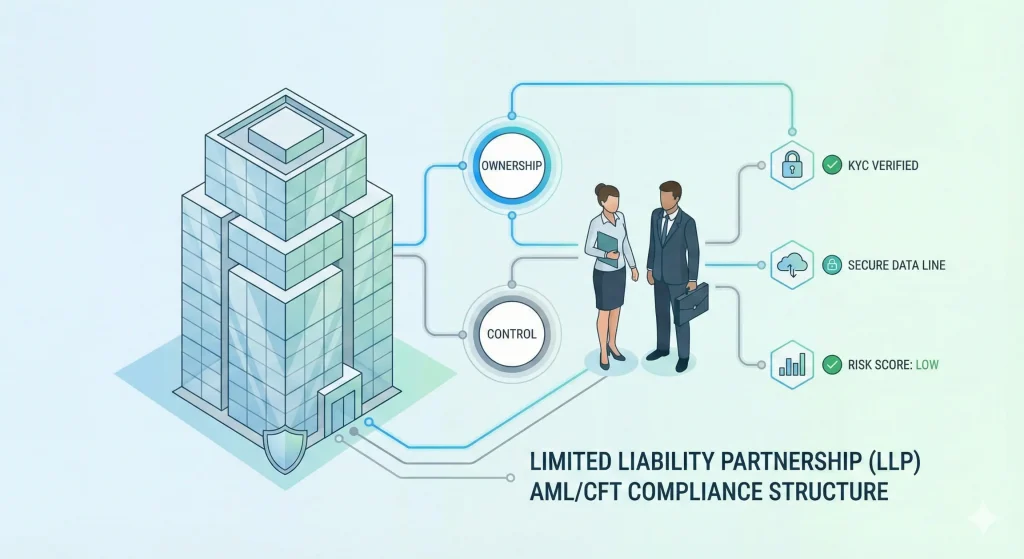
- Due Diligence: Financial institutions should treat an LLP as a distinct legal entity and carry out customer due diligence (CDD) accordingly, verifying the LLP’s registration, management, ownership, and beneficial ownership.
- Beneficial Ownership Transparency: Partners may include natural persons or corporate entities. Institutions must identify and verify ultimate beneficial owners (UBOs) and assess whether the LLP is used to obscure ownership or movement of funds.
- Risk Assessment: The choice of an LLP may reflect certain risk exposures, for example, use by professional services or cross-border operations, requiring elevated monitoring.
- Transaction Monitoring: Activities of LLP clients may warrant enhanced scrutiny depending on their business model, jurisdiction, and sector risk.
- Governance and Compliance Controls: Institutions assessing an LLP should consider the adequacy of internal controls, transparency of partnership agreements, audit obligations, and partner accountability.
Key Risks Associated with LLPs
- Abuse for Concealment: The relative flexibility of LLP-structures may be leveraged to obscure true ownership or facilitate layering of illicit funds.
- Jurisdictional Variation Risk: Differences in regulatory regimes mean that liability protections and transparency requirements may vary, potentially creating gaps.
- Professional Service Exposure: Since LLPs are commonly used by professionals, they may be targeted by criminal actors seeking to exploit service providers for money-laundering, fraud, or sanction-evasion schemes.
- Corporate Governance Weakness: Inadequate partner agreements, weak oversight, or a lack of audit may open the LLP to misuse.
- Conversion Risks: Switching from one legal form to another may create transitional vulnerabilities, particularly in terms of reporting and oversight.
Best Practice Guidance
- Ensure the LLP agreement clearly defines partner rights, responsibilities, profit-sharing, decision-making, and exit arrangements.
- Review the jurisdictional liability protections to ensure they align with the parties’ risk exposure.
- Conduct thorough KYC/CDD, including identification of partners and beneficial owners, assessing for shell partners or complex structures.
- Implement strong internal controls and audit mechanisms in the LLP, especially for professional service firms or cross-border operations.
- Regularly review the LLP’s governance, compliance, regulatory filing status, and risk profile in light of evolving financial crime typologies.
- Financial institutions should apply risk-based approaches when dealing with LLP-clients, aligning monitoring thresholds and EDD with the entity’s risk footprint.
Related Terms
- General Partnership
- Limited Partnership (LP)
- Limited Liability Company (LLC)
- Beneficial Ownership
- Corporate Governance
- Risk-Based Approach
References
- Investopedia – Limited Liability Partnership (LLP) Basics
- Cornell Law School Wex – Limited Liability Partnership (LLP)
- Income Tax Department India – LLP Overview
- The Limited Liability Partnership Act, 2008 (India)
Ready to Stay
Compliant—Without Slowing Down?
Move at crypto speed without losing sight of your regulatory obligations.
With IDYC360, you can scale securely, onboard instantly, and monitor risk in real time—without the friction.