

Link Analysis
Definition
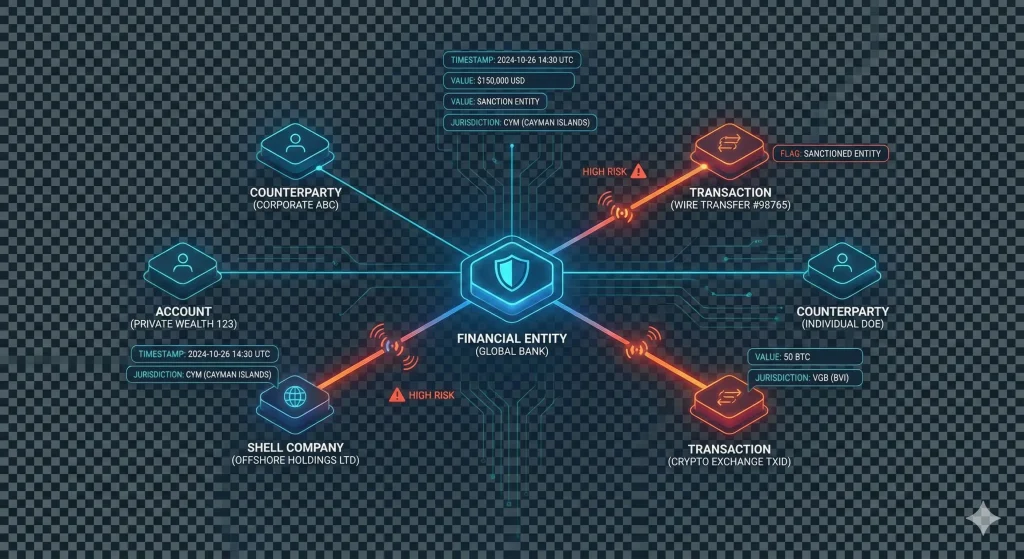
Link analysis is a technique of data analysis that explores the relationships and connections between entities, transactions, and objects.
In the context of AML/CFT, it refers to the mapping and examination of networks of customers, accounts, payments, devices, and other relevant nodes to identify illicit flows, hidden relationships, and suspicious interactions that may not be evident through traditional transaction monitoring alone.
By visualising and interrogating these networks, institutions can detect patterns of behaviour, such as circular flows, layered transfers, common ownership, shared identifiers, or previously unseen links, that signal potential money laundering, fraud, terrorist financing, or other financial crime.
Explanation
Link analysis builds on the premise that financial crime often involves networks rather than isolated transactions.
Money moves through multiple parties, accounts, geographies, devices, and channels in ways that try to disguise the original origin or destination.
Traditional controls may capture anomalous transactions, but without understanding the web of connections around those transactions, many schemes remain hidden.
When embedded into AML/CFT frameworks, link analysis complements rule-based detection, sanctions screening, and transaction monitoring.
By linking entities (e.g., persons, organisations, accounts, devices) and attributes (e.g., addresses, phone numbers, IPs, bank accounts), it allows compliance teams to see clusters, bridges, central nodes, and peripheral actors in networks.
This enhances detection of:
- Structuring of transactions through multiple accounts.
- Use of mule networks and pass-through accounts.
- Shared device or IP infrastructure across unrelated customers.
- Shell companies with common beneficial owners are obscured by indirect links.
- Cross-jurisdiction flows with intermediary nodes and layering.
Link analysis is especially valuable for detecting complex and emerging typologies where the risk arises from interconnected structures rather than single abnormal transactions.
Link Analysis in AML/CFT Frameworks
Link analysis supports several key functions in AML/CFT programmes by enabling insight into network risk.
These include:
Customer and Beneficial Owner Due Diligence
During onboarding and periodic review, institutions may apply link analysis to identify:
- Customers with connections to high-risk persons, entities, or networks.
- Shared addresses, phone numbers, emails, or accounts between “unrelated” customers.
- Known associates or previous counterparties of a customer who are flagged for suspicious activity.
- Hidden beneficial ownership is indicated by intermediary links or patterns of control.
Transaction Monitoring and Network Detection
Link analysis augments transaction monitoring by:
- Mapping the flow of funds across accounts and entities to detect layering.
- Identifying rapid movement of funds between multiple accounts in short timeframes.
- Highlighting triangular or circular flows where funds return to themselves via other nodes.
- Locating clusters of transactions that suggest a network of mule accounts or an organised crime structure.
Case Investigation and Intelligence-Led Review
Within case management, link analysis helps analysts by:
- Visualising complex webs of interactions to prioritise which nodes or relationships are highest risk.
- Tracking entity behaviour over time and across relationships to see the evolution of networks.
- Integrating data from device tracking, IP logs, correspondent bank routes, shareholding data, and more.
Risk Assessment and Reporting
Link analysis supports institutional risk assessment by:
- Providing evidence of network-based risk exposure (rather than just transaction risk).
- Allowing visualisation of exposure across geographies, channels, and product types.
- Enabling more informed classification of residual risk and resource allocation for high-risk networks.
Key Components of Link Analysis
Successful link analysis comprises several major elements:
Data Collection and Integration
To support link analysis, institutions must integrate data from diverse sources, such as:
- Customer and beneficial ownership databases.
- Account and transaction records.
- Device, IP, browser, and geolocation metadata.
- Sanctions lists, PEP databases, adverse media.
- Third-party data, like company registries or real-estate ownership.
- Social network or behavioural indicators (where permitted).
Network Modelling and Graph Construction
Once data is available, the network must be modelled. Key aspects include:
- Entities are represented as nodes and relationships as edges.
- Weighted links to reflect transaction amounts, frequency, or risk scores.
- Extraction of centrality metrics (degree, closeness, betweenness) to identify influential or bridging nodes.
- Detection of subgraphs, clusters, and community structures that may represent organised rings.
Visualisation and Analyst Interface
Effective link analysis requires a user interface so analysts can:
- Explore the network via interactive graph visualisations.
- Filter connections by type, date, risk score, geography, or channel.
- Drill down from entity-to-entity or transaction-to-account.
- Annotate, tag, and escalate nodes for investigation.
Rule Logic and Analytics Integration
Link analysis should integrate with broader AML analytics through:
- Rules that trigger when specific link patterns emerge (e.g., account shares the same device AND common IP).
- Machine learning or graph analytics models that learn suspicious network behaviour.
- Automated scoring of nodes and relationships based on network attributes and behavioural anomalies.
Governance, Monitoring, and Feedback
To ensure effectiveness, institutions must maintain:
- Governance over data quality, model accuracy, and visualisation integrity.
- Monitoring of false positives and detection rates emerging from link-based alerts.
- Feedback loops from investigation outcomes back into modelling rules and network metrics.
Examples of Link Analysis Scenarios
Here are a few illustrative scenarios where link analysis adds value:
- A customer opens an account, deposits small, frequent amounts, then transfers funds to a “new” overseas account. Link analysis reveals that the new account shares a phone number and address with numerous other accounts across several banks, indicative of a mule network.
- Multiple customer accounts trigger low-priority alerts for structuring, yet no single account stands out. Link analysis reveals they all feed into a central node (an intermediary account), which then wires large sums offshore. That central account is now flagged as high-risk.
- A single legal entity is nominally owned by a local nominee, but payments show that multiple subsidiaries funnel funds to one shell company. Graph metrics show that the shell company is a major hub (high betweenness centrality) linking multiple flows.
- A fintech platform observes a cluster of remote digital wallets. Network mapping uncovers that the wallets share device fingerprints and IP addresses, and are transacting among themselves in circular arrangements before moving funds further, suggesting synthetic identity networks.
Impact on Financial Institutions
Adoption of link analysis can drive meaningful impact across compliance, risk, and operations:
- Enhanced detection of complex networks and criminal structures that evade standard controls.
- Reduction in investigation time as analysts can visually target focal nodes instead of chasing each alert individually.
- Improvement in resource allocation, focusing on high-risk networks rather than isolated transactions.
- Better regulatory reporting: Demonstrating that the institution uses network-based detection adds credibility in supervisory reviews.
- Strengthened model performance when integrated with transaction monitoring, sanctions screening, and behavioural analytics.
Challenges in Implementing Link Analysis
While powerful, link analysis also involves certain challenges:
- Ensuring data quality, consistency, and completeness, missing data or mismatched identifiers reduce effectiveness.
- Managing scale and performance: large financial institutions may have millions of nodes and billions of links, requiring efficient graph computation and storage.
- Balancing privacy and compliance: linking across device, IP, and behavioural data may raise data protection concerns and jurisdictional constraints.
- Avoiding “noise” and false positives: dense networks may look suspicious without being illicit, so filtering and prioritisation are critical.
- Maintaining governance and model explainability: as network models grow in complexity, explaining why a node was flagged remains important for regulatory compliance.
Regulatory Oversight & Governance
- The Financial Action Task Force (FATF) emphasises risk-based approaches, including the identification of networks and indirect control, which aligns strongly with link analysis methods.
- Supervisors expect financial institutions to demonstrate effective use of data analytics and insights from networks in their AML/CFT frameworks.
- Internal audit functions should review link analysis practices, ensuring model validity, data lineage, and ongoing calibration.
- Boards and senior management should be briefed on network risk exposures, controls, and link-analysis investment oversight.
Importance of Link Analysis in AML/CFT Compliance
Link analysis is increasingly indispensable in modern AML/CFT compliance. As criminals exploit networks, layering, intermediaries, digital channels, and remote onboarding, institutions must move beyond isolated alerts.
Link-based detection enables seeing the whole picture, how entities, accounts, devices, and geographies interact, and spotting hidden relationships that pose significant risk.
By embedding link analysis into their frameworks, institutions gain:
- A deeper understanding of network-based exposure and risk.
- The ability to prioritise alerts and investigations based on network severity and centrality rather than purely transaction size or count.
- Enhanced intelligence for case investigations, enabling faster, more accurate decisions.
- A stronger foundation for supervisor engagement, demonstrating advanced analytics and proactive risk management.
In summary, link analysis transforms AML/CFT compliance from reactive transaction monitoring to proactive network intelligence.
It equips institutions to address the evolving complexity of financial crime and maintain resilience in an interconnected world.
Related Terms
- Entity Resolution
- Network Analytics
- Graph Theory
- Customer Linkage
- Device Fingerprinting
- Mule Network Detection
References
- Roussos, M. How Technology and Law Interact to Combat Financial Crime. 2024.
- Fronzetti Colladon, A. & Remondi, E. Using Social Network Analysis to Prevent Money Laundering. Expert Systems with Applications, 67, 49-58. 2017.
- Unit21 Blog – What Is Link Analysis In AML Case Management? 12 Aug 2025.
- Eastnets Blog – AI, Link Analysis, and Blockchain: Three Weapons Against Financial Crime. 07 Aug 2022.
Ready to Stay
Compliant—Without Slowing Down?
Move at crypto speed without losing sight of your regulatory obligations.
With IDYC360, you can scale securely, onboard instantly, and monitor risk in real time—without the friction.

