

Joint Comprehensive Plan of Action (JCPOA)
Definition
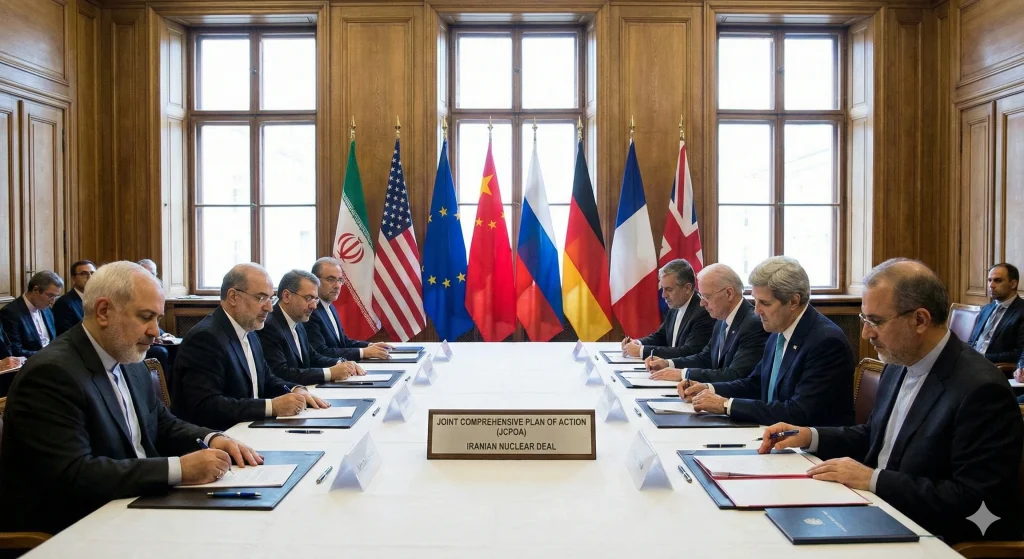
The Joint Comprehensive Plan of Action is an international agreement concluded on 14 July 2015 between the Islamic Republic of Iran and the group of six world powers (China, France, Russia, the UK, the US, and Germany) plus the European Union.
It aimed to limit Iran’s nuclear programme in exchange for relief from certain economic sanctions.
Under the accord, Iran committed to a series of nuclear-related restrictions and oversight measures, while the participating states pledged to lift or suspend specified sanctions conditional on compliance.
The agreement, once adopted by the International Atomic Energy Agency and endorsed through United Nations Security Council Resolution 2231, forms a central part of global non-proliferation architecture.
Explanation
The JCPOA represents a complex diplomatic compromise: Iran accepted limits on uranium enrichment, reductions in its centrifuge programme, conversion of certain facilities, and enhanced monitoring, all in return for sanction relief, reintegration into the global economy, and access to civil nuclear cooperation.
The agreement set time-bound commitments (often ten to fifteen years), introduced “breakout” time safeguards, and required the IAEA to inspect Iran’s nuclear infrastructure.
At the same time, sanctions-related commitments from participating states (including the United States and the European Union) were structured to phase out or suspend if Iran met its obligations.
Although widely heralded as historic at its inception, the agreement also faced criticism and operational challenges.
Some parties questioned the enforceability of its terms, the ability of the IAEA to verify undeclared activities, and the durability of the sanctions relief given Iran’s broader regional behaviour.
Over time, the dynamic shifted: In 2018, the United States withdrew from the JCPOA and re-imposed sanctions; Iran subsequently scaled back its compliance in steps; and efforts to revive or renegotiate the deal remained ongoing as geopolitical conditions evolved.
JCPOA in Non-Proliferation & Sanctions Frameworks
In the context of non-proliferation and sanctions compliance, the JCPOA occupies several key intersections:
Nuclear Safeguards and Monitoring
- Iran agreed to reduce its stockpile of low-enriched and medium-enriched uranium.
- Centrifuge numbers were restricted, including limitations on advanced machines.
- The IAEA gained enhanced inspection rights, including access to key facilities and monitoring of uranium conversions.
Sanctions Relief and Snapback
- In return for compliance, participating states committed to lift or suspend specific sanctions relating to Iran’s nuclear programme.
- The agreement included a “snapback” mechanism whereby original sanctions could be reinstated if Iran violated key provisions.
Multilateral Legal Framework
- The JCPOA was endorsed by UN Security Council Resolution 2231, which gave the deal a binding international force.
- Annexes and implementation modalities defined detailed provisions such as nuclear commitments, sanctions-related measures, and procedural timelines.
Financial Crime and Dual-Use Export Controls
- The deal impacted financial institutions and export-control regimes, requiring banks, insurers, and trade entities to adjust operations.
- Entities engaging with Iran had to navigate layered sanctions, export restrictions, and careful due diligence procedures.
Key Components of the JCPOA
The agreement can be analysed into several interlocking components:
Nuclear-Related Commitments
- Iran committed to limit enrichment to 3.67 % for a defined period and not to build new heavy-water reactors for a set time.
- Existing enrichment facilities, such as Fordow, were to be converted, and the number of installed centrifuges reduced drastically.
- Iran had to export or convert substantial amounts of enriched uranium and plutonium stocks.
Verification, Monitoring, and Transparency
- The IAEA was given regular reporting obligations to its Board of Governors and the UN Security Council.
- Iran accepted new monitoring capabilities, including real-time data access, frequent inspections, and facility visits.
- A Joint Commission (Iran and E3/EU+3) was established to oversee implementation and resolve disputes.
Sanctions and Relief Mechanisms
- UN, US, and EU nuclear-related sanctions were suspended or terminated upon “Implementation Day”.
- The lifting of nuclear-related restrictions allowed Iran to re-enter certain global trade and finance channels.
- Financial institutions had to adapt to residual risks, especially regarding sanctions not covered by the deal (such as human-rights or missile-related sanctions).
Dispute Resolution and Snapback
- The Joint Commission served as the forum for addressing concerns or raising potential breaches.
- If Iran were judged non-compliant, participating states could trigger the “snapback” clause, reinstating UN sanctions automatically.
- The mechanism aimed to deter non-compliance while preserving international oversight.
Examples of Implementation & Outcomes
Implementation Day (16 January 2016)
The IAEA confirmed Iran’s key nuclear steps, and sanctions relief commenced for nuclear-related restrictions.
US Withdrawal (8 May 2018)
The United States announced its exit from the deal and reintroduced unilateral sanctions; other parties remained formally in the agreement.
Iran’s Compliance Steps (Post-2018)
Iran gradually reduced its adherence, exceeding enrichment levels, installing advanced centrifuges, and limiting IAEA access, citing US “maximum-pressure” measures.
Ongoing Revival Talks (2021-2022)
Diplomacy resumed to restore or revise the deal; discussions touched on extended restrictions, enforcement guarantees, and financial mechanisms.
Impact on Policy, Finance & Compliance
Non-Proliferation Landscape
The JCPOA was the first time a developing nation’s enrichment programme was formally recognised under a multilateral agreement and linked to sanctions relief.
It set a precedent for negotiation, verification, and phased-in commitments.
Financial Sector and Sanctions Compliance
Financial institutions operating with or providing services to Iran faced a complex regulatory environment.
Even with sanctions relief, many banks remained cautious due to ongoing risks, US secondary sanctions, and legacy exposure.
The deal’s implementation required enhanced due diligence, screening for counterparties, risk-based segmentation, and monitoring of Iranian financial flows.
Geopolitical and Regional Dynamics
The deal influenced Middle-East power balances, global oil markets, and relations between Iran and the West.
The evolving status of the JCPOA affected perceptions of Iran’s regional role, its economic reintegration, and the design of sanctions-related risk frameworks.
AML/CFT and Financial Crime Considerations
Entities dealing with Iran or Iranian entities must assess heightened risks:
- Iranian counterparties may be subject to residual sanctions, complicating payments and international trade.
- Money-laundering risks remain elevated when dealing with jurisdictions under sanctions pressure.
- Financial institutions must maintain robust controls, screening, sanctions-compliance frameworks, and transaction monitoring when acting in Iran-related corridors.
Challenges & Criticisms
Durability and Enforcement
Critics argue that the deal’s phased approach and “sunset” clauses create risk when restrictions cease to apply.
The effectiveness of the IAEA’s inspection regime in detecting covert activities has also been subject to debate.
Secondary Sanctions and Financial Channel Risk
Despite relief, banks remained wary of secondary sanctions exposure (especially US jurisdiction), leading to “de-risking” of Iran-related clients and reduced financial access for Iran.
Regional and Strategic Spill-Over
The agreement did not directly address Iran’s missile programme, regional proxies, or human-rights record, which remained key concerns for stakeholders like Israel and Saudi Arabia.
Re-Entry and Withdrawal Risks
The withdrawal of the US demonstrated the fragility of the deal’s backing.
The possibility of a return to full sanctions exposes counterparties to rapid shifts in risk profiles.
Integration With AML/CFT Frameworks
From a financial crime perspective, cross-border flows, correspondent banking relationships, and trade-finance mechanisms involving Iran require heightened due diligence and monitoring for illicit trafficking, sanctions evasion, and proliferation financing.
Related Terms
- Break-out Time
- Sanctions Snapback
- Dual-Use Goods
- Implementation Day
- Non-Proliferation Treaty (NPT)
- Secondary Sanctions
References
- Full text of the Joint Comprehensive Plan of Action (E3/EU+3 and Iran, 14 July 2015)
- UN Security Council Resolution 2231 (2015), endorsing the JCPOA
- https://researchbriefings.files.parliament.uk/documents/CBP-7178/CBP-7178.pdf
- SIPRI Yearbook Section on the JCPOA
Ready to Stay
Compliant—Without Slowing Down?
Move at crypto speed without losing sight of your regulatory obligations.
With IDYC360, you can scale securely, onboard instantly, and monitor risk in real time—without the friction.

