

Informal Value Transfer System (IVTS)
Definition
An Informal Value Transfer System (IVTS) refers to a non-bank, non-formal financial mechanism used to transfer value across regions or borders without relying on traditional banking channels.
IVTS networks operate on trust, community relationships, and personal or commercial connections rather than formal financial infrastructure.
The most well-known IVTS models include hawala (South Asia and the Middle East), fei ch’ien (China), hundi (South Asia), and other region-specific forms of informal transfer.
In AML/CFT frameworks, IVTS presents elevated financial crime risk because value transfers may occur outside regulated environments, leaving limited audit trails and creating opportunities for money laundering, terrorist financing, tax evasion, corruption, and fraud.
Explanation
IVTS networks emerged historically as efficient means of transferring value in regions where banking systems were underdeveloped, inaccessible, or lacked trust.
These systems remain popular today due to their speed, low cost, cultural familiarity, and reach into remote or underserved communities.
Transactions often rely on verbal agreements, coded communication, and longstanding relationships between brokers or intermediaries.
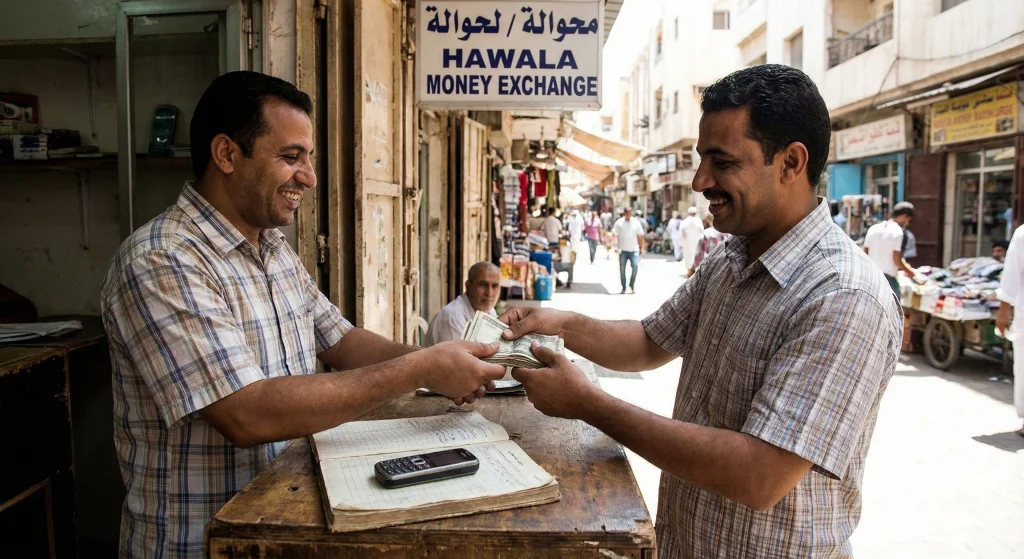
A typical IVTS transaction involves a sender giving money to a local IVTS broker, who instructs a counterpart broker in another region or country to deliver the equivalent value to the designated recipient.
Settlement between brokers occurs later through trade balancing, goods movement, cash settlements, or other informal arrangements.
This flexibility makes IVTS attractive for legitimate purposes, such as migrant remittances or rural transfers, but also vulnerable to misuse for illicit objectives.
From an AML/CFT perspective, IVTS is classified as a high-risk sector due to its anonymity, lack of documentation, cross-border flow complexity, and frequent overlap with underground economies.
Criminal networks use IVTS to obscure fund origin, bypass sanctions, disguise illicit trade proceeds, and evade law enforcement scrutiny.
IVTS in AML/CFT Frameworks
IVTS intersects with AML/CFT obligations due to its structural vulnerabilities and cross-border nature.
Financial institutions and regulators must identify when IVTS activity is entering or exiting the formal financial system, as these touchpoints often reveal risks of illicit movement.
Key intersections include:
Risk Assessment and Customer Profiling
Financial institutions must classify customers involved in high-volume cash transactions or cross-border trade with limited documentation as higher-risk segments.
Indicators associated with IVTS may include:
- Unusual cash deposits inconsistent with business operations.
- Frequent remittances to high-risk corridors without economic rationale.
- Customers closely linked to community brokers or informal financial agents.
- Trade flows with unusual pricing, quantity, or documentation patterns.
Transaction Monitoring
IVTS-related transfers often display anomalies in volume, velocity, or counterparties.
Transaction monitoring systems must capture:
- Layering patterns involving multiple small-value transfers.
- Transfers inconsistent with declared business activity.
- Funds moving rapidly through personal accounts.
- Clustering of transfers within specific ethnic or community groups aligned with known IVTS corridors.
Enhanced Due Diligence (EDD)
EDDs should be applied to individuals or businesses operating in sectors known to facilitate IVTS, such as:
- Cash-intensive businesses.
- Currency exchanges.
- Precious metals and jewellery traders.
- Small import/export businesses.
- Travel agencies and freight handlers.
EDD focuses on validating source of funds, verifying beneficial ownership, and assessing the legitimacy of business models.
Cross-Border Payments Analysis
IVTS schemes often rely on trade-based mechanisms to settle balances.
Financial institutions must analyse:
- Over- or under-invoicing trends.
- Third-party remittances without a commercial basis.
- Use of multiple intermediaries to disguise payment origin.
- Circular trade arrangements indicative of laundering attempts.
Sanctions Alignment
IVTS may be used to bypass sanctions, particularly in jurisdictions with restricted banking access.
Screening systems must consider:
- Transfers involving sanctioned countries routed through intermediaries.
- Entities with known involvement in evasion schemes.
- Beneficiaries with unclear identities or incomplete documentation.
Key Components of Informal Value Transfer Systems
Trusted Network of Brokers
IVTS brokers operate within networks built on trust, social ties, and reputational commitments.
Key features include:
- Brokers maintaining informal ledgers.
- Transactions executed based on verbal confirmation.
- Long-standing relationships reducing the need for documentation.
Parallel Settlement Mechanisms
Settlement between brokers often involves informal channels, such as:
- Trade balancing using goods shipments.
- Cash exchanges across borders.
- Use of intermediaries to net out obligations.
- Settlement via other IVTS brokers within the network.
Minimal or No Recordkeeping
Limited recordkeeping creates opacity, enabling illicit actors to exploit the system.
Common practices involve:
- Coded communication for transaction instructions.
- Absence of formal receipts or contracts.
- Reliance on memory or informal handwritten notes.
Cultural and Community-Centric Operations
IVTS often operates within specific communities or diaspora networks.
This cultural nexus strengthens operational durability and customer loyalty, but also reduces external oversight and regulatory visibility.
Speed and Cost Efficiency
IVTS transfers are typically faster and cheaper than traditional banking channels due to:
- Low operational overhead.
- Simplified communication chains.
- Absence of compliance costs or regulatory fees.
Examples of IVTS Scenarios
Migrant Remittance Networks
A worker in a foreign country gives money to a local IVTS broker, who instructs an agent in the home country to remit equivalent funds to the family.
While legitimate, such patterns require monitoring when:
- Transfers exceed typical remittance thresholds.
- Senders use multiple brokers across regions.
- Funds pass through personal or unrelated business accounts.
Trade-Based IVTS Activity
A broker settles IVTS obligations by exporting goods at inflated prices to a counterpart.
Financial institutions may flag:
- Discrepancies between declared value and market rates.
- Quick succession of related-party transactions.
- Multiple shipments with inconsistent documentation.
Laundering of Criminal Proceeds
Organised crime groups deposit illicit cash with IVTS brokers who transfer equivalent value across borders.
Settlement may involve:
- Purchasing goods abroad with clean funds.
- Offsetting accounts through trade or real estate transactions.
- Structuring deposits to avoid detection thresholds.
Sanctions Evasion and Terrorist Financing
Groups in sanctioned regions may use IVTS to receive funds from abroad.
Warning signs include:
- Frequent small transfers to individuals in high-risk jurisdictions.
- Use of intermediaries with unclear identities.
- Transfers coinciding with geopolitical events or conflict activity.
Smurfing Through IVTS Handlers
Multiple individuals deposit small amounts into accounts controlled by an IVTS operator.
Funds are then aggregated and settled offshore through informal arrangements.
Impact on Financial Institutions
Regulatory Exposure
Failure to detect IVTS-related activity can result in:
- Enforcement actions,
- Increased supervision,
- Fines for inadequate AML/CFT controls,
- Remediation mandates.
Operational Burden
Identifying IVTS patterns requires:
- Specialised typology knowledge,
- Cross-team coordination,
- Enhanced transaction monitoring,
- Detailed customer behaviour analysis.
Reputational Risk
Association with IVTS-related money laundering or sanctions evasion damages institutional credibility with regulators, partners, and customers.
Risk of Correspondent Banking Disruptions
Institutions with exposure to IVTS corridors may face:
- De-risking by correspondent banks,
- Increased scrutiny of cross-border flows,
- Additional reporting requirements.
Financial Crime Escalation
IVTS exposure can signal wider criminal networks, including:
- Drug trafficking,
- Human smuggling,
- Terrorist financing,
- Trade fraud.
Challenges in Managing IVTS Risk
Lack of Transparency
Informal operations make it difficult to identify the origin, purpose, and ultimate beneficiaries of transactions.
Cultural Embeddedness
IVTS often operates within tight-knit communities, limiting visibility and complicating investigations.
Cross-Border Complexity
Brokers operate across multiple jurisdictions with differing regulatory expectations, complicating detection and supervision.
Overlap With Legitimate Activity
Legitimate remittances may resemble illicit IVTS signals, creating challenges in distinguishing normal behaviour from suspicious patterns.
Use of Hybrid Mechanisms
Criminal networks may combine IVTS with:
- Digital payments,
- Cryptocurrency transfers,
- Trade-based laundering,
- Cash smuggling.
Limited Law Enforcement Visibility
Investigations require multi-jurisdictional cooperation, which may not always be available or effective.
Regulatory Oversight and Governance
Financial Action Task Force (FATF)
FATF identifies IVTS as a high-risk typology for money laundering and terrorist financing and recommends:
- Licensing or registration of money/value transfer services,
- Strong customer due diligence,
- Mandatory reporting of suspicious transactions.
National Regulators
Countries regulate IVTS differently, ranging from strict licensing regimes to partial oversight or full prohibition.
Key regulators include:
- Central banks,
- Financial services authorities,
- Ministries of finance.
Financial Intelligence Units (FIUs)
FIUs monitor suspicious activity reports involving:
- Unusual remittances,
- Trade anomalies,
- Community-based financial agents.
Law Enforcement Agencies
Cross-border investigations frequently involve:
- Interpol,
- Regional policing bodies,
- Customs authorities.
International Standard-Setting Bodies
Organisations including the World Bank and IMF provide policy guidance on mitigating risks associated with informal financial systems.
Importance of Addressing IVTS in AML/CFT Compliance
IVTS is an integral part of global financial ecosystems, especially in regions with limited banking access.
While the system serves legitimate humanitarian and economic needs, its vulnerabilities to financial crime demand robust AML/CFT controls.
Effective detection and mitigation enable institutions to:
- Identify risk exposure early,
- Protect customers and communities,
- Reduce regulatory and legal penalties,
- Strengthen cross-border compliance,
- Support legitimate remittance activity,
- Enhance intelligence-sharing across financial crime teams.
By adopting intelligence-led frameworks, advanced analytics, and risk-based oversight aligned with IDYC360’s intelligence-first AML architecture, institutions can mitigate IVTS risks without disrupting legitimate financial flows.
Related Terms
- Hawala
- Hundi
- Trade-Based Money Laundering
- Remittances
- Sanctions Evasion
- Value Transfer Systems
- Beneficial Ownership
References
- FATF – Money or Value Transfer Services
- World Bank – Informal Remittance Systems
- IMF – Financial Integrity and Informal Financial Flows
- Interpol – Financial Crime and Illicit Flows
Ready to Stay
Compliant—Without Slowing Down?
Move at crypto speed without losing sight of your regulatory obligations.
With IDYC360, you can scale securely, onboard instantly, and monitor risk in real time—without the friction.