

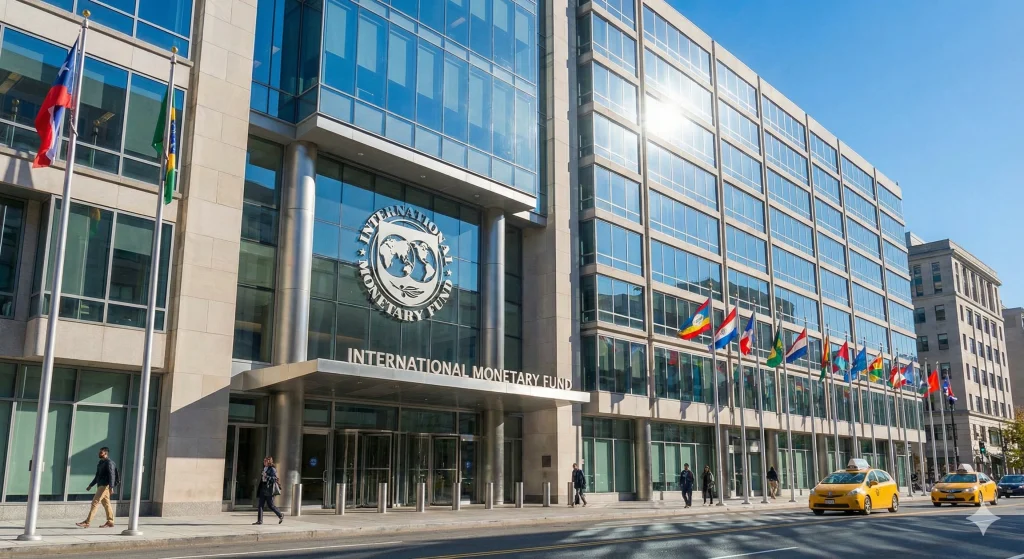
IMF: International Monetary Fund
Definition
The International Monetary Fund (IMF) is a global financial institution comprised of nearly all the world’s sovereign states.
It serves as a cooperative entity for promoting monetary stability, facilitating international trade, providing policy advice, delivering financial assistance when needed, and supporting economic growth and poverty reduction worldwide.
Explanation
Founded in the aftermath of the Second World War to rebuild and stabilise the global economic order, the IMF’s mandate is to help its members maintain balanced external payments, foster stable exchange rate systems, and avoid systemic financial crises.
Over time, the institution’s role has expanded into surveillance of global economic trends, capacity development (technical assistance and training), and offering precautionary or direct financial support to countries facing economic or balance-of-payments problems.
The IMF operates on the principle of collective responsibility: member countries contribute quotas that reflect their economic weight, and they gain access to the Fund’s resources when eligible.
In return, the IMF monitors member policies, offers recommendations, and often attaches conditions to its financial packages.
By providing a forum for international monetary cooperation, the IMF facilitates coordination of macroeconomic policies, analyzes economic trends, and identifies emerging risks to global stability.
It thus acts as an early-warning system as well as a lender of last resort to sovereign nations.
Roles & Functions
The IMF fulfils several core functions that support both individual member states and the international monetary system as a whole.
Among its principal roles are:
- Surveillance of the global economy and of each member country’s policy frameworks.
- Financial assistance to countries experiencing balance-of-payments difficulties.
- Capacity development through technical assistance and training for member states.
- Promoting international monetary cooperation and exchange rate stability.
- Providing a platform for policy dialogue among member countries and coordinating responses to global economic shocks.
These functions interlink to enable the IMF to detect systemic risks, assist members in crisis or vulnerability, and help design policy frameworks aimed at sustainable growth and stability.
Key Components of the IMF’s Work
Surveillance
The IMF monitors economic, financial, and monetary developments across its membership and beyond, identifying risks to the global system.
Its surveillance function includes:
- Regular reviews of member countries’ economic policies and outlooks.
- Publication of world economic reports, regional analyses, and thematic research.
- Bilateral consultations where the IMF assesses a country’s financial system, external position, policy settings, and vulnerabilities.
- Early-warning mechanisms that highlight contagion risk, external imbalances, or structural weaknesses.
Lending and Financial Assistance
When countries face external imbalances or crises, the IMF can provide financing under various facilities.
Features include:
- Short-term loans to correct balance-of-payments deficits and stabilise economies.
- Medium and long-term programmes with structural adjustment components for deeper reform.
- Precautionary or flexible credit lines to countries with sound policies that may face sudden shocks.
- Technical conditions attached to programmes to foster sound macroeconomic policies, debt sustainability, and transparency.
Capacity Development
To enhance member countries’ ability to manage their economies, the IMF offers:
- Technical assistance in areas such as public financial management, monetary policy, banking regulation, and statistics.
- Training programmes for policymakers and central bankers.
- Tools and guidance on governance, anti-money-laundering, and financial sector supervision.
Resource Mobilisation and Quota System
The IMF’s financial resources stem principally from member quotas, each country’s share of the institution’s capital.
This system determines:
- A country’s subscription to the Fund and its access to financing.
- A country’s voting rights and influence in IMF decision-making.
- Periodic reviews of quotas that reflect changes in global economic realignment.
Policy Advice and Technical Research
The IMF serves as a global knowledge hub by:
- Publishing working papers, statistical databases, and country economic outlooks.
- Advising on macroeconomic policy, structural reforms, debt management, and financial regulation.
- Engaging in policy dialogue with governments, central banks, and international institutions.
Examples of IMF Activities
- A country experiencing a currency crisis secures an IMF programme, implements fiscal consolidation and structural reform, and stabilises its external position.
- A low-income nation receives technical assistance to strengthen its central bank’s capacity for banking supervision and financial sector resilience.
- The IMF issues a world economic outlook report, alerting members to risks from global debt accumulation and trade tensions.
- The IMF provides a precautionary credit line to an emerging market vulnerable to external shocks and global interest-rate rises.
- The IMF and regional partners coordinate to provide emergency liquidity support following a global economic shock or pandemic.
Impact on Member Countries and the Global System
For Member Countries
- Access to IMF financing can avert sovereign default or severe currency depreciation and stabilise macroeconomic conditions.
- Policy advice and technical assistance support institutional strengthening, governance improvement, and economic resilience.
- Participation in the IMF system enhances credibility in global markets, which may reduce borrowing costs and improve investor confidence.
For the Global Monetary System
- IMF surveillance contributes to collective awareness of global economic risks, helping mitigate contagion and cross-border spill-overs.
- Coordinated responses through the IMF assist in stabilising global financial markets and managing systemic crises.
- The quota system ensures broad participation and risk-sharing among member states, reinforcing multilateralism.
Challenges and Critiques
Despite its many contributions, the IMF has faced significant criticism and operational challenges in recent decades.
Common Criticisms
- The conditions attached to IMF programmes are often seen as imposing austerity, disproportionately affecting vulnerable populations and slowing social development.
- Governance structures reflect legacy economic weights; smaller or emerging economies argue for greater voice and representation.
- Policy conditionality may undermine domestic ownership of reforms and overlook local context or political feasibility.
- Critics argue that the IMF’s focus on macroeconomic stabilisation sometimes neglects longer-term development priorities such as inequality, climate risk or inclusive growth.
- Some contend that IMF programmes prioritize financial markets and creditor interests over the social welfare of ordinary citizens.
Operational Constraints
- Balancing speed and legitimacy in crisis responses can challenge the institution.
- Accurate forecasting and effective prevention of crises remain difficult given the complexity of global interconnections.
- Ensuring that reform programmes translate into sustainable outcomes remains a persistent hurdle.
- Engaging diverse membership and maintaining relevance amidst proliferating multilateral actors adds complexity.
Relevance to AML/CFT and Financial Crime Risk
The IMF’s role intersects with AML/CFT frameworks and financial crime prevention in several respects.
It monitors global financial stability, including risks arising from illicit flows, corruption, terrorism finance, and weak governance.
By supporting institutional strengthening, promoting transparent financial systems, and enhancing regulatory frameworks, the IMF contributes indirectly to the prevention of money-laundering and terrorist-financing vulnerabilities.
Member states benefitting from IMF capacity development may strengthen their AML/CFT regimes, which in turn reinforces global financial integrity.
Related Terms
- Balance-of-Payments Crisis
- Quota and Voting Rights
- Technical Assistance
- Conditionality
- Special Drawing Rights (SDRs)
- Surveillance and Reform Programmes
References
- “What is the IMF?” International Monetary Fund
- “What Is the International Monetary Fund (IMF)?” Investopedia
- “Role of IMF” Economics Help
Ready to Stay
Compliant—Without Slowing Down?
Move at crypto speed without losing sight of your regulatory obligations.
With IDYC360, you can scale securely, onboard instantly, and monitor risk in real time—without the friction.