

ID&V: Identification and Verification
Definition
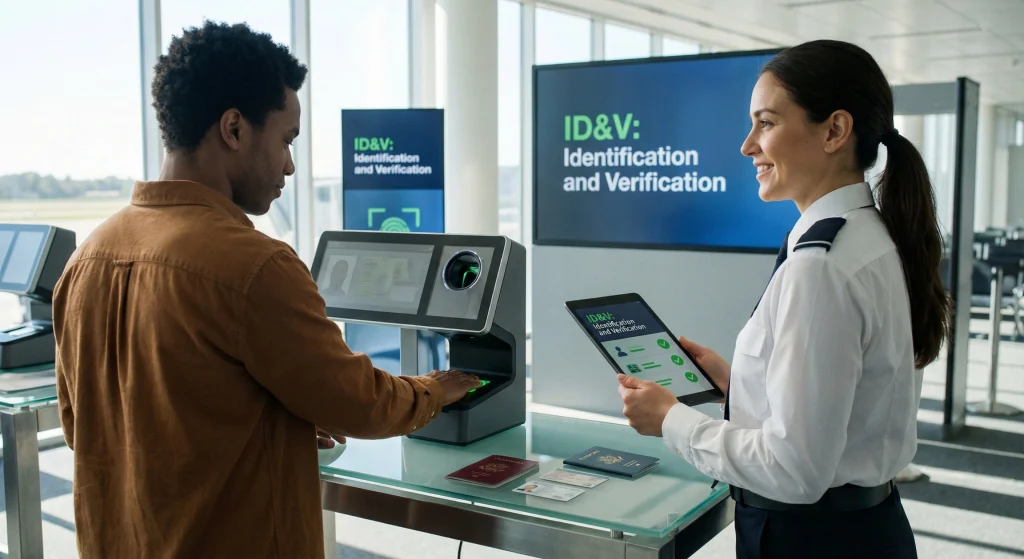
Identification and Verification (ID&V) refers to the set of processes financial institutions, fintechs, regulated entities, and service providers use to establish and authenticate the identity of a customer or counterparty.
Identification involves collecting personal, organisational, and risk-relevant information, while verification confirms the authenticity and accuracy of this data through reliable, independent sources.
In AML/CFT contexts, ID&V is a foundational control within Know Your Customer (KYC), Customer Due Diligence (CDD), and onboarding frameworks.
Effective ID&V ensures that individuals and entities transacting within the financial system are who they claim to be and that their identity documentation, biometric attributes, and supporting data have been validated in accordance with regulatory standards.
Explanation
ID&V is critical in safeguarding the financial system from misuse by criminals, money launderers, fraudsters, terrorist financiers, proliferators, and sanctioned actors.
Strong identification helps institutions gather essential customer attributes, while robust verification prevents attackers from exploiting gaps through forged documents, stolen identities, synthetic identities, or impersonation attacks.
The ID&V landscape has evolved significantly due to digitisation, remote onboarding, and increasing regulatory scrutiny.
Traditional face-to-face verification has expanded into digital identity frameworks involving biometric checks, liveness detection, identity databases, eKYC utilities, government digital ID systems, and AI-driven verification.
From an AML/CFT standpoint, ID&V not only supports compliance but also influences downstream processes such as risk scoring, transaction monitoring, enhanced due diligence (EDD), sanctions screening, and ongoing monitoring.
Inaccurate or ineffective ID&V increases the risk of onboarding bad actors, enabling the creation of mule accounts, facilitating fraudulent transactions, or supporting complex laundering networks.
ID&V in AML/CFT Frameworks
ID&V plays a central role in implementing global AML/CFT obligations.
Financial institutions must follow risk-based approaches to ensure identity accuracy before enabling access to products and services.
Customer Due Diligence (CDD)
ID&V is the first step in CDD. Institutions must:
- Collect essential identity information such as name, date of birth, address, and national identifiers.
- Verify information using independent and credible sources.
- Apply additional checks if customers belong to higher-risk categories.
- Maintain records of identification documents for audit and regulatory review.
Enhanced Due Diligence (EDD)
High-risk customers require deeper verification measures.
This includes:
- Validating additional documents.
- Verifying employment, purpose of account, or wealth source.
- Conducting biometric checks or video-based KYC.
- Screening for adverse media, sanctions, and PEP exposure.
Sanctions and Watchlist Screening
ID&V accuracy enhances matching outcomes.
Errors in identity data may result in:
- False negatives that allow sanctioned or high-risk individuals to bypass controls.
- False positives that burden operations and delay onboarding.
Screening quality is directly tied to quality of identification.
Beneficial Ownership Identification
ID&V extends beyond individuals to legal entities.
Institutions must:
- Identify directors, shareholders, and ultimate beneficial owners (UBOs).
- Verify ownership structures using corporate registries and legal documentation.
- Detect shell companies or opaque structures commonly used for laundering and tax evasion.
Ongoing Monitoring
ID&V does not end at onboarding.
Institutions must update and re-verify identity attributes when:
- Customers change key information.
- Risk profiles increase.
- Trigger events occur (e.g., unusual transactions).
Key Components of an ID&V Framework
Identity Collection
During the identification stage, institutions gather relevant details such as:
- Full legal name and aliases.
- Government-issued identification numbers.
- Address and contact details.
- Date and place of birth.
- Corporate registration IDs for legal entities.
Identity Verification Methods
Verification strengthens the integrity of the collected data. Common methods include:
- Document Verification: Checking authenticity of passports, IDs, and licences.
- Database Verification: Comparing information with government or regulated databases.
- Biometric Verification: Using facial recognition, fingerprints, or iris scans.
- Liveness Checks: Ensuring the user is physically present and not using spoofed media.
- Video KYC: Conducting remote verification through regulated video processes.
Risk-Based Controls
ID&V systems apply risk-based logic such as:
- Additional verification for high-risk geographies.
- Multi-factor identity validation for online onboarding.
- Fraud risk scoring based on behavioural patterns.
- Enhanced checks for entities operating in sensitive sectors.
Recordkeeping and Audit Trails
Institutions must maintain:
- Verified copies of documents.
- Digital logs of verification attempts.
- Metadata from biometric and electronic verification systems.
- Time-stamped audit trails for regulatory inspection.
Technology Integration
Modern ID&V systems integrate seamlessly with:
- KYC utilities,
- Fraud detection platforms,
- Sanctions screening engines,
- Identity registries,
- Onboarding workflows,
- Document authenticity checks powered by AI and OCR.
Examples of ID&V Scenarios
Remote Customer Onboarding With Document Verification
A customer uploads a passport during digital onboarding.
The system performs document authenticity checks, compares the image to biometric photos, and validates machine-readable zones to confirm identity.
Biometric Verification for High-Risk Transactions
A customer attempting a high-value transfer undergoes facial recognition verification paired with liveness detection to ensure authenticity.
Corporate Customer Verification
A business applies for an account. The institution validates business registration, cross-checks director identities, and verifies UBOs through national registries.
Mule Account Prevention
A fraudster attempts to open multiple accounts using synthetic identities.
Strong biometric and document verification prevents account creation.
Periodic Re-Verification of Customer Identity
A customer updates their KYC information. The institution re-verifies documents and performs sanctions screening to confirm continued eligibility.
Video KYC for Geographically Remote Customers
A regulated video-based KYC process validates identity when physical document review is not feasible.
Impact on Financial Institutions
Improved AML/CFT Compliance
Accurate identity verification strengthens the institution’s defence against money laundering and terrorist financing.
Reduced Fraud Exposure
Strong ID&V reduces risks such as account takeover, synthetic identity fraud, impersonation, and mule account creation.
Operational Efficiency
Automated ID&V systems decrease manual review workload, accelerating onboarding while maintaining accuracy.
Enhanced Customer Experience
Frictionless verification improves user satisfaction in digital channels while upholding compliance standards.
Regulatory Alignment
ID&V compliance demonstrates adherence to:
- FATF recommendations,
- Local AML laws,
- eKYC regulations,
- Customer onboarding guidelines issued by supervisory authorities.
Lower Financial and Reputational Risk
Strong ID&V prevents regulatory penalties, operational losses, and reputational damage associated with weak customer verification.
Challenges in ID&V Management
Document Fraud and Identity Theft
Fraudsters increasingly use:
- Forged documents,
- Deepfake images,
- Manipulated photos,
- Synthetic identities.
Institutions must deploy advanced verification mechanisms.
Global Variations in Identification Standards
Different jurisdictions have varying identity document standards, making cross-border verification complex.
Data Privacy and Consent Requirements
ID&V processes must comply with:
- GDPR,
- Data protection laws,
- Customer consent regulations.
Balancing privacy with compliance is a major challenge.
Technology Limitations
AI-based systems may struggle with:
- Poor image quality,
- Underrepresented demographics,
- Inconsistent data submissions.
Operational Burden for Complex Entities
Verifying beneficial ownership for multinational corporations requires intensive document collection and inter-jurisdictional coordination.
Maintaining Up-To-Date Identity Information
Identity details may change; institutions must ensure continuous updates through ongoing monitoring frameworks.
Regulatory Oversight & Governance
Financial Action Task Force (FATF)
FATF mandates customer identification and verification as part of its global AML/CFT standards. Institutions must apply risk-based ID&V controls.
National Regulators
Central banks, securities regulators, and financial supervisory authorities publish detailed KYC, eKYC, and video KYC guidelines.
Data Protection Authorities
Regulators oversee the secure handling of identity data and enforce privacy regulations applicable to ID&V processes.
Digital Identity Authorities
In some countries, government-led digital ID frameworks provide reliable verification sources (e.g., Aadhaar in India, BankID in Nordic countries).
Financial Intelligence Units (FIUs)
FIUs rely on the integrity of ID&V during investigation and reporting processes, especially in cases involving suspicious identity behaviour.
Importance of ID&V in AML/CFT Compliance
ID&V is a cornerstone of financial crime prevention.
It ensures that institutions transact only with legitimate customers and avoid onboarding individuals or entities involved in fraud, terrorism, proliferation, sanctions evasion, or money laundering.
Effective ID&V helps institutions:
- Verify customer authenticity,
- Prevent criminal misuse of financial systems,
- Support risk-based monitoring and investigations,
- Uphold regulatory expectations,
- Protect the integrity of digital channels,
- Strengthen institutional resilience.
In intelligence-first AML architectures, such as those advocated by IDYC360, ID&V forms the data foundation upon which risk scoring, behavioural analytics, and systemic monitoring are built.
Related Terms
- Customer Due Diligence
- Know Your Customer
- Beneficial Ownership
- Digital Identity
- Sanctions Screening
- Biometric Verification
- Risk Scoring
References
- FATF – International Standards on Customer Due Diligence
- European Banking Authority – Guidelines on Customer Due Diligence
- UK Financial Conduct Authority – KYC and AML Guidance
- Reserve Bank of India – KYC and Digital KYC Circulars
Ready to Stay
Compliant—Without Slowing Down?
Move at crypto speed without losing sight of your regulatory obligations.
With IDYC360, you can scale securely, onboard instantly, and monitor risk in real time—without the friction.

