

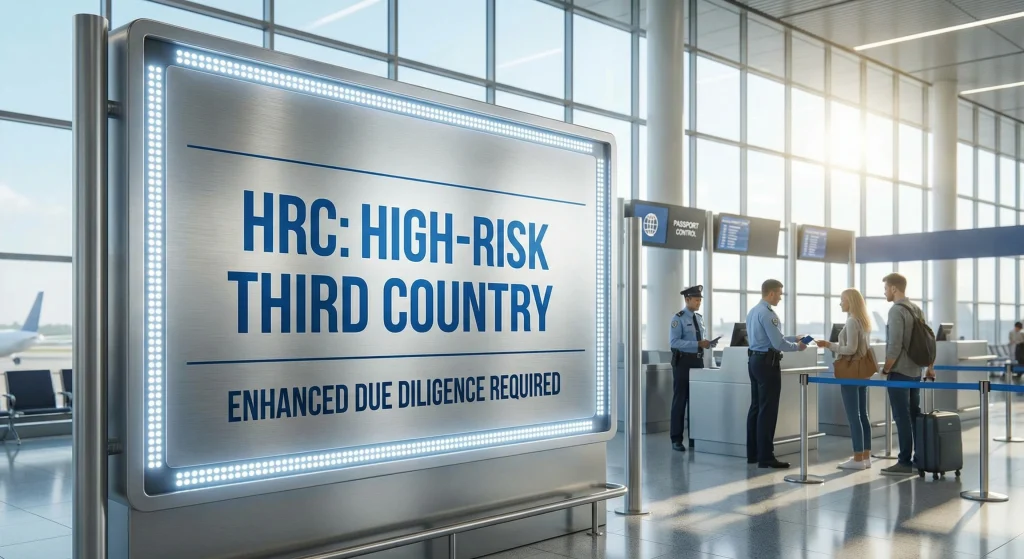
HRC: High-Risk Third Country
Definition
A High-Risk Third Country (HRC) refers to a jurisdiction identified by international regulatory bodies, regional authorities, or national governments as having strategic deficiencies in their anti-money laundering and counter-terrorist financing (AML/CFT) frameworks.
These deficiencies may relate to weak regulatory oversight, ineffective enforcement mechanisms, inadequate financial crime controls, widespread corruption, or systemic vulnerabilities that create opportunities for illicit financial activity.
In AML/CFT contexts, HRCs pose elevated risks because financial transactions, corporate structures, or cross-border activities involving these jurisdictions may enable money laundering, terrorist financing, proliferation financing, tax evasion, or fraud.
Financial institutions are required to apply enhanced due diligence (EDD), risk-based monitoring, and additional controls when dealing with customers, transactions, or beneficial owners linked to high-risk third countries.
HRC classifications often derive from FATF’s lists (High-Risk Jurisdictions Subject to a Call for Action and Jurisdictions Under Increased Monitoring), the European Union’s High-Risk Third Countries List, or national regulatory equivalents.
Explanation
High-risk third countries represent jurisdictions where AML/CFT weaknesses create significant opportunities for illicit actors.
These weaknesses may arise due to political instability, weak law enforcement, limited financial supervision, lack of beneficial ownership transparency, reliance on cash-based economies, or historically high levels of corruption.
In AML/CFT frameworks, institutions must treat connections to HRCs as red flags that demand increased scrutiny.
HRC exposure may occur through customer residency, nationality, business operations, correspondent banking partnerships, trade corridors, or transaction destinations and origins.
Designation as a high-risk third country is not necessarily a judgment about the intentions of specific entities within the jurisdiction.
Instead, it reflects a systemic assessment of the jurisdiction’s AML/CFT regime.
These assessments consider:
- Legislative gaps,
- Enforcement challenges,
- Supervisory inconsistency,
- Lack of regulatory transparency,
- Weaknesses in financial intelligence capabilities.
For institutions operating globally, HRC designations require adjustments to onboarding processes, transaction monitoring strategies, cross-border payment controls, and sanctions screening workflows.
HRC in AML/CFT Frameworks
High-risk third countries intersect with AML/CFT systems in multiple ways, shaping regulatory expectations and institutional risk management.
Customer Due Diligence (CDD) and EDD Requirements
Institutions must apply heightened scrutiny to customers or counterparties linked to an HRC.
Enhanced due diligence measures commonly include:
- Verification of beneficial ownership with independent documentation,
- Detailed understanding of source of funds and source of wealth,
- Ongoing monitoring of customer activity,
- Independent validation of corporate structures and business models.
Risk Scoring and Segmentation
Customers operating in, from, or through HRCs automatically carry elevated risk scores.
This influences:
- Onboarding decisions,
- Transaction monitoring thresholds,
- Account activity reviews,
- Periodic KYC refresh cycles.
Cross-Border Transaction Controls
Transactions involving HRCs require closer surveillance.
Controls may assess:
- Legitimacy of international trade activity,
- Consistency of transaction purpose,
- Documentary evidence supporting the payment,
- Patterns indicative of layering or round-tripping.
Correspondent Banking Considerations
Correspondent relationships with institutions in HRCs are subject to:
- Enhanced risk assessments,
- Additional contractual controls,
- Periodic review of AML/CFT frameworks,
- Continuous monitoring for suspicious behaviour.
Sanctions and Watchlist Alignment
Some high-risk third countries may overlap with jurisdictions subject to UN, EU, or national sanctions regimes.
Institutions must ensure robust screening to identify:
- Designated individuals,
- Restricted entities,
- Prohibited transactions.
Characteristics of High-Risk Third Countries
High-risk third countries often share common vulnerabilities that signal elevated exposure to financial crime risks.
- Weak governance and corruption: High levels of political influence, bribery, and lack of institutional independence.
- Inadequate AML/CFT regulation: Poor alignment with FATF standards or incomplete legal frameworks.
- Limited financial intelligence capacity: FIUs lacking resources, expertise, or operational independence.
- Weak supervisory oversight: Insufficient monitoring of banks, NBFIs, and DNFBPs.
- Opaque corporate structures: Difficulty identifying beneficial owners due to secrecy laws or lax requirements.
- High cash reliance: Large volumes of informal or cash-driven activity complicating audit traceability.
- Unmonitored cross-border flows: Vulnerability to trade-based money laundering and informal value transfer systems.
These characteristics do not apply uniformly but collectively inform regulatory designation processes.
Examples of HRC-Related Scenarios
Cross-Border Payment to a High-Risk Jurisdiction
A corporate client initiates frequent payments to a supplier located in an HRC without adequate documentation or explanation.
The institution triggers enhanced due diligence and escalates the activity for investigation.
Beneficial Ownership Obfuscation
A customer uses a company incorporated in an HRC to hold assets in multiple jurisdictions.
The corporate structure contains nominee directors and unclear ownership links, prompting deeper reviews and risk classification.
Trade-Based Money Laundering Through High-Risk Corridors
A trading company routes goods through multiple HRCs with inconsistent documentation, inflated invoices, and mismatched cargo details indicative of layering.
Correspondent Banking Exposure
A bank maintains a correspondent relationship with an institution headquartered in an HRC.
Regulators require independent verification of the partner’s AML controls and periodic reassessment.
Crypto and Digital Asset Transactions
A customer transfers digital assets to exchanges or wallets registered in HRCs known for weak regulation and anonymity-enhanced services.
Monitoring flags the pattern for review.
Cash-Intensive NGO Operating in High-Risk Zones
A nonprofit working in conflict-affected HRCs routinely withdraws and distributes large cash amounts with limited audit evidence.
The institution treats the activity as a high-risk profile under AML/CFT guidelines.
Impact on Financial Institutions
Regulatory Obligations
Institutions must comply with stringent regulatory expectations when dealing with HRCs.
Non-compliance may result in:
- Enforcement actions,
- Penalties,
- Remediation obligations,
- Loss of correspondent relationships.
Operational Complexity
HRC exposure requires enhanced onboarding procedures, additional documentation, and escalated reviews, increasing operational workload.
Reputational Risk
Banking customers linked to HRC-related financial crime can damage institutional reputation and weaken public trust.
Transaction Delays and Customer Friction
Enhanced controls may slow down payment processing or onboarding, affecting customer experience.
However, regulators expect institutions to prioritise risk reduction.
Heightened Suspicious Reporting
HRC-linked activity is more likely to generate Suspicious Transaction Reports (STRs), increasing volume and complexity for AML teams.
Impact on Product Risk Assessment
Products such as cross-border transfers, trade finance, corporate banking, and digital assets carry higher inherent risk when linked to HRCs.
Challenges in Managing HRC Risk
Rapidly Changing Regulatory Lists
HRC lists evolve frequently. Institutions must ensure timely updates to avoid outdated controls or unintended violations.
Fragmented Global Standards
Different authorities use their own criteria to classify high-risk countries, creating inconsistencies for multinational institutions.
Limited Data Transparency
Public records, beneficial ownership data, and regulatory filings in HRCs may be incomplete, inaccurate, or unavailable.
Complex Networks and Intermediaries
Cross-border networks involving multiple intermediaries make tracing beneficial ownership difficult.
False Negatives and Hidden Exposure
Customers may conceal links to HRCs through:
- Offshore structures,
- Intermediaries,
- Nominee arrangements,
- Relocation strategies.
Operational Burden of Continuous Monitoring
Enhanced due diligence requires ongoing assessments rather than one-time checks, adding strain to AML teams.
Regulatory Oversight & Governance
Financial Action Task Force (FATF)
FATF publishes two primary lists that influence HRC designation:
- High-Risk Jurisdictions Subject to a Call for Action (often referred to as the “blacklist”),
- Jurisdictions Under Increased Monitoring (often referred to as the “greylist”).
These lists influence global AML/CFT risk classification and regulatory expectations.
European Union (EU) High-Risk Third Countries List
The EU maintains its own HRC list aligned with FATF’s assessments but may include additional jurisdictions based on EU-specific criteria.
National Regulators and Supervisory Authorities
Many jurisdictions maintain national high-risk country classifications for their financial institutions, affecting onboarding policies and monitoring standards.
Financial Intelligence Units (FIUs)
FIUs monitor suspicious activity involving HRCs and issue alerts, advisories, and intelligence reports to guide institutions.
International Organisations
Bodies such as the United Nations (UN), World Bank, IMF, and OECD provide additional assessments on governance, corruption, and regulatory frameworks influencing HRC categorisation.
Importance of HRC Controls in AML/CFT Compliance
High-risk third countries represent a critical focal point for AML/CFT efforts.
Proper identification and mitigation of HRC exposure enable institutions to:
- Protect themselves from illicit financial flows,
- Prevent misuse of financial systems,
- Enhance their overall risk-based frameworks,
- Comply with domestic and international regulations,
- Maintain correspondent banking access,
- Strengthen trust with regulators and partners.
By integrating intelligence-led monitoring, dynamic risk scoring, and robust governance frameworks, such as IDYC360’s intelligence-first AML architecture, institutions can effectively manage risks associated with high-risk third countries and respond proactively to emerging threats.
Related Terms
- Country Risk
- Enhanced Due Diligence
- Sanctions Screening
- Cross-Border Payments
- Risk Scoring
- Correspondent Banking
- Beneficial Ownership Transparency
References
- FATF – High-Risk Jurisdictions Subject to a Call for Action
- European Commission – High-Risk Third Countries List
- IMF – Governance and Anti-Corruption Resources
- UNODC – Global Illicit Flows and AML/CFT Capacity
Ready to Stay
Compliant—Without Slowing Down?
Move at crypto speed without losing sight of your regulatory obligations.
With IDYC360, you can scale securely, onboard instantly, and monitor risk in real time—without the friction.