

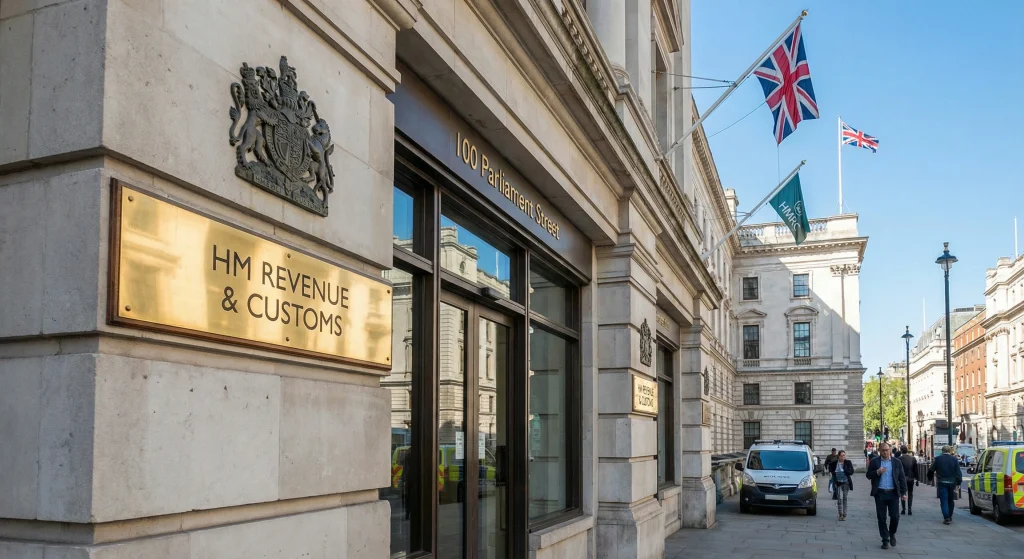
HMRC: HM Revenue & Customs
Definition
HM Revenue & Customs (HMRC) is the United Kingdom’s tax, payments, and customs authority responsible for collecting taxes, administering state support schemes, enforcing customs regulations, and safeguarding the integrity of the UK’s financial system.
Established in 2005 through the merger of the Inland Revenue and HM Customs and Excise, HMRC plays a critical role in the prevention, detection, and disruption of financial crime, including tax evasion, money laundering, terrorist financing, fraud, and trade-based illicit activity.
In AML/CFT contexts, HMRC functions as both a supervisory authority and an enforcement body.
It supervises certain sectors under the UK Money Laundering Regulations (MLRs), conducts risk assessments, issues penalties for non-compliance, and collaborates with national and international agencies to combat financial crime.
Explanation
HMRC operates across multiple domains of financial governance: tax administration, customs enforcement, AML/CFT supervision, and criminal investigation.
Its authority extends to overseeing compliance frameworks, monitoring cross-border trade activity, and ensuring organisations within its remit adhere to the MLRs.
HMRC has powers to conduct civil and criminal investigations, impose penalties, seize assets, and prosecute financial crime offences.
HMRC’s role in AML/CFT is multifaceted.
It supervises non-financial and financial entities such as high-value dealers, trust or company service providers (TCSPs), estate agency businesses, money service businesses (not supervised by the FCA), accountancy service providers, and bill payment service providers.
These sectors are commonly targeted for misuse by criminals seeking to hide beneficial ownership, obscure the source of funds, or move illicit proceeds across borders.
The agency also participates in intelligence-led operations involving tax fraud, VAT carousel schemes, money laundering networks, crypto-asset misuse, and evasion of import/export controls.
HMRC collaborates with the UK Financial Intelligence Unit (UKFIU), the National Crime Agency (NCA), Border Force, international customs unions, and law enforcement to detect suspicious behaviours and financial abuse.
HMRC in AML/CFT Frameworks
HMRC integrates AML/CFT responsibilities through supervision, investigation, and policy enforcement.
Its role connects directly to financial institutions and regulated sectors through:
Supervision Under the Money Laundering Regulations
HMRC is one of the UK’s designated AML/CFT supervisory authorities.
It oversees compliance in sectors vulnerable to money laundering and terrorist financing. HMRC supervises entities that include:
- Estate agency businesses
- Money service businesses not supervised by the FCA
- High-value dealers
- TCSPs
- Accountancy service providers
- Art market participants
- Bill payment service providers
These sectors present elevated risks, given their exposure to cash payments, cross-border transfers, and beneficial ownership concealment.
Registration and Compliance Monitoring
Supervised businesses must register with HMRC and maintain compliance with risk assessment requirements, customer due diligence (CDD), ongoing monitoring, record-keeping, and staff training obligations.
HMRC conducts assessments through:
- Desk-based reviews
- On-site inspections
- Targeted interventions
- Thematic reviews based on typologies
Non-compliance may result in penalties, restrictions, or deregistration.
Suspicious Activity Reporting (SAR) Integration
HMRC has visibility into SARs submitted by businesses it supervises.
It collaborates with the NCA and the UKFIU to ensure that SARs related to tax evasion, trade fraud, or money laundering are analysed and escalated appropriately.
Tax Crimes as Predicate Offences
Tax evasion is a predicate offence to money laundering under UK law.
HMRC plays a vital role in:
- Identifying illicit wealth
- Detecting undeclared income
- Tracing funds through complex ownership structures
- Coordinating with financial institutions during investigations
Cross-Border Trade and Customs Enforcement
Customs controls represent a significant overlap between HMRC’s operational jurisdiction and AML/CFT risks.
High-risk areas include:
- Misclassification of goods
- Under-invoicing or over-invoicing
- Abuse of duty relief schemes
- Use of shell companies in import/export chains
- Illicit trade financing
These vulnerabilities are often exploited by organised crime networks, sanctions evaders, and money launderers.
Crypto-Asset Investigations
HMRC investigates misuse of crypto-assets for tax evasion, fraud, and money laundering.
Its powers allow access to customer data from crypto exchanges operating in the UK, and it may impose penalties for non-disclosure or inaccurate reporting.
Key Components of HMRC’s AML/CFT Responsibilities
Registration and Supervision
Businesses falling within HMRC’s supervisory remit must register and maintain compliance. Key supervisory components include:
- Risk-based inspections of regulated entities
- Monitoring changes in beneficial ownership
- Ensuring compliance with CDD and EDD processes
- Evaluating internal controls and governance frameworks
Policy and Guidance Development
HMRC publishes extensive AML/CFT guidance to help businesses interpret regulatory requirements.
This includes:
- Sector-specific risk guidance
- Internal control expectations
- Customer due diligence best practices
- Typology updates based on intelligence
Data and Intelligence Sharing
HMRC collaborates with domestic partners and international agencies through:
- The UK Joint Money Laundering Intelligence Taskforce (JMLIT)
- Europol and Interpol networks
- Cross-border tax cooperation agreements
- The OECD Common Reporting Standard (CRS)
These partnerships help identify tax and financial crime across jurisdictions.
Civil and Criminal Enforcement
HMRC’s enforcement actions may include:
- Civil penalties
- Criminal investigation and prosecution
- Search and seizure
- Freezing orders
- Confiscation of proceeds
- Disqualification of directors
Trade-Based Money Laundering (TBML) Controls
HMRC plays a central role in detecting TBML through customs and trade data.
Red flags include:
- Unusual commodity routes
- Mislabelled goods
- Discrepancies in invoices
- Unexplained under-valuation or over-valuation
Counter-Terrorist Financing (CTF) Oversight
HMRC supports efforts to identify charities, NGOs, businesses, or individuals whose activities may intersect with CTF risk indicators.
Examples of HMRC AML/CFT Scenarios
Unregistered Money Service Business
HMRC identifies a business offering informal remittance services without AML registration.
The investigation reveals cash-based transfers to high-risk jurisdictions without CDD, leading to significant penalties and criminal charges.
High-Value Dealer Violations
A jewellery retailer accepts multiple cash payments above regulatory thresholds without performing due diligence.
HMRC issues fines and conducts an on-site inspection uncovering links to organised crime.
Estate Agency AML Failures
An estate agency fails to verify beneficial ownership for high-value property purchases linked to offshore entities.
HMRC imposes penalties and mandates corrective measures.
VAT Carousel Fraud Ring
HMRC disrupts a cross-border VAT fraud network involving fictitious import/export chains, identifying layered money laundering activities within partner entities.
Crypto-Asset Tax Evasion Scheme
HMRC obtains data from a UK-based crypto exchange revealing undeclared gains.
Investigations uncover interlinked wallets used to obscure taxable income and launder proceeds.
Illicit Trade and Smuggling
HMRC intercepts misdeclared goods crossing UK borders. Further investigation reveals a larger network engaged in customs fraud, TBML, and tax evasion.
Impact on Financial Institutions
Although not a direct supervisor of mainstream financial institutions, HMRC significantly influences the AML/CFT landscape in which banks, fintechs, and payment providers operate. Impacts include:
Heightened Reporting Expectations
Financial institutions must:
- Report suspicious tax-related behaviour
- Flag unusual cross-border activity
- Support investigations involving fraud or evasion
Customer Risk Scoring Integration
Banks integrate HMRC risk signals such as:
- Businesses operating in HMRC-supervised sectors
- Customers penalised by HMRC for AML lapses
- Entities with tax irregularities
Operational Disruption During Investigations
Financial institutions may be required to:
- Freeze accounts
- Provide transactional data
- Respond to production orders
- Support asset recovery
Reputational Considerations
Institutions linked to tax crimes or TBML may face:
- Regulatory scrutiny
- Media exposure
- Correspondent banking challenges
Collaborative Risk Mitigation
HMRC intelligence supports financial institutions in refining risk models, enhancing detection controls, and adjusting transaction monitoring thresholds.
Challenges in Managing HMRC-Related AML/CFT Risk
Complexity of Tax and Customs Ecosystems
Financial institutions must understand HMRC-related risk indicators that intersect with:
- Tax evasion
- Duty fraud
- TBML
- Smuggling networks
Evolving Regulatory Expectations
HMRC continually updates:
- Guidance
- Penalty structures
- Risk typologies
- Supervisory expectations
Institutions must adapt rapidly to stay compliant.
Opaque Ownership Structures
Criminals exploit company formation processes to obscure beneficial ownership and mislead HMRC.
This creates challenges for CDD and EDD.
Cross-Border Dependencies
Global trade networks and offshore financial centres introduce complexity in understanding:
- Supply chain flows
- Customs declarations
- Tax obligations
High Volume of Regulated Businesses
HMRC supervises thousands of businesses, many of which lack sophisticated AML controls, creating systemic vulnerability.
Regulatory Oversight & Governance
UK Money Laundering Regulations (MLRs)
HMRC enforces key components of the MLRs across its supervised sectors, ensuring risk-based compliance.
National Crime Agency (NCA)
HMRC collaborates with the NCA on large-scale financial crime investigations involving laundering, evasion, and organised crime.
UK Financial Intelligence Unit (UKFIU)
SARs involving tax crime or fraudulent behaviour are shared with HMRC where relevant.
Joint Money Laundering Intelligence Taskforce (JMLIT)
HMRC participates in public–private intelligence-sharing initiatives to combat financial crime.
Border Force and International Customs Bodies
HMRC works with global and regional customs networks to detect illicit trade and high-risk cross-border movement.
Importance of HMRC in AML/CFT Compliance
HMRC represents a critical pillar of the United Kingdom’s financial crime ecosystem.
Its supervisory, investigative, and enforcement capabilities directly support the identification and mitigation of high-risk activity within the financial sector and regulated non-financial businesses.
Effective collaboration with HMRC helps institutions:
- Enhance detection of tax-linked laundering
- Strengthen oversight of high-risk sectors
- Improve cross-border financial crime visibility
- Support compliance with national regulations
- Maintain operational integrity and public trust
With the increasing sophistication of tax fraud, customs abuse, and cross-border illicit finance, HMRC’s role remains essential to safeguarding the UK’s financial stability and supporting global AML/CFT efforts.
Related Terms
- Tax Evasion
- Trade-Based Money Laundering
- Money Service Businesses
- Beneficial Ownership
- High-Value Dealers
- Suspicious Activity Reports
- Customs Enforcement
References
- HMRC – Anti-Money Laundering Supervision
- HMRC – Tax Evasion and Enforcement
- UK National Crime Agency – Financial Crime
- FATF – Country Evaluation: United Kingdom
Ready to Stay
Compliant—Without Slowing Down?
Move at crypto speed without losing sight of your regulatory obligations.
With IDYC360, you can scale securely, onboard instantly, and monitor risk in real time—without the friction.