

Geographic Risk
Definition
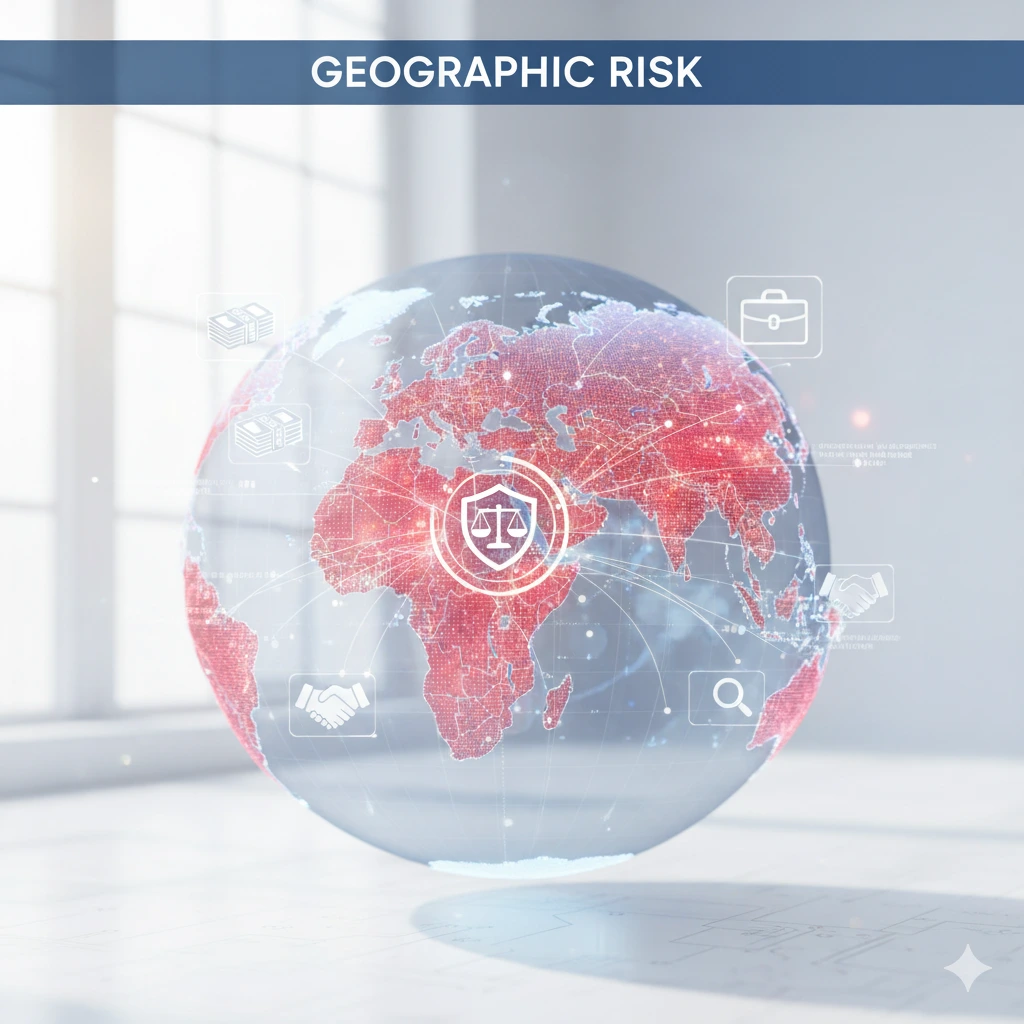
Geographic risk refers to the potential exposure to money laundering, terrorist financing, proliferation financing, fraud, and other financial crimes arising from a customer’s location, transactional corridors, operational footprint, or exposure to specific jurisdictions.
These risks stem from factors such as weak regulatory environments, high corruption levels, sanctioned jurisdictions, active conflict zones, tax havens, or regions with known vulnerabilities in financial governance.
In AML/CFT contexts, geographic risk is used by financial institutions and regulators to classify jurisdictions based on their effectiveness in combating financial crime.
High-risk geographies often correspond to jurisdictions with inadequate AML/CFT controls, ongoing sanctions, political instability, or significant levels of organised crime.
Geographic risk forms a core component of risk-based approaches in customer due diligence, transaction monitoring, sanctions compliance, and cross-border payment risk assessments.
Explanation
Geographic risk is a foundational pillar of AML/CFT frameworks because illicit financial activity frequently exploits cross-border channels, jurisdictional arbitrage, and gaps in international financial regulation.
Criminals often route funds through multiple countries to disguise origin, ownership, and intent.
Jurisdictions with weak supervisory structures or opaque corporate frameworks are particularly attractive to financial criminals.
Financial institutions must remain vigilant when dealing with customers or transactions associated with high-risk countries.
This risk applies not only to the country where the customer is located but also to the origin and destination of payments, the residence of beneficial owners, the location of counterparties, and the countries where business activities occur.
Geographic risk is not solely negative.
Certain jurisdictions may be high-risk due to geopolitical context rather than criminal intent.
Institutions must therefore apply risk-based, context-specific judgment, ensuring that controls reflect genuine exposure rather than blanket assumptions.
Geographic Risk in AML/CFT Frameworks
Geographic risk influences nearly every AML/CFT function.
It shapes customer onboarding, ongoing monitoring, sanctions screening, correspondent banking, and enhanced due diligence.
Key intersections include:
Customer Due Diligence (CDD)
Customers or beneficial owners located in high-risk jurisdictions require assessment to determine the legitimacy of their activities, the strength of local regulatory oversight, and the nature of cross-border exposure.
Enhanced Due Diligence (EDD)
EDD applies when customers or transactions involve jurisdictions with elevated AML/CFT concerns.
EDD may include:
- Obtaining additional documentation on beneficial ownership.
- Verifying the legitimacy of business operations in-country.
- Conducting adverse media checks on foreign partners.
- Reviewing the purpose and nature of international transactions.
Transaction Monitoring
Geographic risk enhances the analysis of cross-border payments.
Rules and monitoring models may flag transactions involving:
- High-risk regions.
- Sanctioned territories.
- Countries with contradictory AML/CFT stances to international standards.
Sanctions Screening
Jurisdictions subject to UN, EU, US OFAC, or other national sanctions represent elevated risk.
Screening systems must incorporate:
- Country-level sanctions.
- Sectoral and trade sanctions.
- Sanctions related to proliferation financing.
Correspondent Banking Relationships
Banks rely heavily on geographic risk ratings when onboarding or maintaining correspondent accounts, particularly with institutions located in:
- Offshore jurisdictions.
- Countries with strategic AML/CFT deficiencies.
- Regions known for corruption or organised crime.
Trade Finance and Cross-Border Activities
Geographic risk affects trade-based AML, especially when shipments, suppliers, or logistics chains intersect jurisdictions known for:
- Weak customs enforcement.
- High levels of smuggling.
- Dual-use or proliferation-sensitive goods.
Key Contributors to Geographic Risk
Geographic risk arises from multiple interconnected factors. Common contributors include:
Weak AML/CFT Regulatory Environments
Countries lacking strong financial supervision, enforcement capabilities, or regulatory transparency contribute significantly to global financial crime exposure.
Sanctioned or Embargoed Jurisdictions
Regions under international sanctions, including those related to terrorism, nuclear proliferation, or human rights violations, pose a heightened risk for financial institutions.
Conflict Zones and Fragile States
Countries experiencing active conflict or political instability face disruptions in financial oversight and increased exposure to illicit financing networks.
High-Corruption Environments
Jurisdictions with entrenched corruption create opportunities for bribery, embezzlement, and state-linked money laundering activities.
Tax Havens and Offshore Centres
Certain countries offer secrecy-driven financial infrastructures with minimal tax obligations, attracting both legitimate tax planning and illicit finance.
Regions With High Levels of Organised Crime
Countries with active drug trafficking, human trafficking, smuggling, and arms networks create a significant money laundering risk.
Jurisdictions With Known Terrorist Activity
Areas with terrorist groups or extremist networks present high risk for terrorist financing, fundraising, and channelled donations.
Examples of Geographic Risk Scenarios
Cross-Border Payments to High-Risk Jurisdictions
A corporate customer frequently sends payments to entities located in a jurisdiction identified as having significant AML deficiencies.
Monitoring systems flag inconsistent business justification and limited documentation.
Customer Based in a Sanctioned or Restricted Region
A newly onboarded customer lists an address, business operations, or beneficial ownership in a country currently subject to international sanctions.
EDD is triggered, and additional screening is required.
Use of Offshore Jurisdictions for Layering
Funds originating from multiple offshore financial centres appear in a customer’s account through layered transactions with complex ownership structures.
Investigators determine possible attempts to obscure beneficial ownership.
Charitable Transfers to High-Risk Conflict Zones
A charity sends funds to a region experiencing active conflict.
While humanitarian intent may be genuine, the lack of transparent distribution channels increases terrorist financing risk.
Trade Finance Exposure to Weak Customs Jurisdictions
A shipment involving dual-use goods transits through a country known for poor customs enforcement, raising proliferation financing concerns.
Payments Through Intermediaries in High-Corruption Countries
A customer uses intermediaries located in countries ranked poorly on corruption indices, increasing the risk of bribery-linked money flows.
Impact on Financial Institutions
Geographic risk, if unmanaged, can expose institutions to significant consequences:
Regulatory Penalties
Institutions that fail to properly classify and mitigate geographic risk may face enforcement actions, fines, and remediation mandates from regulators.
Reputational Damage
Association with high-risk jurisdictions can damage trust among customers, partners, and correspondent banks.
Operational Burden
Managing geographic risk requires:
- Additional documentation.
- Intensive due diligence.
- Continuous transaction monitoring.
This increases the workload for compliance teams.
Correspondent Banking De-Risking
Banks may lose correspondent relationships if perceived to have inadequate geographic risk controls, affecting cross-border banking capabilities.
Suspicious Reporting Obligations
Geographic anomalies frequently trigger STR/SAR filings, especially when combined with:
- High-value transfers,
- Unusual transaction behaviour,
- Opaque counterparties.
Heightened Scrutiny From Global Regulators
Jurisdictions with active regulators may require institutions to demonstrate ongoing monitoring of geographic risk exposure, especially when dealing with foreign customers.
Challenges in Managing Geographic Risk
Changing Geopolitical Landscape
Political shifts, conflict developments, and sanctions updates occur rapidly, making static geographic risk assessments inadequate.
Inconsistent International Standards
Different countries maintain varying AML/CFT enforcement levels. Some may appear compliant on paper but show weak implementation in practice.
Data Availability and Reliability
In certain countries, publicly accessible corporate records, beneficial ownership data, and regulatory disclosures are limited, complicating risk assessments.
Over-Reliance on Public Indices
Indices such as corruption rankings or AML evaluations provide helpful signals but must be supplemented with institution-specific intelligence.
Cross-Border Payment Complexity
Multi-hop cross-border transactions can obscure the true origin or destination of funds, reducing visibility into geographic exposure.
Balancing Risk and Financial Inclusion
Institutions must avoid blanket de-risking that may exclude legitimate customers or humanitarian organisations operating in high-risk regions.
Regulatory Oversight & Governance
Financial Action Task Force (FATF)
FATF publishes lists of high-risk and other monitored jurisdictions requiring heightened action from financial institutions.
National Regulators and Supervisory Authorities
Regulators require risk-based assessments of customer geography, transaction corridors, and exposure to high-risk jurisdictions.
Sanctions Authorities
Agencies such as OFAC, the EU Council, HM Treasury, and the UN Security Council regularly issue geographic sanctions that institutions must enforce.
International Development and Security Bodies
Organisations like the World Bank, IMF, and United Nations publish assessments on governance, corruption, and economic fragility, influencing geographic risk analysis.
FIUs and Law Enforcement
FIUs analyse suspicious reports tied to high-risk jurisdictions and share intelligence on cross-border financial crime trends.
Importance of Managing Geographic Risk in AML/CFT Compliance
Effective management of geographic risk strengthens financial institutions’ resilience against cross-border criminal activity.
Geographic risk assessments support:
- Protection against money laundering and terrorist financing.
- Enhanced visibility into global financial flows.
- Prioritisation of resources toward high-risk customers and corridors.
- Alignment with global regulatory expectations.
- Better decision-making around correspondent banking and trade finance exposure.
Geographic risk will continue to evolve alongside geopolitical events, technological developments, and regulatory changes.
Integrating intelligence-led frameworks, such as IDYC360’s intelligence-first AML approach, ensures institutions maintain adaptive, real-time geographic risk controls.
Related Terms
- Sanctions Risk
- Country Risk
- Cross-Border Payments
- Correspondent Banking
- Enhanced Due Diligence
- Proliferation Financing
- Terrorist Financing
References
- FATF – High-Risk and Other Monitored Jurisdictions
- Transparency International – Corruption Perceptions Index
- OFAC – Sanctions Programs and Country Listings
- World Bank – Governance Indicators
Ready to Stay
Compliant—Without Slowing Down?
Move at crypto speed without losing sight of your regulatory obligations.
With IDYC360, you can scale securely, onboard instantly, and monitor risk in real time—without the friction.