

Free Trade Zone (FTZ)
Definition
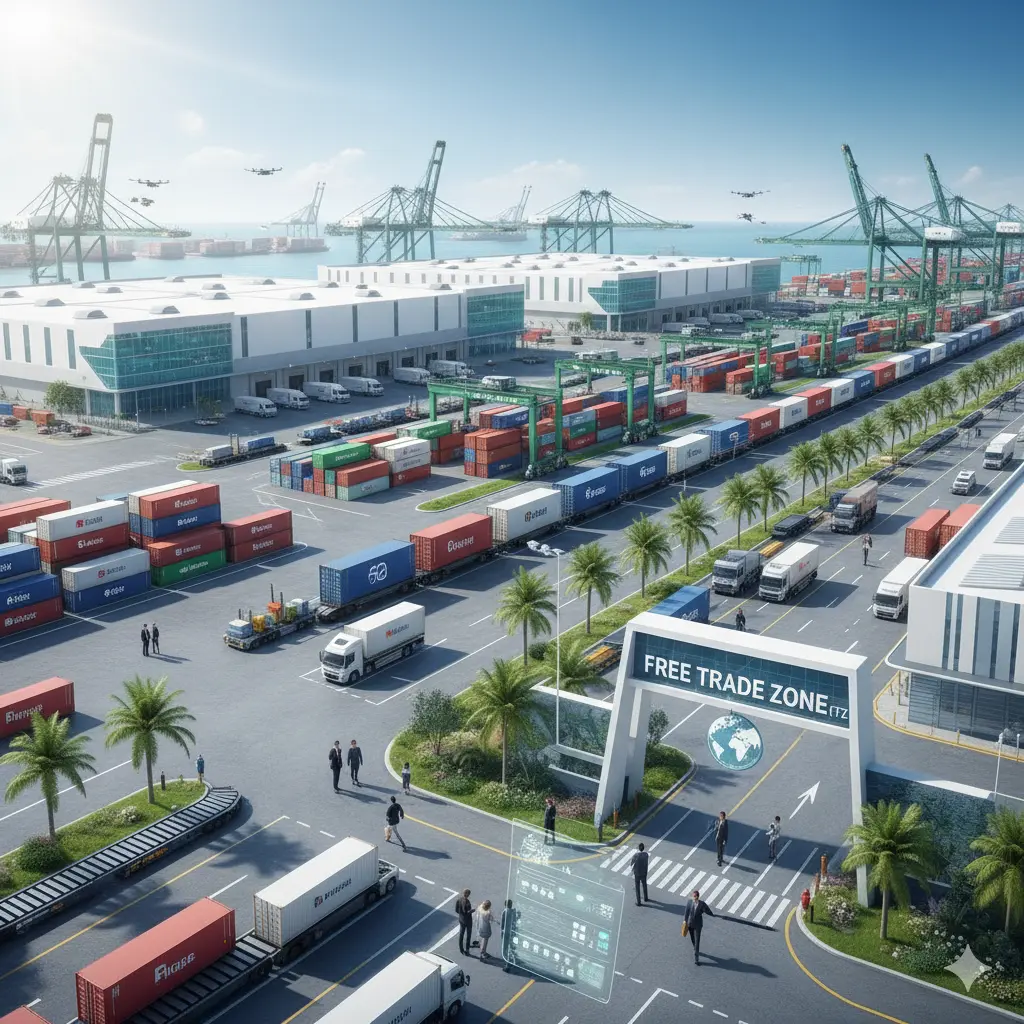
A Free Trade Zone (FTZ) is a designated geographic area within a country where goods may be imported, stored, processed, manufactured, or re-exported with reduced customs oversight and preferential regulatory treatment.
These zones often provide tax incentives, simplified customs procedures, and relaxed regulatory requirements to promote trade, investment, and economic development.
In AML/CFT contexts, FTZs represent areas of elevated financial crime risk because their reduced oversight, high trade volumes, and complex supply chains may be exploited for illicit purposes.
Fraudsters, money launderers, proliferation networks, and organised crime groups often misuse FTZs to obscure the origin, ownership, or destination of goods and financial flows.
FTZs play a legitimate role in international commerce, but their structural vulnerabilities require enhanced controls to mitigate misuse in laundering schemes, trade fraud, sanctions evasion, and terrorist financing.
Explanation
Free Trade Zones operate at the intersection of customs regulation, international trade, and cross-border financial activity.
By design, FTZs provide commercial benefits: faster movement of goods, less administrative overhead, and flexibility in processing or repackaging items before re-export.
However, these same characteristics create opportunities for illicit actors.
Many FTZs allow companies to incorporate with minimal documentation, maintain low levels of financial transparency, and operate warehouses that facilitate the bulk movement of goods.
These features attract legitimate traders seeking efficiency but also attract criminals seeking anonymity.
Financial crime risks in FTZs include:
- Misrepresentation of goods, values, or quantities.
- Use of shell companies or opaque ownership structures.
- Manipulation of trade documents such as invoices, bills of lading, certificates of origin, and customs declarations.
- Trans-shipment of dual-use or restricted goods through intermediaries.
- Movement of bulk cash or high-value commodities through minimally supervised facilities.
In AML/CFT frameworks, FTZs are frequently associated with trade-based money laundering (TBML), sanctions evasion, smuggling, counterfeiting networks, and proliferation financing.
Regulators such as FATF have highlighted FTZs as high-risk environments that require stronger governance and AML/CFT controls.
Free Trade Zone (FTZ) in AML/CFT Frameworks
FTZs intersect with AML/CFT compliance through their role in cross-border trade, corporate structuring, and financial flows.
Financial institutions supporting clients operating in FTZs must apply enhanced risk assessments and controls.
Risk Assessment and Classification
Institutions classify FTZ-based customers as higher risk due to elevated exposure to:
- Trade-based money laundering schemes.
- Unverifiable end-use of goods.
- High-volume cash transactions.
- Trans-shipment routes involving sanctioned or high-risk jurisdictions.
Customer Due Diligence (CDD) and Enhanced Due Diligence (EDD)
Working with FTZ entities requires understanding:
- The purpose of operations in the zone.
- Ownership structures and beneficial owners.
- Supply-chain partners, freight forwarders, and intermediaries.
- The nature of goods traded, including dual-use items.
- Historical compliance issues linked to specific FTZs.
EDD may include verifying warehouse locations, site inspections (where feasible), and validating licenses for controlled goods.
Corporate Structure Verification
FTZs often allow easy incorporation with minimal transparency.
Institutions must scrutinise:
- Shell companies and nominee arrangements.
- Unusual changes in ownership or directorship.
- Entities with no physical presence or operational footprint.
- Organisations using shared addresses or virtual offices.
Transaction Monitoring
Transactions related to FTZ entities may show red flags such as:
- Large discrepancies between invoice value and market value.
- Rapid movement of funds unrelated to shipment timelines.
- Payments to unfamiliar intermediaries without commercial justification.
- Sudden shifts in trade volumes or goods types.
- Circular or round-tripping payment flows.
Sanctions and Export Control Screening
FTZs are often transit points for goods bound for sanctioned jurisdictions.
Screening must include:
- Dual-use goods classifications.
- High-risk commodities (e.g., electronics, chemicals, industrial machinery).
- Counterparties operating in multiple jurisdictions.
- Vessels or logistics companies on watchlists.
Cross-Border Flow Monitoring
Complex multi-leg trade routes through FTZs may obscure the true origin or destination of goods.
Monitoring must evaluate:
- Trans-shipment routes involving sanctioned or embargoed regions.
- Use of intermediaries in secrecy jurisdictions.
- Documentation inconsistencies across supply chains.
Key Components of FTZ Risks
Reduced Customs Oversight
FTZs typically allow simplified customs procedures.
While beneficial for efficiency, this can lead to:
- Undeclared goods.
- Misclassification of items.
- Limited supervision of in-zone storage or processing.
Opaque Corporate Structures
Many FTZs allow companies to register with:
- Minimal disclosure requirements.
- Nominee shareholders or directors.
- Limited reporting obligations.
This opacity facilitates illicit ownership concealment.
High-Volume, Rapid Movement of Goods
The velocity and scale of trade in FTZs create opportunities for:
- Trade document manipulation.
- Trojans within legitimate consignments.
- Smuggling of restricted goods.
Bulk Cash and Commodity Movement
Some FTZs permit cash-based transactions or use of high-value commodities like gold, electronics, cigarettes, and alcohol, common tools in laundering schemes.
Multiple Jurisdiction Interactions
FTZs are often integrated with ports, airports, and land borders. This creates opportunities for:
- Trans-shipment fraud.
- Use of FTZs as staging points for sanctions evasion.
- Mixing of legitimate and illicit goods.
Lenient Licensing and Auditing Requirements
Weak regulatory oversight in certain FTZs enables:
- Fraudulent invoicing.
- Phantom suppliers.
- Misuse of warehousing operations.
- Counterfeit goods production.
Examples of FTZ Misuse Scenarios
Misdeclared Goods in Trans-shipment
A company operating in an FTZ falsely declares the type or value of goods to avoid duties or disguise dual-use shipments.
The goods are re-exported to a high-risk jurisdiction.
Phantom Trading Company
A shell entity registered in an FTZ claims to conduct legitimate trade but has no warehouse, staff, or operational activity.
Funds flow rapidly through multiple countries, indicating layering.
Counterfeit Goods Distribution Hub
An FTZ warehouse is used to store and distribute counterfeit pharmaceuticals or electronics. False documentation is used to mask the origin of the items.
Proliferation Financing Through Dual-Use Items
A firm in an FTZ orders industrial machinery with dual-use potential and re-routes it through intermediaries to a sanctioned defence actor.
Trade-Based Money Laundering Scheme
Funds enter an FTZ company from unrelated foreign entities.
Shipments of goods are repeatedly over-invoiced or under-invoiced to move value illicitly across borders.
Gold or Precious Metal Laundering
An FTZ allows movement of precious metals with minimal oversight.
Criminal networks use gold shipments to convert illicit proceeds into portable assets.
Sanctions Evasion Through Re-Packaging
Goods originally from a sanctioned country are re-packaged in an FTZ to misrepresent their origin before being exported to buyers in restricted markets.
Impact on Financial Institutions
Regulatory Exposure
Institutions that fail to properly manage FTZ risks may face penalties for inadequate monitoring, insufficient due diligence, or facilitating illicit trade.
Reputational Consequences
Links to FTZ-related illicit activity can harm credibility with regulators, correspondent banks, and international partners.
Operational Burden
Investigating FTZ-linked anomalies requires detailed scrutiny of:
- Trade documents,
- Shipping routes,
- Intermediaries,
- Goods classifications,
- Beneficiary ownership structures.
Increased Reporting Obligations
Financial institutions may generate higher numbers of STRs related to:
- Suspicious trade patterns,
- Unusual payment routes,
- High-risk commodities,
- Interactions with sanctioned jurisdictions.
Correspondent Banking Risks
Correspondent banks frequently scrutinise FTZ ties, especially when dealing with clients in regions known for weak oversight.
Challenges in Managing FTZ Risk
Lack of Uniform Regulation
FTZ governance frameworks vary widely. Many operate with:
- Limited customs presence,
- Inconsistent reporting obligations,
- Weak inspection capacity.
Complex Supply Chains
FTZ operations may involve multiple intermediaries, making it difficult to identify:
- Actual counterparties,
- Beneficial owners,
- True transaction purposes.
Trade Document Manipulation
Documents associated with FTZ shipments are vulnerable to:
- Forgery,
- Misrepresentation,
- Complex layering across jurisdictions.
Dual-Use Goods Risk
Goods with civilian and military applications present substantial proliferation concerns, particularly when routed through FTZs.
Limited Access to Physical Inspection
Financial institutions often lack visibility into:
- Warehouse activity,
- On-site operations,
- Movement of goods inside the zone.
High Cash Exposure
Certain FTZs, especially in regions with weak AML frameworks, permit cash transactions that complicate value tracing.
Regulatory Oversight & Governance
Financial Action Task Force (FATF)
FATF identifies FTZ vulnerabilities in its typology reports and recommends improved governance, risk assessments, and oversight mechanisms.
National Customs and Trade Authorities
Customs agencies are responsible for monitoring goods entering or exiting FTZs. Their effectiveness varies based on national capacity.
Export Control and Sanctions Authorities
Bodies such as:
- U.S. Bureau of Industry and Security (BIS),
- European Commission DG TRADE,
oversee export restrictions and dual-use goods controls relevant to FTZ operations.
Financial Intelligence Units (FIUs)
FIUs analyse suspicious activity involving FTZ entities, especially related to TBML and proliferation financing.
Port Authorities and Maritime Regulators
These bodies may oversee FTZs integrated with ports, focusing on cargo movement, vessel compliance, and documentation integrity.
International Organisations
UN bodies and the World Customs Organization (WCO) support improvements in FTZ governance and trade transparency.
Importance of FTZ Controls in AML/CFT Compliance
Strong AML/CFT controls over FTZ-related activity help institutions:
- Detect complex TBML and sanctions evasion schemes.
- Mitigate exposure to criminal networks using trade flows to launder money.
- Safeguard against proliferation financing linked to dual-use goods.
- Maintain compliance with global regulatory expectations.
- Protect correspondent banking relationships.
- Strengthen cross-border risk intelligence.
When integrated with intelligence-led frameworks such as IDYC360’s architecture, linking data, behaviour, and transactional intelligence, FTZ risks can be effectively identified, contextualised, and mitigated.
Related Terms
Trade-Based Money Laundering
Proliferation Financing
Sanctions Evasion
Dual-Use Goods
Supply Chain Risk
Beneficial Ownership
Customs Controls
References
- FATF – Trade-Based Money Laundering
- World Customs Organization – Free Zones Guidelines
- U.S. Bureau of Industry and Security – Export Administration Regulations
- UN Security Council – Sanctions and Export Controls
Ready to Stay
Compliant—Without Slowing Down?
Move at crypto speed without losing sight of your regulatory obligations.
With IDYC360, you can scale securely, onboard instantly, and monitor risk in real time—without the friction.