

Fraudulent Charities
Definition
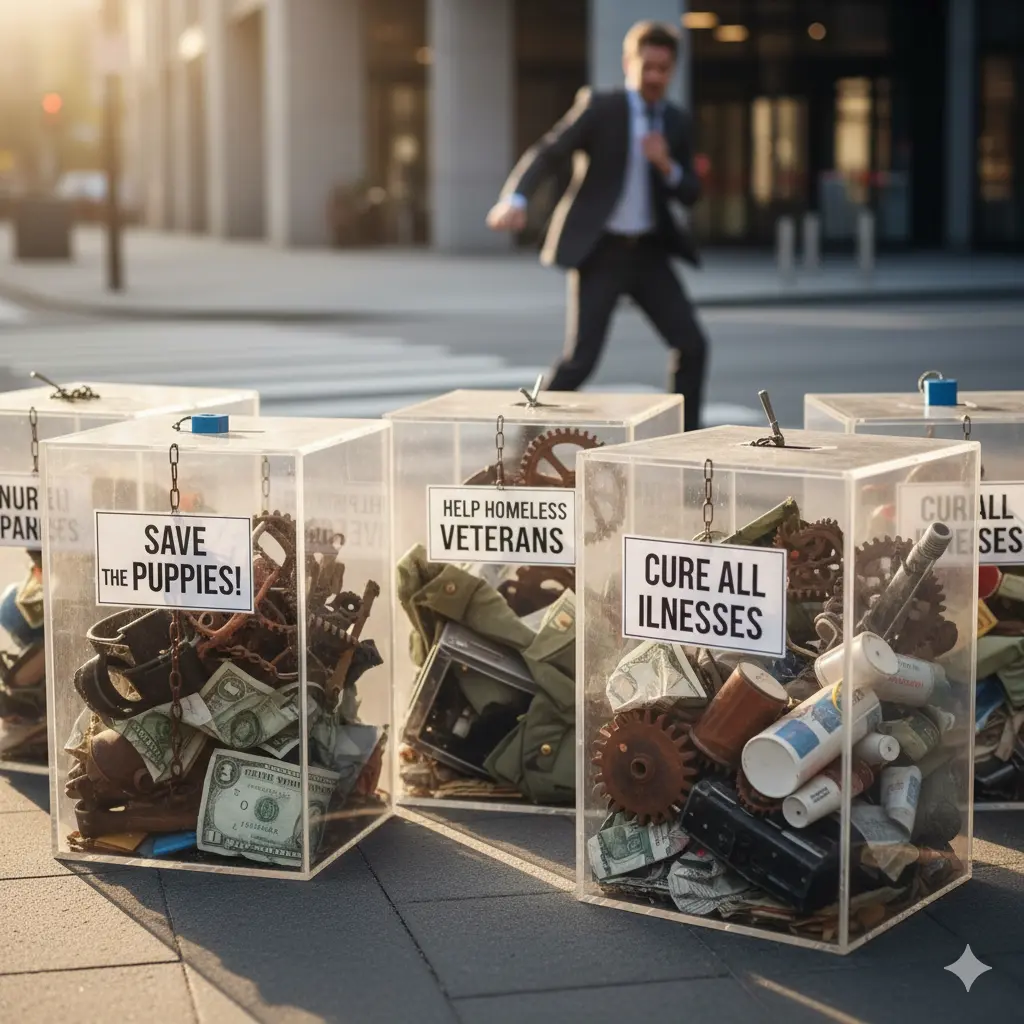
Fraudulent charities are organisations, entities, or individuals that falsely represent themselves as legitimate charitable bodies to solicit donations or financial support for deceptive or illicit purposes.
These entities use the guise of humanitarian relief, social welfare, religious programmes, or community development to mislead donors and divert funds toward personal gain or illicit activity.
In AML/CFT contexts, fraudulent charities often act as vehicles for money laundering, terrorist financing, proliferation financing, or fraud.
By exploiting public trust and humanitarian narratives, these entities conceal the true origin or destination of funds, channel illicit proceeds, or provide financial cover for high-risk actors and criminal networks.
Fraudulent charities may operate entirely as fictitious organisations or infiltrate legitimate charitable ecosystems through manipulated accounts, fabricated projects, or misappropriated donations.
Explanation
Charitable organisations traditionally enjoy widespread public trust, making them attractive conduits for illicit financial activity.
Fraudulent charities leverage this trust to raise funds under false pretences, claiming to support causes such as disaster relief, healthcare, education, poverty alleviation, or conflict-zone humanitarian aid.
They use sophisticated narratives, forged documentation, staged media content, and misleading digital platforms to create legitimacy.
In AML/CFT frameworks, fraudulent charities represent a high-risk segment due to their vulnerabilities:
- Difficulty in verifying the end-use of funds in remote or conflict regions.
- High reliance on cash-based fundraising and informal transfer channels.
- Complex global networks of intermediaries and partner organisations.
- Reduced scrutiny in some jurisdictions due to regulatory exemptions.
- Exploitation of tax benefits and donor incentives.
Fraudulent charity operations manifest in several forms: Fake charities created purely for deception; legitimate charities hijacked or infiltrated by criminal actors; charities that mix legitimate humanitarian work with illicit financing; or charities used knowingly to support terrorist groups, extremist causes, or proliferation networks.
International regulators, including FATF, repeatedly highlight the nonprofit sector as a target for terrorist financing due to its global reach, trust-based model, and uneven oversight. Strengthening controls over charitable sectors remains a priority for national authorities, FIUs, and financial institutions.
Fraudulent Charities in AML/CFT Frameworks
The intersection between fraudulent charities and AML/CFT obligations is significant.
Financial institutions must recognise that charity-related transactions, fundraising patterns, and cross-border flows may conceal illicit intent.
Key intersections include:
Risk Assessment and Classification
Financial institutions must classify charitable activity as part of high-risk sectors when evaluating account opening, customer risk rating, or transaction monitoring.
Fraudulent charities often demonstrate:
- Unusual reliance on high-cash inflows,
- Frequent transfers to conflict zones or sanctioned jurisdictions,
- Opaque governance structures,
- Lack of independent audits or financial transparency.
Know Your Customer (KYC) and Enhanced Due Diligence (EDD)
EDD is required when dealing with charities that operate internationally, especially in high-risk geographies.
Institutions must verify:
- Legitimacy of the charity,
- Governance structure,
- Declared activities and beneficiaries,
- Source of funds,
- Grant disbursement mechanisms.
Beneficiary and Partner Screening
Charities often work through partner organisations.
Fraudulent charities may conceal their true beneficiaries by routing funds via intermediaries with minimal oversight.
Screening must cover:
- Partner NGOs,
- Affiliated trustees,
- Contractors and field agents,
- Delivery partners in conflict-affected regions.
Cross-Border Transaction Monitoring
Fraudulent charities may send funds to jurisdictions with weak regulation or active extremist networks.
Transaction monitoring must capture:
- Transfers inconsistent with stated programmes,
- Round-tripping or rapid pass-through patterns,
- Transactions lacking documentary support,
- Use of informal value transfer systems (IVTS).
Sanctions and Watchlist Integration
Fraudulent charities occasionally mask the financial activities of designated terrorist organisations, proliferators, or sanctioned individuals.
Screening must extend to:
- Board members,
- Significant donors,
- Affiliates,
- Foreign branches,
- Contractors in high-risk corridors.
Use of Fraud Typologies
Fraudulent charities often mirror broader fraud typologies, such as identity fraud, impersonation, digital fundraising scams, and fake disaster relief operations.
AML and fraud teams must align their controls to detect overlaps between fraud and AML risks.
Key Components of Fraudulent Charity Schemes
Fabricated Humanitarian Campaigns
Fraudulent charities frequently exploit emotional appeal through fake campaigns, such as:
- Disaster relief efforts,
- Medical emergencies,
- Refugee support,
- Crisis-driven fundraising.
These schemes use fabricated images, false beneficiary stories, and manipulated reports to generate donations.
Misappropriation of Funds
Some fraudulent charities may engage in limited legitimate activity while diverting significant portions of funds to personal or illegal use.
Warning signs include:
- Excessive administrative expenses,
- Lack of audited financial statements,
- Opacity around project execution.
Use of Shell Entities
Fraudulent charities may set up shell NGOs, foundations, or trusts as part of wider financial crime networks.
These shells facilitate:
- Layering of illicit funds,
- Creation of false invoices,
- Movement of funds across borders under charitable cover.
Terrorist or Extremist Financing
Certain charities act as fronts for extremist organisations, providing:
- Financial support,
- Logistical assistance,
- Procurement and transport of materials,
- Training and recruitment support.
Digital Fundraising Scams
The rise of online platforms has enabled fraudulent charities to reach global audiences.
Common tactics include:
- Fake social media accounts,
- Spoofed websites,
- Fraudulent crowdfunding pages,
- Mmanipulated impact videos.
Manipulated Partnerships and Sub-Grants
Fraudulent charities may exploit legitimate NGOs by forming partnerships and then siphoning funds through sub-grants, inflated project budgets, or false reporting.
Examples of Fraudulent Charity Scenarios
Fabricated Disaster Relief Fund
A charity claims to support victims of a major natural disaster but provides no evidence of on-ground activity.
Funds are directed to offshore accounts controlled by the organisers.
Terrorist Group Front Organisation
A charity raising funds for “education and healthcare” in conflict zones secretly channels donations to the leadership of a designated terrorist group.
Hybrid Charity-Mule Network
A fraudulent charity recruits volunteers to collect donations door-to-door, then uses their accounts to launder proceeds disguised as charitable transfers.
Digital Crowdfunding Fraud
A viral fundraising page claims to assist a sick child overseas.
Investigators later discover the images were stolen from the internet, and funds were withdrawn anonymously through crypto platforms.
Misuse of Legitimate Charity Infrastructure
A board member of a legitimate charity diverts grant money to private businesses disguised as partner organisations.
Cross-Border Diversion Scheme
A charity in a low-regulation jurisdiction receives large inbound donations and transfers them rapidly to intermediaries in high-risk regions without documentation.
Impact on Financial Institutions
Regulatory and Supervisory Risk
Failure to identify fraudulent charities exposes institutions to regulatory penalties, supervisory actions, and mandatory remediation requirements.
Reputational Risk
Associating with fraudulent charities can damage institutional trust with donors, regulators, and correspondent banking partners.
Operational Burden
Investigations involving complex charitable networks require significant time, cross-team coordination, and specialist knowledge.
Suspicious Reporting Obligations
Institutions may need to file multiple STRs, including for:
- Unusual cash deposits,
- Unexplained high-value donations,
- Rapid or inconsistent fund disbursements,
- Transfers to suspicious jurisdictions.
Correspondent Banking Risk
Banks supporting charities operating internationally face heightened scrutiny from global regulators and correspondent partners, especially when transactions relate to high-risk geographies.
Challenges in Managing Fraudulent Charity Risk
Lack of Transparency
Some charities operate in regions where transparency is limited, making it difficult to verify activities or trace fund utilisation.
Regulatory Arbitrage
Weak oversight in certain jurisdictions allows fraudulent charities to register easily, operate with minimal checks, and move funds without scrutiny.
Cash-Intensive Operations
Charities involved in field operations often rely on cash for local distribution, increasing the risk of diversion and misappropriation.
Complex Multi-Level Networks
Many fraudulent charity schemes involve multi-level intermediaries, partners, and local agents, making it difficult to identify the true flow of funds.
Overlap With Legitimate Humanitarian Need
Distinguishing fraudulent charities from legitimate ones—especially in conflict or disaster zones—requires specialist domain knowledge.
Digital Fraud Evolution
Fraudsters continuously create new methods to exploit online platforms, social media, and crowdfunding networks, making early detection difficult.
Regulatory Oversight & Governance
Financial Action Task Force (FATF)
FATF identifies nonprofit organisations as potentially vulnerable to terrorist financing misuse and provides risk-based guidance for their oversight.
National Charity Regulators
Bodies such as the UK Charity Commission, IRS (US), and national ministries regulate charitable registration, reporting, and governance.
Financial Intelligence Units (FIUs)
FIUs analyse suspicious reports involving charitable sectors and disseminate intelligence to law enforcement agencies.
International Humanitarian Oversight Bodies
Organisations, including the UN Office for the Coordination of Humanitarian Affairs (OCHA), issue guidelines to ensure transparency and accountability in humanitarian funding.
Law Enforcement Agencies
Domestic and international law enforcement collaborate to investigate large-scale charity fraud, cross-border diversion, and financing schemes linked to terrorism.
Importance of Detecting Fraudulent Charities in AML/CFT Compliance
Financial institutions play a critical role in preventing fraudulent charities from exploiting the global financial system.
Identifying and mitigating these risks strengthens institutional resilience against financial crime and aligns operations with global regulatory expectations.
Effective controls help institutions:
- Prevent misuse of charitable designations,
- Detect anomalies linked to fraud or terrorist financing,
- Protect customers from deceptive fundraising schemes,
- Uphold regulatory compliance and reporting obligations,
- Maintain trust with donors, partners, and regulators.
Fraudulent charity typologies evolve based on geopolitical developments, emerging fraud trends, and shifting regulatory landscapes.
Institutions must adapt by integrating intelligence-led, risk-based frameworks, such as IDYC360’s intelligence-first AML architecture, to ensure strong preventive and detective capabilities.
Related Terms
Charity Fraud
Terrorist Financing
Nonprofit Organisation Risk
Watchlist Screening
Crowdfunding Fraud
Enhanced Due Diligence
Beneficial Ownership
References
- FATF – Combating the Abuse of Non-Profit Organisations
- UK Charity Commission – Fraud and Financial Crime
- Europol – Fraud Schemes and Criminal Abuse
- UN OCHA – Humanitarian Financing and Accountability
Ready to Stay
Compliant—Without Slowing Down?
Move at crypto speed without losing sight of your regulatory obligations.
With IDYC360, you can scale securely, onboard instantly, and monitor risk in real time—without the friction.