

DOJ: United States Department of Justice
Definition
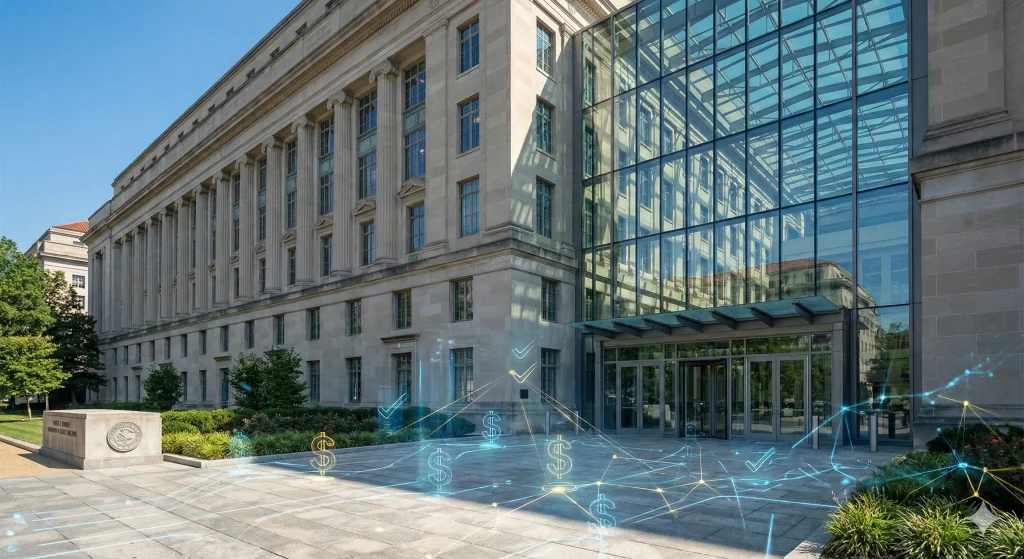
The United States Department of Justice (DOJ) is the federal executive department responsible for enforcing United States federal law, ensuring public safety against domestic and foreign threats, safeguarding civil rights, and administering justice impartially.
In the context of AML/CFT, the DOJ plays a central enforcement role by investigating, prosecuting, and penalising money laundering, terrorist financing, sanctions violations, fraud, corruption, and related financial crimes under U.S. federal statutes.
The DOJ’s authority extends across criminal and civil domains and is exercised through specialised divisions, U.S. Attorneys’ Offices, and coordinated task forces.
Its actions have a global impact due to the extraterritorial reach of U.S. laws, the centrality of the U.S. financial system, and the DOJ’s cooperation with foreign regulators and law-enforcement agencies.
Explanation
The DOJ functions as the primary law-enforcement arm of the U.S. federal government. It represents the United States in legal matters, prosecutes federal crimes, and ensures consistent application of federal statutes.
Within the AML/CFT ecosystem, the DOJ acts as the ultimate enforcement authority when financial crime violations rise to criminal thresholds or involve systemic misconduct.
Unlike regulatory agencies that focus on supervision and compliance, the DOJ concentrates on accountability and deterrence.
Investigations often target individuals, financial institutions, corporates, and facilitators whose conduct demonstrates wilful blindness, conspiracy, or deliberate circumvention of AML controls.
DOJ actions frequently involve parallel proceedings with regulators and may result in criminal convictions, civil forfeiture, deferred prosecution agreements (DPAs), or non-prosecution agreements (NPAs).
Given the U.S. dollar’s dominance in global trade and finance, DOJ jurisdiction can extend to non-U.S. entities where transactions clear through U.S. correspondent banks or involve U.S. persons, systems, or markets.
This makes DOJ enforcement a defining influence on global AML/CFT standards.
DOJ in AML/CFT Frameworks
The DOJ occupies a pivotal position within the U.S. AML/CFT architecture, working alongside supervisory and intelligence agencies while retaining independent prosecutorial discretion. Its role includes:
- Enforcing federal AML statutes, including criminal provisions of the Bank Secrecy Act (BSA).
- Prosecuting money laundering and terrorist financing offences tied to predicate crimes such as fraud, narcotics trafficking, cybercrime, sanctions evasion, and corruption.
- Pursuing corporate criminal liability for failures in AML controls, internal governance, or compliance programmes.
- Coordinating with the Financial Crimes Enforcement Network (FinCEN), Office of Foreign Assets Control (OFAC), and federal banking regulators.
- Leading international cooperation through mutual legal assistance treaties (MLATs) and joint investigations.
The DOJ’s enforcement posture shapes how financial institutions design, implement, and test their AML/CFT programmes, particularly in relation to governance, escalation, and documentation.
Key DOJ Divisions Relevant to Financial Crime
Criminal Division
The Criminal Division oversees prosecutions involving complex financial crime, foreign corruption, sanctions violations, and cross-border money laundering.
Within this division, specialised sections handle bank fraud, money laundering, asset forfeiture, and kleptocracy-related cases.
Money Laundering and Asset Recovery Section (MLARS)
MLARS is the DOJ’s principal unit for prosecuting money laundering offences and recovering criminal proceeds.
It leads cases involving:
- Domestic and international money laundering networks.
- Use of correspondent banking and shell companies to move illicit funds.
- Asset tracing, seizure, and forfeiture across jurisdictions.
- Coordination with foreign prosecutors on shared financial crime investigations.
U.S. Attorneys’ Offices
Each federal judicial district has a U.S. Attorney’s Office that prosecutes federal crimes locally.
These offices frequently bring AML-related cases involving regional banks, money service businesses, cryptocurrency platforms, and professional enablers.
National Security Division
This division prosecutes terrorist financing, sanctions evasion, and financial crimes linked to national security threats. AML/CFT cases here often intersect with counter-terrorism and counter-proliferation financing efforts.
Core AML/CFT Statutes Enforced by the DOJ
The DOJ enforces a wide range of statutes that collectively define U.S. AML/CFT obligations:
- Bank Secrecy Act (BSA) criminal provisions.
- Federal money laundering statutes (18 U.S.C. §§ 1956 and 1957).
- USA PATRIOT Act provisions related to terrorist financing.
- Foreign Corrupt Practices Act (FCPA), where proceeds laundering is involved.
- Sanctions-related criminal statutes linked to OFAC regimes.
These laws enable the DOJ to prosecute not only direct perpetrators but also facilitators who knowingly assist or fail to prevent illicit financial activity.
Risks & Red Flags Identified Through DOJ Enforcement
DOJ enforcement actions consistently highlight recurring AML/CFT risk themes, including:
- Wilful failure to implement or maintain effective AML programmes.
- Suppression or manipulation of internal alerts and suspicious activity reports.
- Poor escalation from compliance teams to senior management and boards.
- Use of shell companies and opaque ownership structures to disguise proceeds.
- Continued servicing of high-risk clients despite repeated red flags.
From an institutional perspective, DOJ cases often reveal governance failures rather than isolated control gaps.
Common Methods & Techniques Targeted by the DOJ
Financial crime typologies frequently addressed in DOJ prosecutions include:
- Layering through correspondent banking and nested account structures.
- Trade-based money laundering involving false invoicing and phantom shipments.
- Use of cryptocurrencies and mixers to obscure transaction trails.
- Laundering of proceeds from cybercrime, ransomware, and online fraud.
- Bribery and corruption proceeds are routed through professional intermediaries.
DOJ cases demonstrate how sophisticated laundering schemes exploit both legacy banking systems and emerging financial technologies.
Examples of DOJ AML/CFT Enforcement Scenarios
Institutional AML Failures
The DOJ has prosecuted financial institutions for systemic AML failures where senior management ignored compliance warnings, under-resourced AML teams, or prioritised revenue over risk.
Outcomes often include substantial monetary penalties and long-term compliance monitoring.
Cryptocurrency and Digital Asset Laundering
Digital asset platforms and service providers have faced DOJ action for facilitating laundering, sanctions evasion, or unregistered money transmission.
These cases underscore the DOJ’s position that technological novelty does not reduce AML obligations.
Cross-Border Corruption and Kleptocracy
The DOJ actively targets laundering of proceeds from foreign corruption, often seizing assets held in U.S. real estate, bank accounts, or investment vehicles.
Such cases rely heavily on international cooperation and financial intelligence.
Impact on Financial Institutions
DOJ enforcement has far-reaching consequences for regulated entities:
- Criminal fines and forfeiture can reach billions of dollars.
- Deferred or non-prosecution agreements impose multi-year compliance obligations.
- Appointment of independent compliance monitors increases operational cost.
- Reputational damage affects correspondent banking and investor confidence.
- Senior executives and compliance officers may face personal liability.
For global institutions, DOJ actions often trigger parallel enforcement by non-U.S. regulators.
Challenges in Detecting & Preventing DOJ-Relevant AML Violations
Institutions face several challenges in preventing conduct that may attract DOJ scrutiny:
- Translating regulatory compliance into demonstrable criminal-risk mitigation.
- Ensuring compliance, independence, and authority within commercial organisations.
- Managing high transaction volumes without suppressing meaningful alerts.
- Maintaining consistent standards across international subsidiaries.
- Documenting decision-making to demonstrate good-faith compliance efforts.
The DOJ increasingly evaluates not just whether controls exist, but whether they function effectively in practice.
Regulatory Oversight, Governance & DOJ Expectations
The DOJ has articulated clear expectations for corporate compliance programmes, including AML frameworks.
Key governance principles include:
- Tone from the top and board-level oversight of financial crime risk.
- Adequate resourcing, expertise, and authority for compliance functions.
- Risk-based policies aligned with business models and geographic exposure.
- Effective investigation, escalation, and remediation processes.
- Continuous testing, auditing, and improvement of controls.
These expectations are often formalised in settlement agreements and public guidance.
Importance of the DOJ in Global AML/CFT Compliance
The DOJ is one of the most influential AML/CFT enforcement authorities worldwide. Its actions:
- Set global benchmarks for AML accountability and deterrence.
- Drive convergence between regulatory compliance and criminal-law standards.
- Influence how financial institutions design governance and risk frameworks.
- Reinforce the extraterritorial reach of AML/CFT enforcement.
- Support international cooperation against complex financial crime networks.
For institutions operating in or through the U.S. financial system, understanding DOJ priorities is essential to managing financial crime risk.
Related Terms
- Bank Secrecy Act (BSA)
- Financial Crimes Enforcement Network (FinCEN)
- Deferred Prosecution Agreement (DPA)
- Asset Forfeiture
- Correspondent Banking
- Sanctions Evasion
References
- United States Department of Justice — Official website and organisational mandate
- DOJ Criminal Division — Overview and enforcement scope
- DOJ Money Laundering and Asset Recovery Section (MLARS)
- DOJ Evaluation of Corporate Compliance Programs (guidance used in AML cases)
- Bank Secrecy Act — Statutory framework enforced by DOJ
- DOJ Asset Forfeiture Program overview
Ready to Stay
Compliant—Without Slowing Down?
Move at crypto speed without losing sight of your regulatory obligations.
With IDYC360, you can scale securely, onboard instantly, and monitor risk in real time—without the friction.

